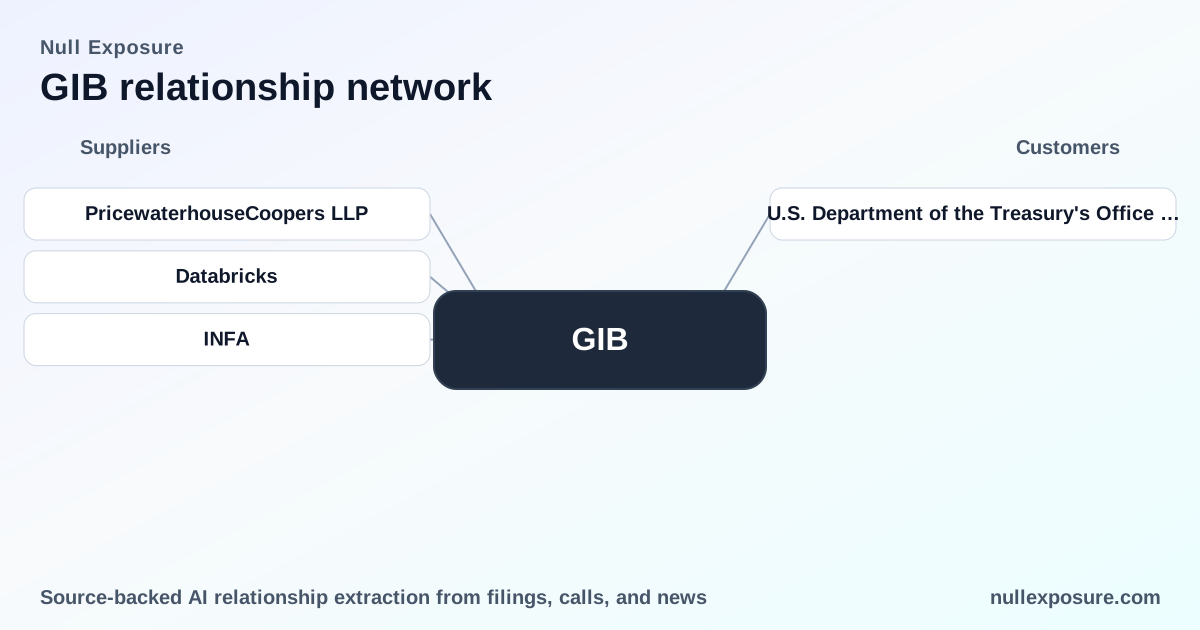
CGI Inc. (GIB) — Customer Relationships That Drive Platform and Contracted Services Revenue
CGI is a global IT and business-process services firm that monetizes through long-duration contracts, managed services, systems integration and platform licensing. Revenue comes from recurring outsourcing agreements with governments and financial institutions, one-off transformation projects, and the rollout of proprietary platforms such as CGI Trade360, giving the company a mix of steady annuity-like cash flow and higher-margin product implementations. For investors, the critical questions are contract concentration, the strategic importance of each client, and the degree to which platform sales (rather than pure services) are growing CGI’s margin profile. Learn more about our coverage at https://nullexposure.com/.
What the customer list tells investors in one line
CGI’s recent customer announcements show a dual go-to-market: large public-sector modernization mandates (content and digital services) and targeted platform wins in financial services, which together reinforce a balanced mix of high-criticality government work and scalable platform licensing.
The customer roll call — each relationship and the source note
U.S. Department of the Treasury’s Office of the Comptroller of the Currency (OCC) — Blanket Purchase Agreement to modernize CMS (FY2025)
CGI secured a Blanket Purchase Agreement to modernize the OCC’s content management and digital services, positioning the firm as the vendor of record for CMS upgrades and faster user experience updates. According to a MarketScreener report dated March 9, 2026, the contract is explicitly aimed at accelerating content updates and improving public-facing digital services (FY2025).
Office of the Comptroller of the Currency — MarketScreener follow-up (FY2025)
A second MarketScreener listing (May 3, 2026) reiterates the OCC modernization engagement and underscores CGI’s role in federal digital transformation, indicating continued media attention and public-sector relevance for the same engagement in FY2025.
BLX — Bladex selects CGI for CGI Trade360 implementation (FY2024) — PR Newswire
Bladex (Banco Latinoamericano de Comercio Exterior) selected CGI to implement CGI Trade360, the company’s global trade finance technology platform, signalling CGI’s strategy of moving clients from bespoke services to platform-based trade finance offerings. This partnership was announced via PR Newswire in FY2024 as part of a business evolution initiative.
BLX — Additional coverage of the Trade360 agreement (FY2024) — GuruFocus
A follow-up report published on GuruFocus (first seen May 2, 2026) repeats that Bladex engaged CGI to deploy Trade360, reinforcing the deal’s market visibility and the positioning of CGI’s trade platform in Latin American correspondent banking channels (FY2024).
SOK Finance — Multi-agent AI implementation for financial operations acceleration (FY2026)
CGI implemented a multi-agent AI solution for SOK Finance to accelerate financial service operations, reflecting the firm’s push into higher-value AI-enabled automation in the financial-services vertical. This engagement was reported in FY2026 (Quantisnow coverage, May 2026) and signals CGI’s effort to upsell advanced automation on top of traditional systems-integration work.
What these relationships reveal about CGI’s operating model and contracting posture
- Contracting posture — defensive and long-term: The government BPA with the OCC is a classic example of procurement that buys continuity and future option value, not just a one-off engagement, which reduces revenue volatility and increases lifetime client value.
- Concentration — diversified across public sector and finance: The mix of a federal modernization mandate and financial-platform sales shows customer diversification by sector, lowering single-client concentration risk while keeping exposure to large-ticket agreements.
- Criticality — high for government work, strategic for finance: OCC modernization is mission-critical and likely hard to substitute quickly; Trade360 implementations and AI automation for SOK Finance are strategic, where CGI sells recurring platform economics and outcomes-based services.
- Maturity of engagements — mix of steady annuity and scaling platforms: Government contracts provide annuity-style revenue, while Trade360 and AI services represent scalable, higher-margin opportunities as clients adopt platform licenses and advanced automation.
These are company-level signals: no individual relationship in the source data includes explicit constraints on concentration or contract length beyond those implied by the procurement vehicle (e.g., BPA).
Investment implications: upside and risks
CGI’s recent customer activity supports several investment theses:
-
Upside:
- Revenue resiliency from long-duration government work (e.g., OCC BPA).
- Margin expansion potential if platform adoption (CGI Trade360) and AI implementations scale across regional banks and finance firms.
- Cross-sell runway within clients that have both digital modernization needs and interest in automation platforms.
-
Risks:
- Execution and delivery risk on complex modernization programs can pressure near-term margins if programs extend or require additional resource investment.
- Competitive pressure in both government procurement and trade-finance platforms from global systems integrators and niche fintechs.
- Customer concentration tail risk if key platform wins do not cascade into broader regional adoption.
Investors should watch four metrics to monitor these dynamics: backlog composition (platform vs. services), renewal/extension rates on BPAs and managed services, margin contribution from platform revenues, and public-sector pipeline conversion.
Tactical takeaways for operators and investors
- Government BPAs like the OCC deal are strategic anchors — they stabilize revenue and create referenceability for other public-sector clients.
- Platform wins (Trade360) convert one-off projects into recurring revenue streams and are the primary channel to improve revenue per employee and margins over time.
- AI and automation engagements (SOK Finance) are incremental margin levers if CGI can productize and scale them across its banking client base.
For a deeper read on how client-level wins translate into mid-cycle earnings and margin improvement, see our broader analysis at https://nullexposure.com/.
Sources and provenance
- MarketScreener reported the OCC Blanket Purchase Agreement to modernize CMS and digital services (first seen March 9, 2026; related coverage May 3, 2026) as part of FY2025 disclosures.
- PR Newswire announced the Bladex (BLX) selection of CGI to implement CGI Trade360 in FY2024; additional coverage appeared on GuruFocus (first seen May 2, 2026).
- Quantisnow reported on CGI’s multi-agent AI implementation for SOK Finance as a FY2026 engagement (May 2026).
Bold takeaways: CGI combines stable public-sector annuity work with scalable platform and AI implementations, creating an earnings mix that supports both downside protection and margin upside — a profile attractive to investors seeking defensive growth in IT services.