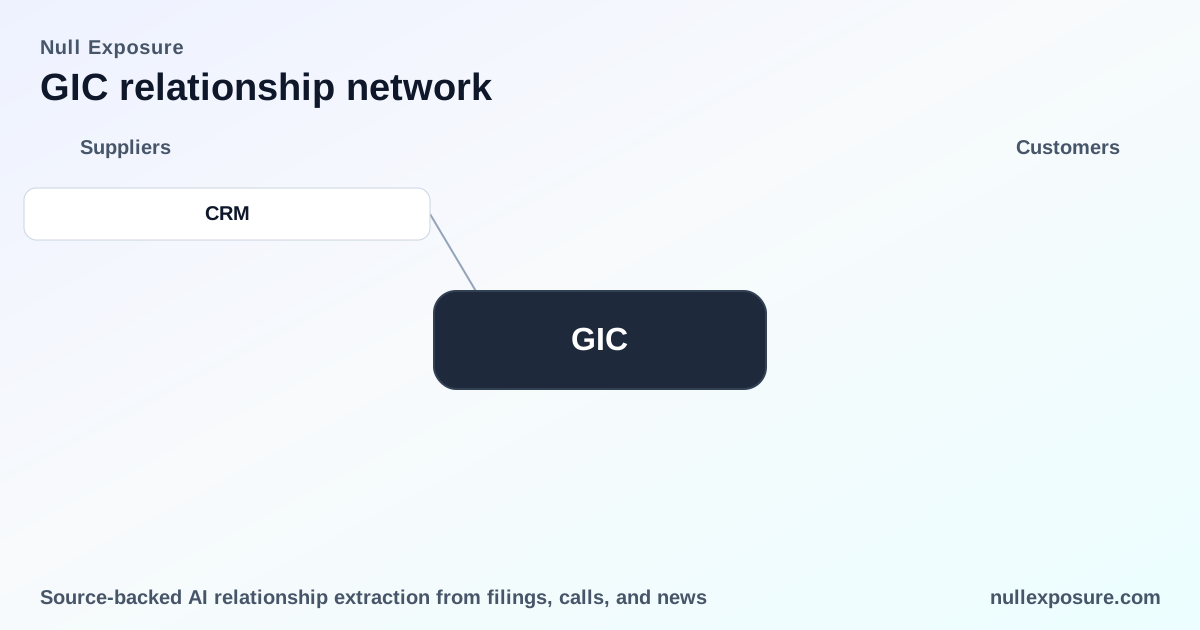
How GIC (Global Industrial) Converts Distribution Scale into Repeatable Cash Flow
Global Industrial (ticker: GIC) is a North American value-added distributor of maintenance, repair and operations (MRO) products that monetizes through product sales and distribution margins delivered across e‑commerce channels and direct relationship marketing. Beyond core SKU sales, GIC’s commercial posture includes short-term customer contracts, a broad mix of public- and private-sector buyers, and occasional capital partnerships that reframe addressable markets — all of which materially influence working capital, revenue durability and capital allocation choices. This profile synthesizes GIC’s customer-facing relationships and the company-level operating constraints that matter for investors and operators.
Learn more about our coverage at https://nullexposure.com/
The business model in plain English: what drives cash and risk
Global Industrial is a distributor that earns margins on a very large catalogue of industrial and MRO products marketed across North America. The company goes to market via branded e‑commerce sites and relationship sales teams, and it sells to a wide spectrum of buyers — from small businesses and mid‑market customers to large enterprises, non‑profits and government entities. Revenue concentration is geographically North American and heavily weighted to the United States, which is the dominant revenue engine.
Operationally, a few characteristics shape investor returns and operational risk:
- Contracting posture: GIC recognizes contract liabilities for customer prepayments that typically resolve within a year; the company reported approximately $4.1 million of contract liabilities as of December 31, 2024 (compared with $3.3 million at year‑end 2023). This signals short-term performance obligations and fast cash conversion on prepayment balances.
- Counterparty breadth: The customer base intentionally spans small businesses, mid‑market, large enterprises, non‑profits and government buyers, providing revenue diversification across customer types while exposing the company to public procurement cycles.
- Geographic concentration: North America is the operating footprint; U.S. net sales were $1,248.6 million in 2024, driving the lion’s share of top-line performance.
- Role and segment: GIC operates as a seller and distributor of industrial supplies, a mature segment that emphasizes logistics, catalogue management and repeat order economics. The firm’s go‑to‑market mix balances e‑commerce scale with relationship selling.
These operating signals combine to produce a core profile of steady, transaction-driven revenue with limited long-term contract lock‑in but broad customer reach — a profile that supports stable cash flows if order volumes and logistics execution remain consistent.
Why the recent customer and capital relationships matter
GIC’s relationships include both classic distribution contracts and strategic capital partnerships. Two relationships reported in public sources provide direct insight into how the company deploys capital and expands market reach.
Realty Income (O): a large joint venture that expands industrial reach
According to a 247WallStreet article in April 2026, GIC is a partner in a joint venture with over $1.5 billion in combined commitments that includes a $200 million Mexico industrial portfolio; the report positions the partnership as expanding GIC’s addressable market beyond its traditional distribution footprint. Source: 247WallStreet, April 24, 2026 — https://247wallst.com/investing/2026/04/24/got-10000-realty-income-vs-agnc-only-one-deserves-your-money-right-now/
- Why this matters: a capital partnership at this scale signals a strategic move from pure distribution to asset-backed industrial exposure, which can diversify revenue drivers but also introduces capital allocation and execution risks outside the company’s core seller role.
INN: equity contribution to a hospitality portfolio transaction
Hotel Business reported that in a transaction completing an NCI portfolio sale, GIC’s 49% equity contribution is being provided in cash, reflecting a minority capital stake in a hospitality/real estate portfolio. Source: Hotel Business, March 2026 — https://hotelbusiness.com/nci-portfolio-sale-completed-aimbridge-to-manage/
- Why this matters: the cash equity contribution indicates GIC is willing to deploy balance-sheet capital into partnership structures, which changes the company profile from pure distributor to occasional capital partner and elevates the importance of balance-sheet management and return-on-capital discipline.
Operating constraints and investor implications
The public excerpts and filings reveal several constraints that shape GIC’s operating model and should figure into investor diligence.
- Short-term contract structure: The explicit recognition of contract liabilities that settle within a year indicates GIC’s revenue recognition and cash conversion are driven by short-dated performance obligations rather than long-term service contracts. This reduces receivable duration risk but places emphasis on inventory turns and fulfillment efficiency. (Company filings covering year‑end 2024)
- Counterparty mix includes government and public sector accounts: GIC sells to federal, state and local municipalities as well as education and non-profit organizations, which creates pockets of procurement-driven seasonality and potential payment timing variability compared with purely commercial customers.
- Broad buyer spectrum reduces single-buyer concentration but increases operational complexity: The blend of small businesses, mid-market and large enterprises requires a multi-channel sales model (digital plus relationship marketers), increasing investments in order management and customer service infrastructure.
- North American geographic concentration: With U.S. net sales at $1,248.6 million in 2024, macroeconomic conditions in the U.S. and cross-border logistics into Canada materially influence performance.
- Distribution‑oriented maturity: The company operates a mature distribution model with established branded e‑commerce and relationship channels; growth levers focus on SKU penetration, margins on exclusive brands and operational scale rather than novel product cycles.
Taken together, these constraints imply that GIC’s core value levers are executional: inventory management, fulfillment efficiency, margin control on exclusive brands and disciplined capital deployment when the company moves into joint ventures or equity contributions.
Key takeaways for investors and operators
- Stable, transaction-driven cash flow: GIC’s short-term contracts and diversified counterparty base support predictable order flows if execution holds.
- Balance-sheet flexibility is now strategic: Recent capital partnerships and cash equity contributions show management will use balance-sheet capital to pursue adjacent opportunities; that raises return-on-capital as a watch item.
- U.S. economic exposure dominates: Macroeconomic shifts in the United States will be the primary demand driver for the business.
- Operational execution is the primary risk and value driver: Logistics, inventory turns and channel profitability determine whether GIC can convert scale into durable margins.
For a concise view of how these dynamics play out across customers and capital partners, visit our homepage for ongoing coverage: https://nullexposure.com/
If you want a deeper diligence brief on any individual relationship or a scenario analysis that quantifies the capital allocation implications of these partnerships, we can produce a focused memo.