GIG: Sponsor-backed IPO services with concentrated ownership — what investors should price in
GIG operates as a sponsor and one‑stop IPO services provider, monetizing through sponsor equity, private placement proceeds and fees tied to executing public listings and related advisory work. Investors should value GIG as a platform play: revenue upside is driven by successful sponsor transactions and associated capital raises, while downside is concentrated in founder and anchor investor positions and the cyclicality of IPO activity. For a quick look at the source materials and relationship traces, visit https://nullexposure.com/.
How GIG earns its stripes — a compact operating thesis
GIG packages capital and services for companies seeking public markets: it supplies sponsor capital and structures private placements and warrants, and it offers legal, accounting, banking and investor relations support as part of an integrated IPO offering. Monetization flows come from: sponsor equity (founder shares), private placement proceeds and advisory/service fees tied to completed transactions. The business is inherently transaction‑driven and correlated with capital markets activity.
The single disclosed customer relationship and what it signals
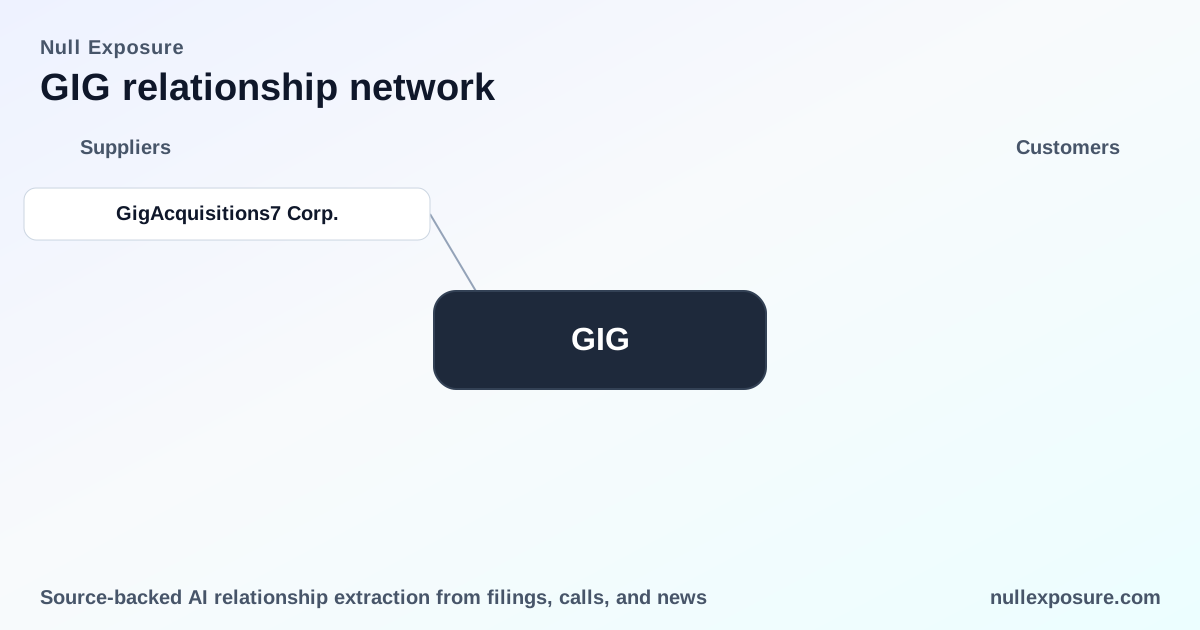
GigAcquisitions7 Corp. — the company's sponsor — participated in a private sale, purchasing 3,719,000 private placement warrants for $58,060, a structure that concentrates upside in future equity conversions and aligns sponsor economics with transaction outcomes. This buying activity was reported in an Investing.com news item dated May 3, 2026. (Investing.com, May 3, 2026)
What the company filings say about ownership and contracting posture
Company disclosures around the offering provide additional clarity on who pays and who provides services:
- Founder alignment is material: between May 8, 2024 (inception) and May 31, 2024 the Founder purchased 17,000,000 Class B ordinary shares for an aggregate $100,000, which is a deliberate structure to preserve founder economics and control (company filing, FY2024).
- Anchor institutional buyers are present: certain institutional investors purchased 2,826,087 Class B ordinary shares at $1.15 per share in a private placement executed with the offering, signaling early concentration of economic interest in a small set of buyers (company filing, FY2024).
- GIG positions itself as a service provider: the offering materials describe delivering a “one stop shop” for becoming public that includes investor access, legal and accounting support, investment and commercial banking services, investor relations and human resources services (offering materials, FY2024).
These disclosures confirm GIG is both a capital organizer and a service business, and that ownership and voting structures are concentrated from inception.
Constraints that shape valuation and counterparty risk
Treat the filing language and purchase activity as company‑level operating signals:
- Contracting posture: GIG sells specialized services while simultaneously acting as a principal investor; expect mixed revenue streams (transaction fees plus sponsor carry) and blended counterparty incentives.
- Concentration: early capital and control sit with the Founder and a small set of institutional buyers, which compresses liquidity and increases event‑risk sensitivity to a few stakeholders.
- Criticality: the service offering is mission‑critical for target companies seeking an expedited public listing — this gives GIG pricing leverage on fees when markets are receptive, but it increases exposure to capital market cycles.
- Maturity: the company’s inception in May 2024 and the Founder’s initial share purchase indicate an early stage operating profile; growth depends on executing and closing sponsor deals into a volatile IPO environment.
Relationship detail — every disclosed customer tie
GigAcquisitions7 Corp.: the sponsor executed a private purchase of warrants — 3,719,000 private placement warrants purchased for $58,060, reflecting sponsor economics focused on upside via warrant conversion rather than near‑term cash flow. This transaction was reported by Investing.com on May 3, 2026. (Investing.com, May 3, 2026)
How these relationships translate into financial levers and risks
- Revenue upside: successful sponsor transactions and subsequent equity appreciation or sponsor fees create outsized returns relative to capital invested, because warrants and founder shares are structured to capture post‑deal upside.
- Dilution and timing risk: warrant instruments and private placement structures compress upside for public shareholders if conversions occur under dilutive terms; the sponsor’s purchase of warrants for a nominal total suggests a focus on long‑dated optionality rather than immediate capital contribution.
- Concentration and governance risk: with a large founder stake and a small set of institutional buyers, control and future strategic decisions will be influenced by a tight investor group, raising the importance of shareholder alignment and governance transparency.
- Cyclicality and service revenue volatility: as GIG markets and executes IPOs, fee revenue will be lumpy and correlated to market windows; downturns in equity issuance will materially reduce fee pools.
For investors modeling scenarios, build sensitivities around the cadence of sponsor transactions, the timing and strike provisions of warrants, and the likelihood of additional private placements to support deal pipelines.
Practical takeaways for operators and counterparties
- Operators: If you partner with GIG for a listing, expect a bundled service contract that trades off speed and access against sponsor economic claims (warrants/founder economics). Negotiate clarity on fee schedules, warrant terms and investor allocation mechanics before engagement.
- Counterparties and lenders: treat GIG as an early‑stage sponsor platform with concentrated ownership and event‑driven cash flows; underwrite exposure to transaction completion risk and governance constraints.
- Investors: prioritize transparency on warrant dilution mechanics and track record of completed sponsor deals; the founder’s large initial stake signals alignment but also limits free float and amplifies volatility around corporate events.
For a concise dossier and ongoing monitoring of GIG’s customer and sponsor relationships, see our coverage hub at https://nullexposure.com/.
Bottom line
GIG is a sponsor‑centric IPO services provider whose monetization blends sponsor equity upside, warrant economics and transactional fees. The disclosed relationship with GigAcquisitions7 Corp. — a sponsor purchase of private placement warrants — and the company’s own filing evidence of founder and institutional placements highlight concentrated ownership, early‑stage maturity and revenue cyclicality as the primary valuation levers. Investors should underwrite both the upside from successful sponsor transactions and the governance and liquidity constraints that accompany a tightly held capital structure.