GigaMedia (GIGM): Customer relationships and what they signal to investors
GigaMedia Limited operates as a regional digital entertainment and multimedia company headquartered in Taipei, monetizing through games and digital services, advertising and marketing solutions, and strategic minority investments that extend its marketing and technology stack into adjacent e-commerce and retail opportunities. For investors, the relevant thesis is simple: GigaMedia leverages its digital marketing and platform capabilities to generate consumer revenue while pursuing strategic stakes in consumer-facing brands to amplify cross-border distribution and monetize marketing technology.
Visit https://nullexposure.com/ for more coverage on small-cap customer relationships that move valuation.
One relationship that matters: Strawberry Cosmetics, explained plainly
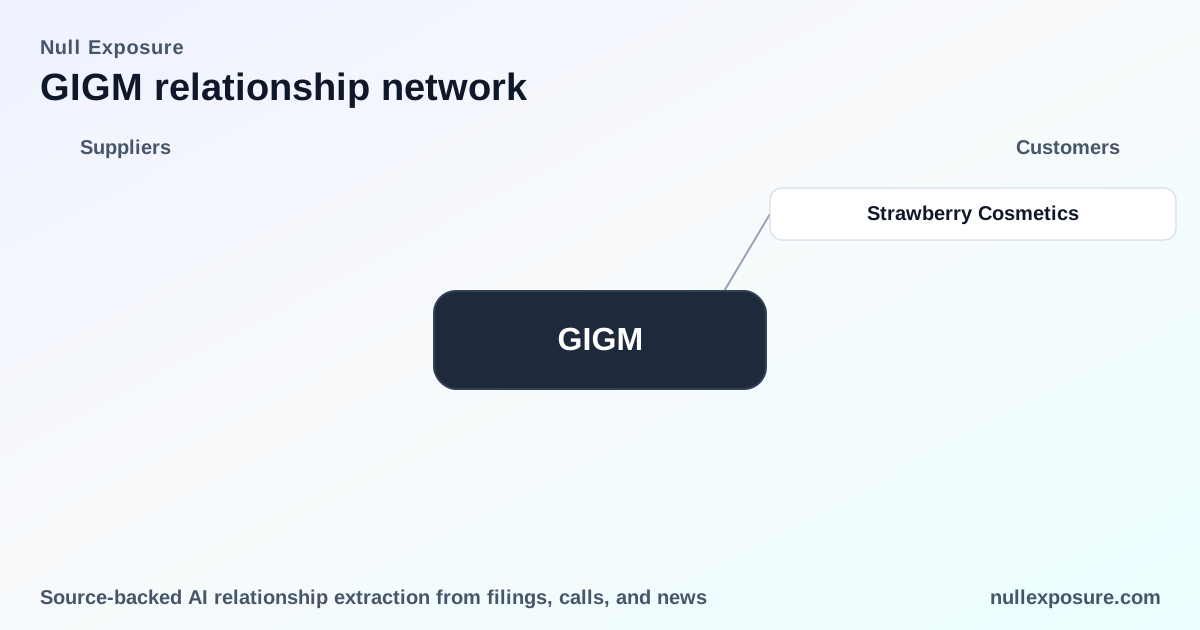
GigaMedia has a disclosed customer/portfolio relationship with Strawberry Cosmetics, where the company has used its online and offline marketing expertise and regional connections to support the retailer’s expansion across Asia. According to a Global Cosmetics News article (reported March 2026), GigaMedia’s involvement positions Strawberry Cosmetics to benefit from GigaMedia’s distribution links in China, Japan and South Korea and from the company’s marketing and technology capabilities. (Global Cosmetics News, March 2026).
What to read between the lines: GigaMedia is not only a service provider; it acts as a strategic partner or investor in consumer businesses where its marketing technology and regional footprint increase the odds of monetization for both sides.
How this relationship fits into GigaMedia’s operating model
Contracting posture and strategic focus
- Opportunistic and partnership-oriented. The Strawberry Cosmetics interaction illustrates a posture that blends platform services with equity backing: GigaMedia supplies marketing, technology and regional access while taking a stake to capture upside.
- Blended revenue drivers. Revenue likely combines recurring digital-services fees with nonrecurring gains tied to portfolio outcomes—this creates lumpy growth but higher optionality if portfolio companies scale.
Concentration and customer criticality
- High concentration risk at the company level. Market data through the latest quarter (2026-03-31) show modest revenue (TTM ~$3.47M) and negative operating margins, indicating a small operating base where a handful of relationships or investments can meaningfully swing results. (Company filings and market data, latest quarter 2026-03-31).
- Customer criticality is relationship-specific. The Strawberry Cosmetics tie is strategic rather than transactional: GigaMedia’s marketing and regional channels are potentially critical to that retailer’s Asia expansion, but at the parent level the company remains concentrated and sensitive to the performance of such relationships.
Maturity and governance signals
- Early-stage, with venture-like characteristics. The company’s balance of small market capitalization (approx. $15.25M), negative EBITDA and heavy insider ownership (insiders own ~45.6%) points to an operator still in a development phase where founders or insiders drive strategy. (Market data).
- Limited institutional oversight. Institutional ownership is low (~4.7%), suggesting few large external governance checks; that increases execution risk but preserves strategic flexibility.
Financial context that shapes customer risk and reward
GigaMedia’s public financial profile constrains how much value a customer or portfolio relationship can generate for investors today:
- Revenue is small and profitability is negative. TTM revenue of roughly $3.47M and operating margins markedly negative mean that marketing investments and equity stakes must scale materially to change the valuation trajectory. (Company filings, latest quarter 2026-03-31).
- Valuation is shallow but opaque. Market cap sits in the mid-single-digit millions and shares outstanding are limited, which amplifies upside if a relationship like Strawberry Cosmetics crystallizes value, but also magnifies downside if execution falters.
- Insider-heavy ownership implies alignment and execution risk. With nearly half the stock held by insiders, management decisions on where to allocate marketing capital and whether to convert partnerships into larger acquisitions will determine outcomes.
Relationship-by-relationship log (complete)
- Strawberry Cosmetics — GigaMedia supported Strawberry Cosmetics’ Asia expansion by providing online and offline marketing, technology support and leveraging its regional connections in China, Japan and South Korea; this engagement was reported in a March 2026 Global Cosmetics News article. (Global Cosmetics News, March 2026).
This article covers the full set of customer relationships available from public reporting for GIGM; no other customer relationships were disclosed in the records reviewed for this update.
Investment implications: risks and catalysts
- Catalyst potential: If GigaMedia converts strategic partnerships into scalable revenue streams (for example, recurring marketing contracts or successful exits/monetizations of portfolio stakes), valuation re-rating is plausible given the small public float and low institutional ownership.
- Key risks: The company is operationally small and loss-making, making it highly sensitive to the performance of a few relationships and to management capital allocation decisions; heavy insider control raises implementation risk if governance is insufficient.
- Event-monitoring checklist for investors: watch for (1) clearer revenue-sharing or recurring-contract terms from strategic partnerships; (2) any announced exits or monetizations of portfolio stakes; (3) quarterly top-line growth consistency beyond one-off gains.
Bottom line — what investors should take away
- GigaMedia operates as a boutique digital entertainment and marketing platform that selectively takes stakes in consumer brands to extend reach and monetize its marketing technology. The Strawberry Cosmetics engagement exemplifies that hybrid model.
- This operating model creates asymmetric outcomes: successful portfolio plays can drive rapid valuation upside given the small market cap and float, but execution failure or contract concentration exposes investors to steep downside.
- For deeper diligence into how customer relationships translate into recurring revenue and valuation drivers, see ongoing coverage at https://nullexposure.com/.
Bold takeaway: GigaMedia’s value is tied less to scale today and more to the execution and monetization of a handful of strategic customer/portfolio relationships; investors must trade the company on event risk and concentrated operational leverage.