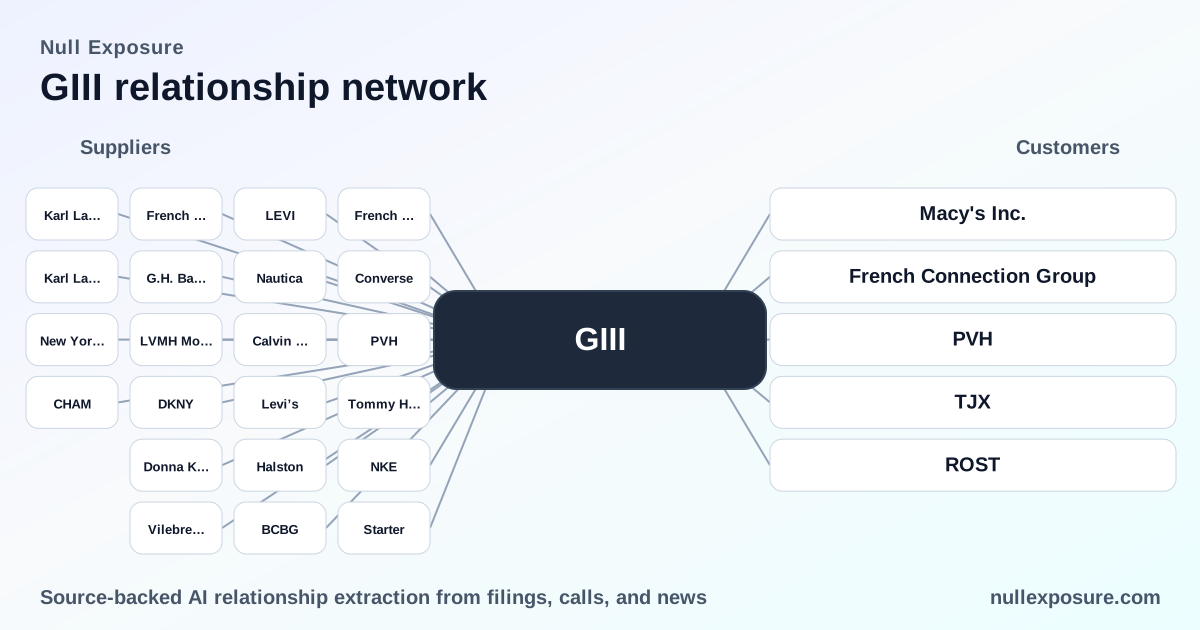
G‑III Apparel Group: Customer Relationships and Commercial Risks
Thesis — G‑III operates as a hybrid apparel manufacturer, wholesale supplier and licensor: it sells owned and licensed brands into large North American retailers, runs direct retail channels, and licenses its trademarks for royalties. The business monetizes through wholesale and retail product sales (point‑of‑sale and short‑term receivables) and recurring licensing royalties, a model that produces meaningful top‑line concentration and credit exposure that investors must price into valuation and covenant risk assessments. For a focused operational view and ongoing monitoring, visit https://nullexposure.com/.
How G‑III actually contracts and where the risks live
G‑III’s operating model blends several mutually reinforcing commercial patterns that shape credit and revenue volatility:
- Sales cadence is largely short‑term and spot: retail revenue is recognized at the point of sale while wholesale customers take standard credit terms (generally due within 60 days), so revenue recognition and cash conversion cycles are quick but sensitive to retailer order timing and inventory flows.
- Licensing is a distinct, recurring revenue stream: G‑III earns royalties under multi‑year licenses and also licenses its trademarks to third parties where a licensee’s local expertise is preferable.
- Counterparties skew to large North American retailers: a substantial majority of revenue is U.S.‑based (~77% of net sales in FY2025), and G‑III’s top buyers are department and off‑price chains, producing concentration risk — ten customers were 69.6% of net sales in FY2025.
- Relationship roles are mixed: G‑III acts as seller to retailers, licensee/licensor in brand deals, and occasionally distributor/consignor where inventory is held at customer facilities.
- Materiality drives systemic exposure: because a small set of accounts represents a large share of sales, credit events or license roll‑offs translate into outsized P&L and cash impacts.
These are company‑level operating signals drawn from filings and public reporting; they define where investors should focus diligence — receivable aging, license renewal timelines, and large‑account credit quality.
Relationship map: every customer connection worth tracking
Macy’s Inc.
G‑III disclosed that the Macy’s group represented approximately 18.0% of net sales in fiscal 2025, making Macy’s the single largest customer and a primary revenue driver. This concentration elevates dependency on Macy’s merchandising and inventory cadence. Source: G‑III FY2025 10‑K.
TJX Companies / TJX
TJX Companies accounted for approximately 13.2% of net sales in fiscal 2025, placing it among G‑III’s top wholesale partners and reinforcing exposure to off‑price channel demand. Source: G‑III FY2025 10‑K.
Ross Stores / ROST
Sales to Ross Stores aggregated 12.6% of net sales in fiscal 2025, reflecting G‑III’s material exposure to a second off‑price operator and the concentration profile among top customers. Source: G‑III FY2025 10‑K.
Saks Global
G‑III recorded a significant bad‑debt charge tied to the bankruptcy of Saks Global, with public filings and earnings commentary attributing $17.5 million of bad debt expense to that event in FY2026 results. The charge demonstrates immediate credit risk when a wholesale partner fails. Source: G‑III FY2026 results press release (GlobeNewswire, March 2026) and subsequent coverage.
Saks (broader reporting)
Analysts and press coverage tied G‑III’s FY2025/Q4 profitability hit to both license exits and the Saks bankruptcy, underlining how credit exposures and license dynamics combined to depress recent results. Source: Simply Wall St coverage of FY2026 results (March–May 2026).
PVH (Calvin Klein / Tommy Hilfiger)
PVH‑related license roll‑offs are a material, finite headwind: industry commentary cites roughly $470 million of lower‑margin revenue exiting by FY2028 due to the PVH license roll‑off, a structural revenue decline that G‑III must replace with owned brands and new licenses. Source: Simply Wall St analysis, May 2026.
Calvin Klein (PVH brand)
G‑III manufactures licensed apparel for Calvin Klein and identified the exit of Calvin Klein licenses as a core driver of revenue pressure, reinforcing that PVH license dynamics directly affect G‑III top‑line and margin composition. Source: WWD / G‑III Q2 commentary (FY2026 coverage).
French Connection Group
In March 2026 G‑III announced a long‑term licensing and distribution partnership with French Connection Group to develop and distribute menswear, womenswear and select accessories across North America, expanding G‑III’s licensed brand portfolio and U.S. wholesale reach. Source: PR Newswire and The Retail Bulletin (March 2026).
Nordstrom
Wholesale performance at Nordstrom was highlighted in Q2 commentary, with G‑III noting strong sell‑through for owned brand Eliza J and licensed Vince Camuto dresses; this underscores G‑III’s dual reliance on owned and licensed assortments within department stores. Source: WWD reporting on G‑III Q2 (FY2026).
Vince Camuto
Vince Camuto licensed dresses logged strong sales gains at Nordstrom, illustrating that licensed product performance continues to contribute meaningfully to wholesale results even as some large licenses roll off. Source: WWD coverage of Q2 results (FY2026).
Karl Lagerfeld
G‑III executed a joint venture and received a five‑year license for multiple Karl Lagerfeld categories, a deal that management characterized as “well in excess of half a billion dollars” of opportunity, signaling sizable potential revenue if execution meets expectations. Source: WWD (FY2026 coverage).
Ivanka Trump
G‑III holds the license for Ivanka Trump sportswear, dresses and suits in North America and expected material income growth for the brand, demonstrating how licensed legacy labels can still be revenue contributors. Source: WWD (FY2026 coverage).
Kenneth Cole
G‑III produces licensed apparel for Kenneth Cole, positioning the brand within its wholesale catalog alongside other legacy licenses that contribute to recently reported profits. Source: WWD (FY2026 coverage).
XELB (Halston master license reference)
A third‑party filing noted that the Halston master license agreement is with G‑III, and the filing described G‑III as one of the largest designers and suppliers of wholesale apparel with annual revenues over $3 billion, contextualizing the company’s scale in licensing markets. Source: XELB FY2024 10‑K reference.
Key investment takeaways and the monitoring checklist
- Concentration is the dominant theme: ten customers accounted for 69.6% of net sales in FY2025; loss or weakening of a major account produces immediate P&L and working‑capital stress.
- Credit exposure is real and quantifiable: the Saks Global bankruptcy produced a $17.5 million bad‑debt charge in FY2026, proof that large wholesale counterparty failures transmit directly to earnings.
- Licensing is a double‑edged sword: PVH license roll‑offs (~$470M of revenue reduction by FY2028) are a known structural headwind, but new license deals (Karl Lagerfeld, French Connection) and owned brand investment (DKNY, Eliza J, Donna Karan) provide offset paths.
- Short cash cycles, but high concentration: most wholesale receivables are short‑term (generally due within 60 days) and retail is point‑of‑sale, so liquidity stress is tied to abrupt order drops, license timing, or clustered credit losses.
- Geographic tilt: roughly 77% of sales are U.S.‑based; North America remains the primary risk and opportunity arena.
For investors and operators, the near‑term checklist is straightforward: monitor large customer credit metrics and receivable aging, track PVH license exit timing and replacement revenue, and quantify the cadence and margins of newly announced licenses. For deeper commercial monitoring and continuous signals on counterparties, see https://nullexposure.com/.
Bold positioning of customer concentration, license roll‑offs, and realized credit losses encapsulates the commercial thesis: G‑III’s revenue is high‑velocity and large‑account concentrated; execution on license replacement and credit management will determine both earnings stability and upside as the company pivots to owned brands.