Gildan Activewear (GIL): Customer Relationships and What They Mean for Investors
Gildan Activewear runs a vertically integrated basic apparel business that monetizes through manufacturing scale, branded and private-label sales, and distribution partnerships. The firm earns revenue by producing core garments for its own brands and for third-party customers, and by leveraging distribution arrangements that extend its reach into wholesale and specialty channels. Recent public reporting shows Gildan balancing the integration of large legacy accounts with targeted channel deals that reshape mix and near-term growth drivers.
If you want a concise dossier of these customer ties and their strategic implications, start here — or explore additional signal products at https://nullexposure.com/ for further transaction-level context.
Quick investor thesis: scale, concentration, and controllable transition
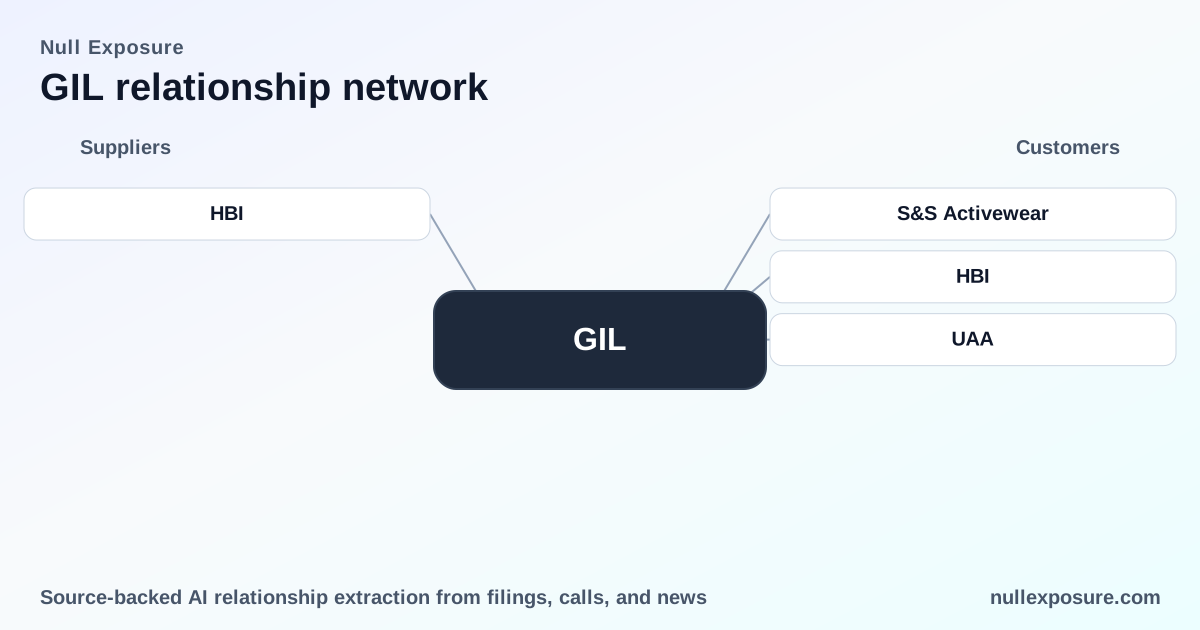
Gildan’s model delivers margin and cash conversion through low-cost manufacturing and distribution scale. Key stock-level drivers are the degree of revenue concentration with large partners, the company’s ability to re-deploy capacity after contract changes, and its control over distribution channels. Recent items in the news cycle — an earlier-than-expected closure of the Hanes supply agreement, the granting of exclusive distribution rights to S&S Activewear, and the historical exit of Under Armour — collectively point to a company reweighting how it allocates capacity and sales channels to sustain growth and protect margins.
Customer relationships — line by line
Hanes (HBI)
Gildan recorded an earlier-than-expected closure of the Hanes supply agreement, and management has already absorbed that change into operating plans, according to the company update reported by The Globe and Mail in March 2026; National Bank revised its target after updating forecasts to reflect the development. This is a material commercial transition for Gildan given Hanes’ prior role in its revenue mix. (Source: The Globe and Mail press release coverage, March 9, 2026.)
S&S Activewear
Gildan granted S&S Activewear exclusive distribution rights for a specified channel, signaling a deliberate channel strategy to consolidate wholesale distribution and lock-in a high-volume partner, according to coverage in InsiderMonkey in March 2026. This move reflects an emphasis on channel control and scale distribution economics. (Source: InsiderMonkey report, March 9, 2026.)
Under Armour / UAA
Gildan’s sales were impacted by the exit of the Under Armour business in 2024; excluding that exit, net sales would have shown a mid-single-digit year-over-year increase, per SGB Online reporting, which highlights both the magnitude of the Under Armour relationship historically and the base-rate strength of the remaining business. The Under Armour exit materially changed growth comparables and product mix. (Source: SGB Online coverage, March 2026.)
What the relationships collectively imply about Gildan’s operating model
-
Contracting posture — pragmatic and execution-focused. The company’s ability to “absorb” the earlier-than-expected Hanes closure into operating plans indicates a contracting posture that includes contingency planning and flexible capacity allocation rather than one that is fully locked into long-term, inflexible supply terms. This suggests Gildan negotiates supply agreements with operational levers to reassign capacity or redirect volumes when counterparty arrangements change.
-
Revenue concentration — significant but manageable. The prominence of Hanes and historical exposure to Under Armour show concentration risk exists; however, the firm is actively diversifying distribution partnerships (for example, the exclusive deal with S&S) to mitigate single-counterparty exposure and preserve volume. Investors should track the share of sales tied to a small number of large customers over time.
-
Customer criticality — commercial partners can be material to near-term top-line dynamics. The Under Armour exit reshaped comparables for 2024–25 and the Hanes supply closure required forecast adjustments in FY2026, underscoring that major customers have had outsized influence on revenue trajectory.
-
Maturity of relationships — shifting from legacy OEM-style ties to channel and distribution alignment. Granting exclusive distribution rights to a major wholesaler indicates a strategic shift toward disciplined channel management rather than purely transactional OEM manufacturing. That repositioning signals a more mature commercial approach focused on margin retention and controlled distribution.
No explicit constraints were recorded in the available relationship feed, which itself is a company-level signal: the data reviewed does not list contractual term limits, dependency thresholds, or other structured constraint items. Investors should treat public reporting and press coverage as the primary inputs for assessing partnership terms and exposure until detailed filings provide more granular contract-level disclosure.
Risks and catalysts investors should watch
-
Risk — Concentration shock from legacy customers. The earlier-than-expected closure with Hanes and the prior Under Armour exit demonstrate that large partner departures can compress year-over-year comparables and demand capacity redeployment. Monitor customer revenue breakdowns in quarterly filings.
-
Catalyst — Successful re-deployment of freed capacity. If Gildan converts capacity vacated by Hanes/Under Armour into higher-margin branded sales or new channel partnerships (such as the S&S exclusive distribution), margins and returns on capital will improve materially relative to the prior mix.
-
Risk — Channel execution on exclusivity deals. Exclusive distribution arrangements deliver scale only if the partner executes; S&S Activewear’s performance as a distribution lead will directly affect top-line conversion from that channel.
-
Catalyst — Transparent guidance on post-transition revenue mix. Clear disclosure on how contract changes alter product mix and margins will shorten investor uncertainty and reduce multiple compression.
Practical takeaways for portfolio managers
- Prioritize tracking customer concentration metrics and ask management for a current list of top customers and the percentage of revenues each represents, as those figures directly affect downside exposure.
- Evaluate the pace at which Gildan is replacing lost volume with higher-margin channels (branded sales, exclusive partnerships) to judge whether the business is improving mix or simply transferring risk.
- Watch quarterly commentary on distributive partners such as S&S for volume cadence and margin guidance; these are the near-term levers to stabilize comparable growth.
For a structured view of partner-level signals and to monitor changes as filings and press coverage evolve, visit https://nullexposure.com/ for the latest curated relationship intelligence.
Conclusion: Gildan’s recent customer moves show a company executing a pragmatic transition away from legacy, high-concentration supply relationships toward a more controlled channel mix. That transition is the central investment story: converting structural customer risk into durable distribution and branded economics.