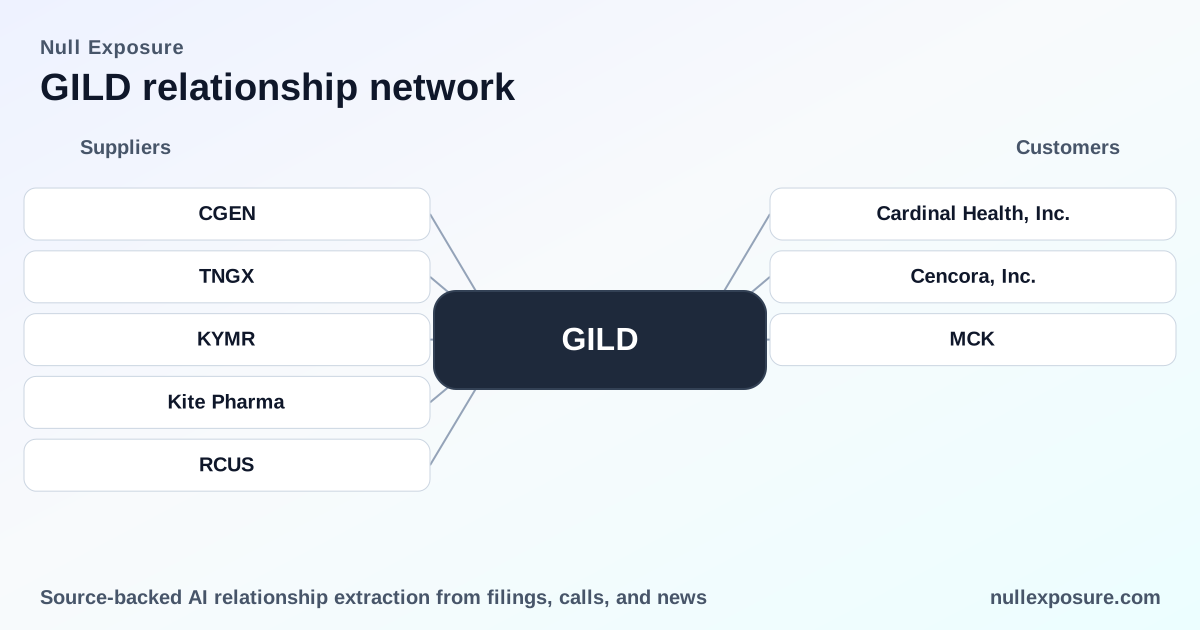
Gilead (GILD) — Customer Relationships and Commercial Levers Investors Should Know
Gilead Sciences monetizes through a mix of specialty pharmaceuticals sold via large wholesale partners, selective licensing of assets, and collaborations that feed its pipeline and royalty streams. Revenue concentration in a small number of wholesale customers and a steady flow of licensing/collaboration activity are core commercial features that determine cash flow stability, negotiating leverage and execution risk. For a concise, machine-independent view of counterparty exposure and commercial roles, visit https://nullexposure.com/.
Why wholesale partners dominate the commercial story
Gilead routes most of its U.S. product volume through a handful of large wholesalers and leverages licensing deals and collaborations to extend its R&D output into partnered development or external commercialization. That dual model — concentrated distribution plus targeted licensing — drives both upside (scale and capital-lite R&D realizations) and downside (counterparty concentration risk).
Cardinal Health, Inc.
Cardinal Health is one of three large wholesalers responsible for the vast majority of Gilead’s U.S. product sales; Gilead’s FY2024 10‑K reports that approximately 91% of U.S. product sales and roughly 65% of global revenues flowed through Cardinal, Cencora and McKesson and their specialty affiliates. (Gilead FY2024 10‑K)
Cencora, Inc.
Cencora is identified alongside Cardinal Health and McKesson as a principal wholesale channel, contributing materially to Gilead’s distribution and revenue concentration in FY2024. (Gilead FY2024 10‑K)
MCK (ticker) — McKesson reference
McKesson is captured both as the ticker MCK and in full corporate name in the filings; Gilead’s FY2024 disclosure confirms McKesson as a core wholesale partner within the three-company concentration noted above. (Gilead FY2024 10‑K)
McKesson Corporation
The full-name entry for McKesson reiterates the same point: McKesson, with Cardinal Health and Cencora, accounted for the lion’s share of U.S. product sales and a major portion of worldwide revenues in FY2024. (Gilead FY2024 10‑K)
Licensing and collaborative touchpoints that affect future cash flows
CGEN (Century Therapeutics / related earnings call)
A Q4 2025 earnings call from a counterparty notes a program was “licensed to Gilead,” signaling active inbound licensing where Gilead acquires rights to external technology or assets as part of pipeline build-out. (CGEN Q4 2025 earnings call)
RPRX (Royalty Pharma reference to Trodelvy)
TradingView coverage of Royalty Pharma’s Q2 2025 results highlighted positive Phase 3 data for Gilead’s Trodelvy in first‑line metastatic triple‑negative breast cancer, underlining the commercial and royalty upside when late‑stage readouts succeed. (TradingView news, Royalty Pharma Q2 2025 coverage)
ASMB (Assembly Bio — FierceBiotech report)
FierceBiotech reported that Gilead paid for first rights to Assembly Bio assets and will contribute programs while Assembly advances others, illustrating Gilead’s strategy of selective upstream investment and option-style access to external R&D. (FierceBiotech, FY2023 reporting)
ASMB (Assembly Bio — Manila Times/GlobeNewswire)
Assembly Bio’s late‑2025 interim study disclosures note that ABI‑1179 was contributed by Gilead under their collaboration, reinforcing that Gilead deploys in‑kind program contributions across partnered development. (GlobeNewswire via Manila Times, FY2025)
GLPG (Galapagos NV — Directorstalk)
Analyst commentary in early FY2026 emphasizes Galapagos collaborations with Gilead as strategic, supplying validation and resources for Galapagos’ pipeline and reflecting Gilead’s role as a large pharmaceutical partner that lends credibility and capital to smaller biotech programs. (Directorstalk interviews, FY2026)
GLPG (Galapagos NV — InsiderMonkey)
InsiderMonkey coverage noted a binding framework between Galapagos and Gilead tied to Gilead’s acquisition of Ouro Medicines, demonstrating how Gilead’s corporate actions create downstream partnership dynamics for smaller biotechs. (InsiderMonkey, FY2026)
IDYA (Ideaya Biosciences)
A PR Newswire release for Ideaya (FY2026) indicates the company deprioritized clinical combinations with Trodelvy and will conclude enrollment in certain Phase 1/2 trials with Gilead, showing the practical constraints collaborations place on smaller partners’ development priorities. (PR Newswire / Ideaya FY2026)
NNVC (Nanoviricides)
A FY2026 press communication from Nanoviricides describes NV‑CoV‑2‑R, which encapsulates remdesivir — a Gilead‑developed antiviral — highlighting Gilead’s role as originator of foundational antiviral compounds that other developers reference or integrate. (JSOnline / Nanoviricides FY2026)
What the constraints tell investors about Gilead’s operating model
The extracted company-level signals paint a coherent operating profile:
- Contracting posture — licensing is a material part of Gilead’s playbook. Evidence shows Gilead both licenses assets and accepts licensed assets from partners, reflecting a hybrid strategy of direct commercialization plus licensed technology exchange.
- Counterparty profile — large enterprise counterparties dominate distribution. The business routes most U.S. sales through major wholesalers, creating both scale benefits and concentration exposure.
- Geographic reach — global footprint with North American distribution concentration. Gilead operates internationally while selling and distributing most products in the U.S. through the wholesale channel.
- Materiality and criticality — relationships are commercial linchpins. Wholesaler concentration is marked as critical to revenue, making these counterparties strategically important for cash flow and inventory management.
- Relationship roles — multiple commercial roles coexist. Gilead acts as a seller and intellectual‑property owner, partners act as distributors, and other parties assume licensee or manufacturer responsibilities under certain agreements (company‑level signal based on contract excerpts).
These constraints combine into a real-world business model: highly scalable distribution that is operationally concentrated, complemented by licensing and collaboration activity that spreads R&D risk but creates dependency on partner milestones and decision-making.
Investment implications — upside, vulnerability, and what to watch
- Upside: Successful late‑stage clinical data (as with Trodelvy) and disciplined licensing can generate outsized royalty and revenue uplifts. Positive Phase 3 readouts amplify valuation via both product sales and partner royalty streams.
- Vulnerability: Very high customer concentration in three wholesale players exposes Gilead to pricing, payment and terms negotiation leverage; any disruption or dispute with those enterprises would have outsized earnings impact.
- Operational risk: Dependence on external licensees and manufacturers for some programs shifts control of launch timing and quality to third parties.
- Catalysts to monitor: FY earnings and 10‑K disclosures for shifts in the three‑wholesaler concentration, major licensing transactions, and pivotal clinical readouts for partnered assets.
For a structured feed of counterparty exposures and relationship summaries tailored for institutional analysis, visit https://nullexposure.com/.
Bottom line
Gilead’s commercial strength rests on scale distribution through major wholesalers and an active licensing/collaboration agenda that converts R&D into commercial and royalty outcomes. That combination delivers both predictable baseline cash flow and event‑driven upside — while concentrating execution risk in a small set of counterparties and partner milestones. Investors must track distribution concentration metrics, licensing receipts, and partner program milestones to assess near‑term revenue resilience and medium‑term growth prospects.