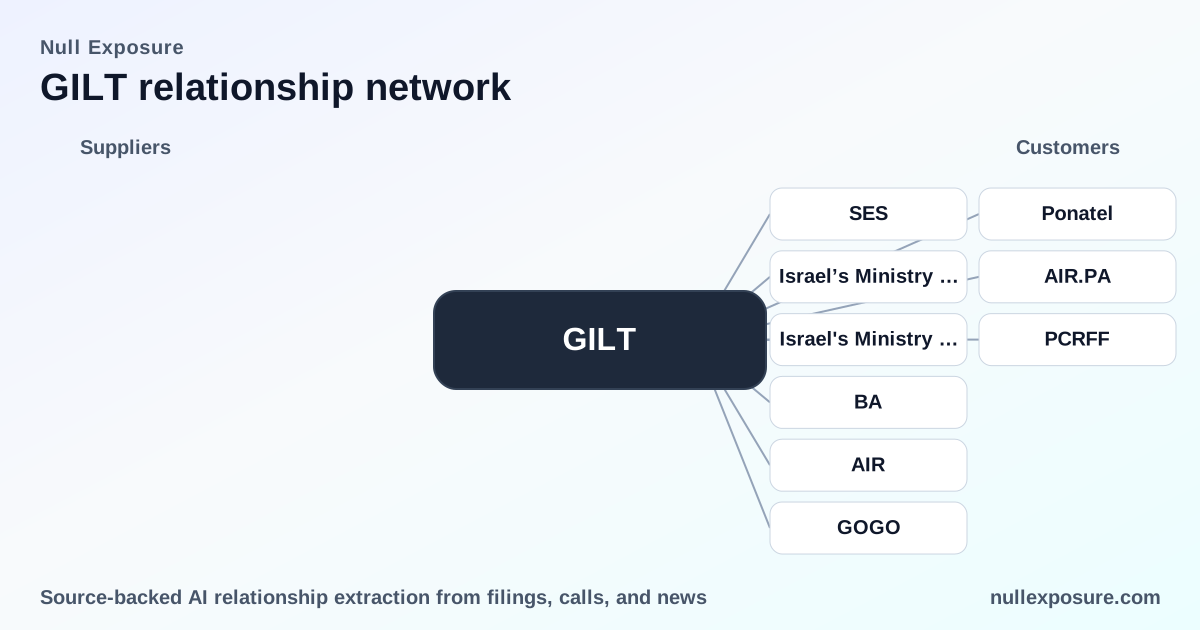
GILT customer map: where revenue, defense work and aviation line‑fit converge
Gilat Satellite Networks (GILT) monetizes by selling satellite networking equipment and integrated solutions, then layering recurring services and field support contracts on top—spanning commercial VSAT networks, enterprise wholesale, aviation line‑fit opportunities and government/defense procurements. Revenue drivers are a hybrid of one‑off equipment sales, multi‑year services and high‑margin defense orders, giving investors exposure to both cyclical capital programs and sticky service annuities. For an actionable view of customer counterparties and the operational implications, read on. For further company relationship analytics visit https://nullexposure.com/.
Why these customer names matter to valuation and risk
Gilat’s customer list signals a dual commercial‑defense go‑to‑market. Commercial engagements (telcos, retail chains, energy and banks) supply scale and recurring connectivity; defense and government contracts provide short‑cycle, higher‑visibility orders and integration work that supports margin expansion in specialized units like Gilat Defense and Gilat DataPath. The company’s contracting posture is therefore mixed—transactional equipment sales coupled with multi‑year service and field‑support agreements. Concentration is moderate: GILT engages many large counterparties across geographies, reducing single‑counterparty exposure, but certain sectors (defense, telco) are strategically critical to near‑term earnings. Product maturity is heterogeneous: legacy VSAT networks remain cash cows while the Sidewinder aviation terminal represents a newer, potentially scalable revenue stream.
Key investor takeaways: Gilat’s commercial breadth reduces single‑buyer risk; defense contracts raise margins and predictability in specific segments; aviation line‑fit deals introduce upside optionality if certification and OEM partnerships advance.
Relationship roll‑call — concise, source‑backed notes
Below are every customer name flagged in reporting; each item is a short plain‑English summary with the original source.
SES
Gilat has an agreement with SES to bring the Sidewinder airborne terminal to line‑fit with Airbus, enabling SES to install units within Airbus premises for aircraft integration (Q4 FY2025 earnings commentary). (Source: InsiderMonkey earnings transcript, Mar 2026 — https://www.insidermonkey.com/blog/gilat-satellite-networks-ltd-nasdaqgilt-q4-2025-earnings-call-transcript-1693379/)
Telikom Papua New Guinea (Telikom PNG)
Gilat was selected to supply a hub and 500 DialAw@y IP VSATs to extend rural telephony across Papua New Guinea, a commercial rural‑connectivity award. (Source: SpaceWar report, May 2026 — https://www.spacewar.com/reports/Gilat_Selected_To_Deploy_Rural_Telephony_Network_In_Papua_New_Guinea.html)
Fondo de Inversion en Telecomunicaciones del Peru (FITEL)
Gilat signed a contract with FITEL to deploy a fixed rural satellite telephony network in Peru, a programmatic national‑scale award. (Source: SpaceWar report, May 2026 — https://www.spacewar.com/reports/Gilat_Connects_2_000_Rural_Peru_In_%2427_Million_VSAT_Deal.html)
FITEL, Peru’s National Telecommunications Fund
Company filings and press commentary separately confirmed the FITEL contract for a rural telephony network, cited in Gilat corporate disclosures. (Source: SpaceDaily coverage, May 2026 — https://spacedaily.com/gilat-says-revenues-fall-below-estimates/)
Israel’s Ministry of Defense
Gilat Defense received a $9 million contract from Israel’s Ministry of Defense to deliver and integrate satcom systems and services—an explicit defense win for its specialized unit. (Source: GlobeNewswire press release, Feb 17, 2026 — https://www.globenewswire.com/news-release/2026/02/17/3239094/0/en/Gilat-Receives-9-Million-Order-for-Defense-SATCOM-Solutions-from-Israel-s-Ministry-of-Defense.html)
SES (additional commercial context)
Management identified SES among partners with “decent awards” contributing to expected large orders in the first half of the year. (Source: SatelliteToday finance article, Feb 11, 2026 — https://www.satellitetoday.com/finance/2026/02/11/gilat-increased-revenue-nearly-50-in-2025-on-strength-of-ifc-business/)
BA
Gilat reported active progress toward Boeing line‑fit certification for the Sidewinder terminal, expecting certification and deliveries within FY2026. (Source: SatelliteToday finance coverage, Feb 11, 2026 — https://www.satellitetoday.com/finance/2026/02/11/gilat-increased-revenue-nearly-50-in-2025-on-strength-of-ifc-business/)
Airbus
Gilat reported a collaboration involving SES to install the Sidewinder within Airbus premises as part of a line‑fit pathway. (Source: InsiderMonkey earnings transcript, Mar 2026 — https://www.insidermonkey.com/blog/gilat-satellite-networks-ltd-nasdaqgilt-q4-2025-earnings-call-transcript-1693379/)
Boeing (explicit)
Management reiterated expectations to pass Boeing certification in H1 and begin deliveries later in the year—critical for avionics revenue scale. (Source: InsiderMonkey earnings transcript, Mar 2026 — https://www.insidermonkey.com/blog/gilat-satellite-networks-ltd-nasdaqgilt-q4-2025-earnings-call-transcript-1693379/)
GIS Bank
Gilat Europe has deployed enterprise VSAT networks for financial customers including GIS Bank in continental projects. (Source: SpaceWar feature, May 2026 — https://www.spacewar.com/reports/Gilat_Does_%24200_Million_Euro_Deal_To_Sell_Internet_Via_VSAT.html)
AGIP
Gilat Europe counts AGIP among enterprise customers for deployed VSAT networks across Europe. (Source: SpaceWar feature, May 2026 — https://www.spacewar.com/reports/Gilat_Does_%24200_Million_Euro_Deal_To_Sell_Internet_Via_VSAT.html)
BTopenworld
Gilat established wholesale relationships servicing BTopenworld for satellite broadband to SOHO and consumer subscribers. (Source: SpaceWar reporting, May 2026 — https://www.spacewar.com/reports/Gilat_Does_%24200_Million_Euro_Deal_To_Sell_Internet_Via_VSAT.html)
Esso Deutschland
Gilat Europe has implemented VSAT networks for Esso Deutschland as part of enterprise connectivity contracts. (Source: SpaceWar feature, May 2026 — https://www.spacewar.com/reports/Gilat_Does_%24200_Million_Euro_Deal_To_Sell_Internet_Via_VSAT.html)
GE Capital Bank
Gilat Europe lists GE Capital Bank among enterprise VSAT deployments across European operations. (Source: SpaceWar feature, May 2026 — https://www.spacewar.com/reports/Gilat_Does_%24200_Million_Euro_Deal_To_Sell_Internet_Via_VSAT.html)
U.S. Army
Gilat DataPath received approximately $6 million in orders to continue field and technical services supporting U.S. Army global communications under the GTACS II contract vehicle. (Source: SatelliteEvolution report, Mar–May 2026 coverage — https://www.satelliteevolution.com/post/gilat-receives-approximately-6-million-in-orders-supporting-us-army-global-communications-operation)
Exelis
Exelis placed initial orders for tri‑band SR300 satcom‑on‑the‑move antennas from Gilat, indicating defense/OEM channel traction. (Source: SpaceWar report, May 2026 — https://www.spacewar.com/reports/Gilat_Receives_First_Orders_for_its_SR300_Satcom_on_the_Move_Antenna_from_Exelis_999.html)
Ponatel
Gilat Peru closed more than $85 million in agreements with Ponatel for upgrades of four regional networks, highlighting sizable national contracts. (Source: InsiderMonkey earnings transcript, Mar 2026 — https://www.insidermonkey.com/blog/gilat-satellite-networks-ltd-nasdaqgilt-q4-2025-earnings-call-transcript-1693379/)
Army’s Program Executive Office for Command, Control and Communications Networks
The U.S. Army award extended Gilat’s work with the Army’s Program Executive Office under a multi‑year GTACS II engagement. (Source: InsiderMonkey coverage, May 2026 — https://www.insidermonkey.com/blog/how-gilat-gilt-extended-its-u-s-army-communications-support-work-with-new-orders-1732686/?amp=1)
Program Executive Office for Command, Control and Communications Networks (PEO C3N)
Press reports confirm the extension under GTACS II, reinforcing Gilat’s multi‑year U.S. defense relationship. (Source: SatelliteEvolution, May 2026 — https://www.satelliteevolution.com/post/gilat-receives-approximately-6-million-in-orders-supporting-us-army-global-communications-operation)
MCI WorldCom
Historical reporting referenced potential prospective orders tied to large telecom contracts in backlog discussions; cited as part of enterprise backlog context. (Source: SpaceWar historical feature, May 2026 — https://www.spacewar.com/reports/Gilat_Gets_Indigestion_Following_Year_of_Acquisitions.html)
StarBand Communications
StarBand was mentioned historically as a prospective customer in equipment backlog commentary. (Source: SpaceWar historical feature, May 2026 — https://www.spacewar.com/reports/Gilat_Gets_Indigestion_Following_Year_of_Acquisitions.html)
GOGO / Gogo
Gilat noted that Gogo is promoting Gilat’s terminal with initial small awards for antenna installations on aircraft. (Source: InsiderMonkey earnings call excerpt, Mar 2026 — https://www.insidermonkey.com/blog/gilat-satellite-networks-ltd-nasdaqgilt-q4-2025-earnings-call-transcript-1693379/)
Dollar General Corporation
Spacenet, a Gilat subsidiary, was selected to provide a nationwide broadband satellite network to Dollar General’s large store footprint—an enterprise retail rollout. (Source: SpaceWar coverage, May 2026 — https://www.spacewar.com/reports/Gilat_Gets_Indigestion_Following_Year_of_Acquisitions.html)
Peugeot/Citroen
Gilat Europe has deployed enterprise VSAT networks for automotive group Peugeot/Citroen as part of continental contracts. (Source: SpaceWar feature, May 2026 — https://www.spacewar.com/reports/Gilat_Does_%24200_Million_Euro_Deal_To_Sell_Internet_Via_VSAT.html)
Tiscali
Gilat (via SATLYNX integration) services wholesale broadband contracts with Tiscali for consumer and SOHO subscribers in Europe. (Source: SpaceWar report on SATLYNX and SES deals, May 2026 — https://www.spacewar.com/reports/Gilat_Completed_Vsat_Deal_With_SES_Global.html)
TOTAL
Gilat Europe lists TOTAL among enterprise customers for deployed VSAT solutions across its regional footprint. (Source: SpaceWar feature, May 2026 — https://www.spacewar.com/reports/Gilat_Does_%24200_Million_Euro_Deal_To_Sell_Internet_Via_VSAT.html)
Panasonic
Management flagged Panasonic alongside SES as a customer with meaningful awards contributing to order expectations in early FY2026. (Source: SatelliteToday finance article, Feb 11, 2026 — https://www.satellitetoday.com/finance/2026/02/11/gilat-increased-revenue-nearly-50-in-2025-on-strength-of-ifc-business/)
Operational constraints and what they imply for investors
- Contracting posture: Gilat executes a mix of transactional equipment sales and multi‑year service/field support contracts; defense and government work is typically event‑driven but can be extended under contract vehicles such as GTACS II, increasing revenue visibility for discrete periods.
- Concentration and diversification: Customer set spans national telecom funds, global aerospace OEMs, defense ministries and enterprise clients—diversification reduces single‑counterparty risk, but sector concentration in defense and telco means macro policy and procurement cycles materially affect near‑term topline.
- Criticality: Several relationships are mission‑critical (U.S. Army, Israel MOD, national telecom funds), implying high retention potential and premium for support/maintenance services.
- Maturity: Legacy VSAT deployments generate stable cash flow while newer initiatives (Sidewinder aviation line‑fit) create a technology adoption runway that can re‑rate commercial avionics revenue if certification and OEM installs scale.
If you want a convertible view that ties these counterparties to revenue buckets and win‑probabilities, our platform synthesizes relationship intensity and public disclosures into an investor‑ready map—see https://nullexposure.com/ for access.