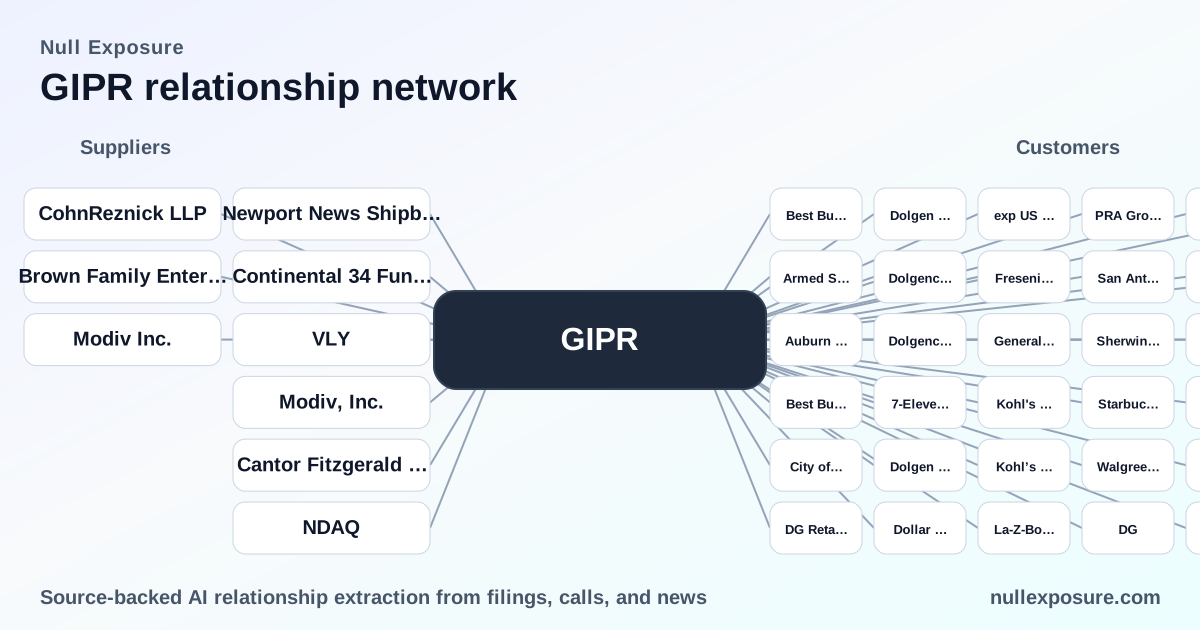
Generation Income Properties (GIPR): Tenant Map and Commercial Implications
Generation Income Properties operates as an internally managed REIT that acquires single-tenant retail, office and industrial properties and monetizes them through long‑term net leases, collecting fixed and variable rental income while transferring most operating costs to tenants. Revenue is concentrated in a small set of large, often investment‑grade counterparties and government leases, which drives stable cash flow but creates concentration and counterparty risk for investors. For a deeper look at tenant-level exposure and strategic signals, visit https://nullexposure.com/.
Quick read: what the tenant list tells you
GIPR’s portfolio is heavily skewed toward national retailers, a handful of large institutional and government tenants, and municipal obligations that together represent a large share of annualized base rent. Occupancy runs near 99%, leases are structured for the long term, and recent asset sales and lease extensions indicate active portfolio management and debt reduction.
Tenant by tenant: concise commercial summaries
Below are plain‑English takeaways for every tenant relationship identified in GIPR public filings and press releases.
-
Best Buy Co., Inc. — Best Buy is a multi‑location tenant in GIPR’s portfolio; two Best Buy leases comprised 60,960 sq ft and accounted for roughly 11% of portfolio area and 9% of 2024 annualized base rent, per GIPR’s 2024 10‑K.
Source: GIPR 2024 Form 10‑K (Tenants table, FY2024). -
Best Buy Stores, L.P. — A formal lease vehicle for Best Buy, cited in a 2006 lease agreement in the 10‑K, reflecting GIPR’s use of long dated commercial leases with corporate guarantors.
Source: GIPR 2024 Form 10‑K (Lease Agreement excerpt). -
Armed Services YMCA of the U.S.A. — A single long‑term tenant occupying 22,247 sq ft and contributing ~3% of 2024 ABR, indicating GIPR’s occasional non‑retail social/civic tenants.
Source: GIPR 2024 Form 10‑K (Tenants table, FY2024). -
Auburn University — A single‑tenant industrial building leased to Auburn University (59,091 sq ft) was listed in the 10‑K and later reported sold in May 2025 as part of a two‑asset disposition for ~$10.5 million.
Source: GIPR 2024 Form 10‑K; May 2025 AccessWire/press release. -
City of San Antonio — The city is a major municipal tenant and, together with GSA and Dollar General, was reported as one of the top contributors to annualized base rent (part of the group representing ~39% of ABR at year‑end 2024).
Source: GIPR 2024 Form 10‑K (Tenants and top‑tenant disclosure). -
7‑Eleven Corporation / 7‑Eleven — A small footprint location (3,000 sq ft) accounted for ~2% of 2024 ABR; separate press commentary notes the 7‑Eleven in Washington, D.C. became unencumbered after related debt retirements.
Source: GIPR 2024 Form 10‑K; Q2 2025 business update (Newswire). -
DG Retail, LLC / Dollar General / DG — Dollar General entities appear throughout filings and releases as a major rent contributor; Dollar General is consistently listed among GIPR’s largest tenants and was part of the top‑tenant group representing a material share of ABR.
Source: GIPR 2024 Form 10‑K and multiple investor releases (FY2024–FY2025). -
Dolgen California, LLC; Dolgencorp, LLC.; Dolgencorp of Texas, Inc; Dolgen Midwest, LLC — Multiple Dollar General / Dolgen affiliate leases appear across states, cumulatively representing several leases and low single‑digit percentage ABR contributions per entity.
Source: GIPR 2024 Form 10‑K (Tenants table, FY2024). -
Walgreens Co. — A Walgreens location (14,490 sq ft) contributed ~4% of ABR in 2024, reflecting exposure to national pharmacy footprints.
Source: GIPR 2024 Form 10‑K (Tenants table, FY2024). -
Dollar Tree Stores, Inc. — A single Dollar Tree lease (10,906 sq ft) provided ~1% of 2024 ABR, illustrating diversification among value‑retail tenants.
Source: GIPR 2024 Form 10‑K (Tenants table, FY2024). -
exp US Services / exp U.S. Services, Inc. — A 33,118 sq ft tenant accounted for ~6% of portfolio area and ~10% of 2024 ABR, and company statements in mid‑2025 reiterated exp U.S. Services as part of the top tenant cohort.
Source: GIPR 2024 Form 10‑K; Q2 2025 investor update (Yahoo Finance). -
Fresenius Medical Care Holdings, Inc. / Fresenius Medical Care (FMS) — A medical tenant of ~10,947 sq ft provided ~3% of ABR in 2024; GIPR announced an extension retaining the FMS lease through October 31, 2033 in a 2025 release.
Source: GIPR 2024 Form 10‑K; AccessWire release (Aug 2025). -
General Services Administration (GSA) — The GSA accounts for multiple leased facilities and is explicitly cited among the largest tenants, reflecting direct government counterparty exposure that contributes materially to portfolio ABR.
Source: GIPR 2024 Form 10‑K (top‑tenant disclosure). -
Kohl’s Corporation / Kohl's — A large Kohl’s lease (88,408 sq ft) represented ~16% of portfolio area and ~10% of 2024 ABR, a single‑tenant exposure that ranks among the largest line items in GIPR’s rent roll.
Source: GIPR 2024 Form 10‑K (Tenants table, FY2024). -
La‑Z‑Boy Inc. — A single La‑Z‑Boy leased location (15,288 sq ft) represented a mid‑single digit ABR contribution, consistent with GIPR’s strategy of national single tenants.
Source: GIPR 2024 Form 10‑K (Tenants table, FY2024). -
PRA Group, Inc. — PRA Group leased a ~34,847 sq ft asset that contributed ~9% of 2024 ABR, making it a material single tenant by rent.
Source: GIPR 2024 Form 10‑K (Tenants table, FY2024). -
Starbucks Corporation / SBUX / Starbucks — Starbucks appears as a two‑location tenant (4,842 sq ft total) and one Starbucks asset was included in a May 2025 sale; Starbucks contributed a modest share of ABR.
Source: GIPR 2024 Form 10‑K; May 2025 disposal announcement (AccessWire). -
San Antonio Early Childhood Education Municipal Development Corporation — A municipal development corporation leased a 50,000 sq ft property representing ~9% of portfolio area and ~11% of 2024 ABR, underscoring municipal credit exposure.
Source: GIPR 2024 Form 10‑K (Tenants table, FY2024). -
Sherwin‑Williams Company — A small Sherwin‑Williams lease (~3,500 sq ft) accounted for ~1% of ABR in 2024.
Source: GIPR 2024 Form 10‑K (Tenants table, FY2024). -
Quanta Services / PWR — Quanta is listed as a small tenant (7,826 sq ft, ~2% of ABR), reflecting industrial/service sector exposure.
Source: GIPR 2024 Form 10‑K (Tenants table, FY2024). -
919 Investments LLC — 919 Investments is cited in an August 2025 notice terminating a previously announced purchase and sale agreement for a Fresenius‑leased Chicago property, illustrating active transaction negotiations and occasional failed divestitures.
Source: AccessWire release (Aug 18, 2025). -
Other ticker aliases (BBY, SBUX, DG, GSA, FMS, PWR) — Multiple news items and market summaries reference ticker aliases such as BBY, SBUX, DG, GSA and PWR in coverage of acquisitions, lease extensions and the FY2025–FY2026 portfolio updates; these represent the same tenant relationships captured under legal names above.
Source: TradingView, Globe and Mail and other market news items (2025–2026).
Operational constraints and what they imply for investors
GIPR’s public filings and releases reveal consistent company‑level characteristics investors should treat as structural:
-
Long‑term contracting posture. GIPR records leases as long‑term net operating leases with disclosed future minimum rents through 2029 and thereafter, indicating predictable near‑term cash flows from existing contracts.
Source: GIPR 2024 Form 10‑K (Future Minimum Rents). -
Geographic focus: United States only. All properties and regulatory exposure sit inside the U.S., concentrating political and economic risk domestically.
Source: GIPR 2024 Form 10‑K (geography disclosure). -
Material concentration. Top tenants collectively contributed roughly 39% of annualized base rent as of December 31, 2024, creating meaningful single‑tenant and sector concentration risk.
Source: GIPR 2024 Form 10‑K (Top‑tenant disclosure). -
Government counterparty exposure. The portfolio includes multiple GSA leases and other municipal tenants, establishing government credit exposure that impacts risk/return differently than retail-only rolls.
Source: GIPR 2024 Form 10‑K (GSA disclosure); Q2 2025 investor update. -
Active asset management. In 2025 GIPR sold two assets for ~$10.5M, retired CMBS debt and executed lease extensions (Best Buy, Fresenius), demonstrating portfolio rotation and balance sheet repair as a stated strategy.
Source: May–Aug 2025 company press releases (AccessWire, Newswire).
Place to learn more on tenant analytics: https://nullexposure.com/.
Investment implications — what matters now
- Stability vs. concentration: Long leases and high occupancy support stable cash flows, but top‑tenant concentration and municipal/government exposure require close monitoring for policy or credit shifts.
- Execution risk: Asset sales and debt retirements indicate management is actively reshaping the balance sheet; investors should watch disposition proceeds and remaining leverage.
- Tenant quality mix: A meaningful portion of ABR is with investment‑grade or municipal counterparties, which reduces default risk but does not eliminate the impact of losing any of the largest tenants.
Conclusion: GIPR is a classic single‑tenant net‑lease REIT with predictable lease cash flows and concentrated counterparty exposure; valuation and risk depend on the company’s ability to recycle capital and maintain or extend leases with its largest tenants. For ongoing monitoring of tenant exposures and material filings, explore https://nullexposure.com/.