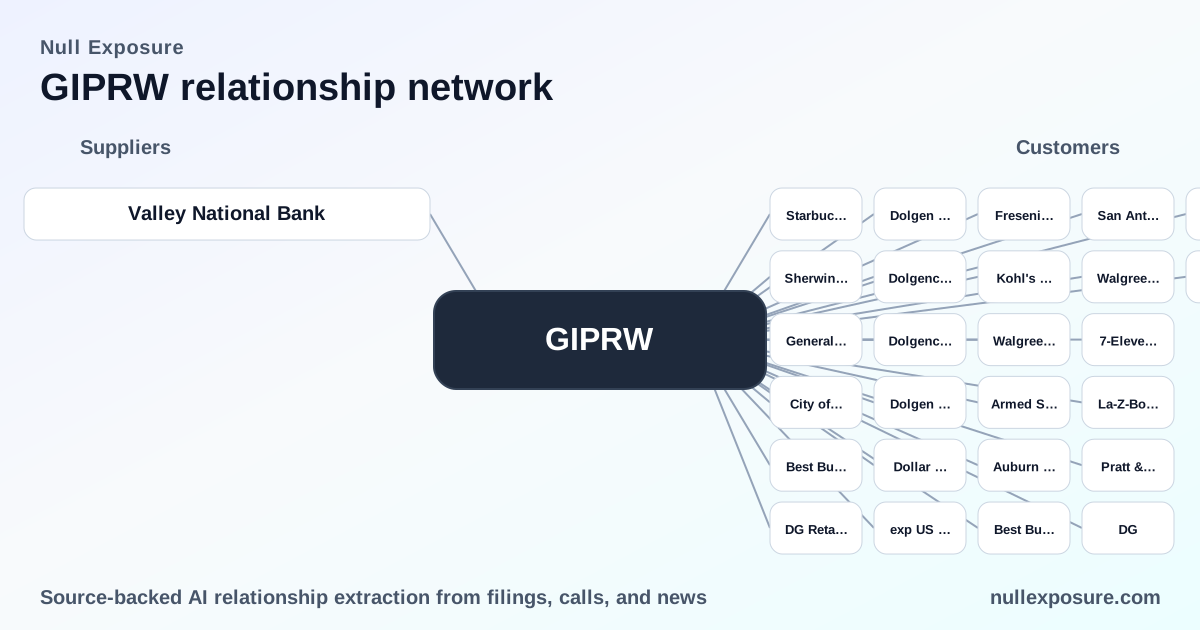
What GIPRW Investors Need to Know About Generation Income Properties’ Tenant Base
Generation Income Properties (GIP) operates as an internally managed real estate investment trust that acquires single-tenant retail, office and industrial properties and monetizes them primarily through long‑term net leases that generate steady base rent and occasional property sale gains. The company emphasizes high occupancy, concentrated but credit‑rated tenants and in‑house property management, creating an income‑centered profile that underpins the warrant GIPRW’s exposure to the equity economics. For more on how we surface tenant exposure across portfolios, visit https://nullexposure.com/.
Why tenants define the risk/reward for this warrant
GIP’s cash flow depends on a small number of meaningful leases: three tenants (the General Services Administration, Dollar General and the City of San Antonio) collectively supplied roughly 39–40% of annualized base rent as of December 31, 2024, per the company’s FY2024 filing. The portfolio is reported at 99% occupancy, and leases are accounted as long‑term net leases, which favors durable rent visibility but concentrates counterparty and geographic risk in U.S. markets. These characteristics make tenant credit and lease duration the primary drivers of valuation and downside risk for equity and warrant holders.
How the company runs its landlord business (constraints that matter)
GIP’s operating posture is clear: it acts as the lessor/seller of income-producing real estate, maintaining operations internally for most properties while outsourcing or otherwise excluding management for a handful of locations. The company explicitly reports long‑term lease structures, a U.S. (North American) geographic focus, and material concentration with several tenants each constituting more than 10% of rental revenue. One corporate implication: rental cash flow is predictable so long as key tenants perform, but portfolio concentration means tenant defaults would be highly material.
For a direct read of the filing that underpins these signals, review Generation Income Properties’ FY2024 Form 10‑K.
Tenant roll call — line‑by‑line takeaways from the FY2024 10‑K
Below are concise, plain‑English summaries for every tenant relationship reported in the FY2024 Form 10‑K excerpts, with the source noted for each entry.
Sherwin Williams Company
GIP holds a small retail lease to Sherwin Williams covering 3,500 sq ft that represented less than 1% of portfolio square footage but generated approximately $126,788 in 2024 base rent. According to Generation Income Properties’ 2024 Form 10‑K, Sherwin Williams is a minor, revenue‑contributing tenant.
City of San Antonio
The City of San Antonio is listed among GIP’s largest tenants and, together with top counterparts, contributed materially to annualized base rent — part of the group producing roughly 39–40% of portfolio rent. This appears in the company’s FY2024 10‑K disclosure.
General Services Administration (GSA)
The GSA is a strategic government tenant named among the top contributors to portfolio rent, with multiple properties listed in Norfolk, Manteo and Vacaville; this supports the company’s government counterparty signal. The FY2024 10‑K describes GSA as one of the largest tenants.
Starbucks Corporation
GIP reports two Starbucks leases totaling about 4,842 sq ft and representing roughly 4% of annual base rent (about $348,966 in 2024), positioning Starbucks as a meaningful retail tenant in the portfolio per the 2024 10‑K.
Best Buy Stores, L.P.
A Best Buy Stores, L.P. lease is recorded in a historical lease agreement (2006); Best Buy is a material retail occupier in the portfolio. The agreement and Best Buy’s occupancy are described in the FY2024 10‑K.
DG Retail, LLC
DG Retail, LLC operates a roughly 9,026 sq ft store that accounted for about 2% of portfolio square footage and roughly 1% of annual base rent in 2024, per the company’s 10‑K.
Dolgen California, LLC
Dolgen California occupies an 18,827 sq ft site and produced about $361,075 in 2024 base rent — roughly 4% of annual base rent — as stated in the FY2024 10‑K.
Dolgencorp, LLC.
Dolgencorp, LLC. is listed with a ~9,100 sq ft lease contributing approximately $85,998 of base rent in 2024, according to the 10‑K.
Dolgencorp of Texas, Inc
Dolgencorp of Texas, Inc is recorded with a ~9,026 sq ft location contributing roughly $86,041 in 2024 base rent, per the FY2024 filing.
Dolgen Midwest, LLC
Dolgen Midwest operates four leases totaling 36,178 sq ft and contributed about $358,719 in base rent (≈4% of annual base rent) in 2024, per the 10‑K.
7‑Eleven Corporation
A small 3,000 sq ft 7‑Eleven lease generated approximately $129,804 in 2024 base rent, representing a modest but stable convenience‑store cash flow item in the portfolio (FY2024 10‑K).
Armed Services YMCA of the U.S.A.
Armed Services YMCA occupies ~22,247 sq ft and contributed roughly $274,380 in 2024 base rent, a mid‑sized non‑profit tenant referenced in the FY2024 10‑K.
Auburn University
Auburn University occupies a large facility (59,091 sq ft) that began tenancy in August 2024 after Pratt & Whitney vacated, generating about $283,500 in 2024 rent and reflecting a transition in tenant mix described in the 10‑K.
Best Buy Co., Inc.
Best Buy Co., Inc. is reported with two leases totaling 60,960 sq ft and delivering about $758,533 in annual base rent (≈9% of total base rent), making Best Buy one of the largest single customers in the portfolio per the FY2024 filing.
Kohl’s Department Stores, Inc.
Kohl’s appears in historical sublease documentation; the 10‑K cites a sublease dating from 2003, indicating Kohl’s presence in some contractual records though not quantified in the excerpt.
La‑Z‑Boy Inc.
La‑Z‑Boy leases a retail property in Rockford, IL and the company purchased the remaining TIC interest in that property for $1,318,367, per the FY2024 10‑K, signifying a full ownership move to secure that tenancy.
Pratt & Whitney Automation, Inc.
Pratt & Whitney Automation vacated a Huntsville, AL site in January 2024; the vacancy was subsequently filled by Auburn University in August 2024, as disclosed in the 10‑K.
San Antonio Early Childhood Education Municipal Development Corporation
This municipal corporation leases a large 50,000 sq ft site that generated about $924,000 in 2024 base rent — roughly 11% of annual base rent and one of the single largest tenant contributions noted in the 10‑K.
Walgreens (site level)
A Walgreens retail site in Santa Maria, CA (14,490 sq ft) produced roughly $369,000 in 2024 base rent; the company lists five Walgreens locations across the portfolio in its property schedule (FY2024 10‑K).
Walgreens Co.
Walgreens Co. is also recorded as a portfolio tenant in the 10‑K with a 14,490 sq ft lease producing about $369,000 in base rent (≈4% of total annual base rent), confirming Walgreens’ material presence.
Dollar Tree Stores, Inc.
Dollar Tree is recorded with a ~10,906 sq ft lease that generated about $103,607 in 2024 base rent, per the FY2024 filing.
exp US Services, Inc.
exp US Services occupies roughly 33,118 sq ft and contributed about $864,583 in 2024 base rent — approximately 10% of portfolio base rent and therefore a major tenant according to the 10‑K.
Fresenius Medical Care Holdings, Inc.
Fresenius Medical Care occupies about 10,947 sq ft and generated $233,480 in 2024 base rent, a specialized healthcare tenant recorded in the 10‑K.
Dollar General
Dollar General is listed among the company’s largest tenants and, together with GSA and the City of San Antonio, is part of the cohort that contributed approximately 39–40% of portfolio annualized base rent as disclosed in the FY2024 10‑K.
DG (duplicate entry)
DG is separately recorded (same entity) and appears in the FY2024 10‑K alongside the Dollar General listing as a principal tenant accounting for material base rent.
La‑Z‑Boy (LZB) — tickered entry
La‑Z‑Boy is also referenced with ticker LZB in the filing and documented in the Rockford, IL purchase of the TIC interest for $1,318,367, per the 10‑K.
LZB (duplicate)
LZB appears again as a separate indexed result; the underlying disclosure is the same purchase and tenancy detail in the company’s FY2024 filing.
BBY (ticker entry)
The 10‑K describes a 30,465 sq ft Best Buy property acquired in Ames, Iowa during 2024 for approximately $5.5–$5.6 million and occupied by Best Buy with roughly six years remaining on the lease, highlighting targeted acquisitions of income‑producing retail (FY2024 10‑K).
Best Buy (duplicate)
Best Buy is also returned as a non‑tickered entry; the FY2024 10‑K treats Best Buy as a material retail tenant with multiple referenced properties.
Bottom line for investors
Generation Income Properties runs a classic single‑tenant net‑lease REIT play: predictable cash flows from long‑term leases, a U.S. retail/industrial/office footprint, and concentration risk driven by a handful of large tenants (GSA, Dollar General, Best Buy, municipal tenants and exp US Services). Primary risks for warrant and equity holders are tenant credit deterioration and the impact of losing a top tenant that together account for a large share of base rent; primary strengths are long‑dated nets, high occupancy and a pipeline of portfolio acquisitions designed to preserve yield.
For a structured view of tenant exposure and to track changes across filings, see our company coverage hub at https://nullexposure.com/.