General Mills (GIS): Retail-driven scale, concentrated buyers, and a retailer-led reformulation risk
General Mills is a global branded packaged-foods company that monetizes through large-scale retail and foodservice distribution of household brands, supplemented by targeted direct-to-consumer retail for premium products. The company generates the bulk of revenue from branded grocery and mass‑merchandiser sales, operates with healthy operating margins (around 19% operating margin TTM) and material scale (roughly $18.4B revenue TTM), while customer concentration and retailer-driven product requirements shape commercial and supply-chain dynamics. Learn more about our coverage at https://nullexposure.com/.
How General Mills sells — a commercial profile investors should read plainly
General Mills is a seller to major retail, mass and foodservice channels rather than a niche supplier. Its public disclosures show sales dominated by North America (United States net sales reported at roughly $15.8B versus $3.7B non‑U.S.), and the company lists grocery chains, mass merchandisers, membership stores, e‑commerce retailers, and foodservice distributors as its primary customers. The commercial posture is direct: General Mills typically sells through a direct sales force to large retailers and distributors, with supplemental routes to market via distributors, operators and owned retail shops for super‑premium ice cream and frozen desserts.
- Distribution and channel breadth are strengths: multiple customer channels reduce single‑channel dependence and support shelf presence across formats.
- Concentration is a material governance factor: five largest customers account for roughly 55% of net sales, and while Walmart is singled out as a top customer, no other single customer besides Walmart crosses the 10% threshold in filings — a structural leverage point in buyer negotiations.
- Geography is both North America‑centric and global: General Mills is a leading global brand with presence in more than 100 countries, while North America remains the revenue engine; Latin America and the Caribbean are noted export markets and joint‑venture destinations.
These commercial characteristics create a business that is resilient at scale but exposed to retailer product policies, private‑label competition, and reformulation waves that large buyers can set.
What the sourced customer signals show — every relationship surfaced
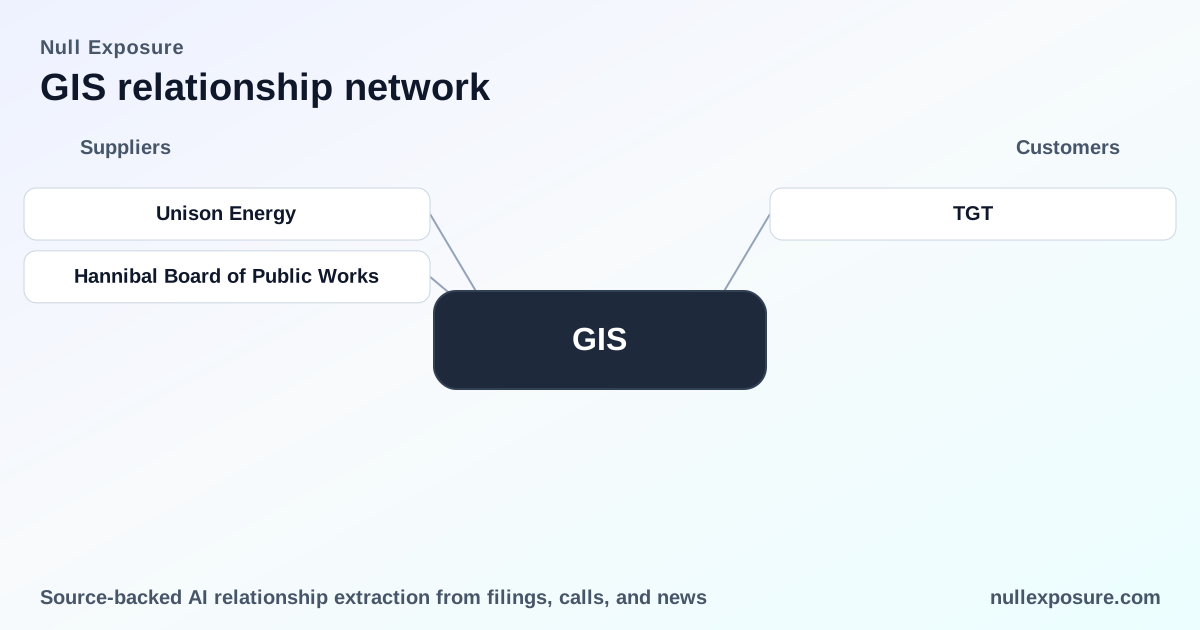
The raw results returned two related news mentions referencing Target Corporation (TGT). Both entries point to the same retailer action; we include both items from the record.
Target — news mention (first item) General Mills’ Lucky Charms is explicitly named among products that Target has said will remove artificial colors, with Target targeting completion for Lucky Charms by 2027. This is a retail‑driven reformulation mandate that affects product formulation, ingredient sourcing and potentially SKU economics. (Finviz news report, March 9, 2026.)
Target — news mention (second item) A duplicate news sentiment entry reiterates that Target plans to phase out artificial colors from certain products on its shelves, including General Mills’ Lucky Charms, with a 2027 completion target for that SKU. The coverage underscores retailer-level commitments that impose timelines on suppliers. (Finviz news report, March 9, 2026.)
Why these retailer actions matter to investors and operators
Retailer product requirements translate directly into supply‑chain change and incremental cost. When a major buyer like Target imposes ingredient or labeling standards and a specific deadline (Lucky Charms targeted for 2027), General Mills must execute reformulation programs, revalidate manufacturing processes, and absorb or reallocate costs across SKUs. For a company that sells through a direct sales force into big-box and supermarket channels, these timelines become operational priorities across R&D, procurement and quality.
- Margin impact: reformulation can shift ingredient costs and packaging, pressuring near‑term gross margins until scale and procurement adjustments settle.
- Shelf and assortment risk: retail mandates can spur private‑label producers or competitors that adapt faster to capture incremental shelf space.
- Supply‑chain complexity: global sourcing footprints and multiple manufacturing sites require synchronized rollouts to meet a retailer’s deadline across SKUs and geographies.
Company-level constraints and what they signal for relationships
The extracted constraints give high‑level signals about General Mills’ operating model rather than any single relationship:
- Channel roles: the company functions both as a seller to retailers and as a supplier to distributors and operators; it also runs direct retail for premium ice cream, indicating mixed counterparty types including individual consumers.
- Customer concentration: the top five customers account for ~55% of net sales, creating material counterparty exposure and bargaining dynamics with the largest chains.
- Geographic mix: the business is North America‑centric but inherently global, with manufacturing for export to Latin America and a brand presence in 100 countries.
- Relationship maturity and stage: most customer relationships are active, long‑standing commercial contracts with established grocery and mass channels rather than one‑off transactional sales.
Taken together, these constraints portray a firm with scale and channel breadth but material dependency on a small set of large retailers, which drives both negotiating dynamics and strategic priorities (e.g., reformulation, label changes, sustainability commitments).
Operational signals to monitor continuously
Investors and commercial operators should track a short list of tactical indicators that flow directly from the retailer‑led relationship model:
- Retailer policy deadlines and product mandates (the Target 2027 timeline is a live example).
- Changes in the retailer mix among the top five customers — any shift moves concentration risk metrics and bargaining power.
- Reformulation cost pass‑throughs and margin reconciling in quarterly reporting.
- Shelf‑space wins or losses versus private label at major chains.
- Execution cadence across manufacturing sites for coordinated SKU transitions.
These are the variables that will determine whether reformulation and retailer demands are a temporary margin headwind or a persistent operating cost.
Bottom line — position and path
General Mills is a scale branded‑foods operator with strong profitability and significant retailer exposure. That exposure is a double‑edged sword: it gives the company access to massive distribution and consistent volume, but also concentrates commercial risk in a handful of large buyers that set product and timing requirements. The Target action on artificial colors is a clear contemporary example of how retailer mandates drive supplier agendas and operational investment.
For investors and operators, the critical evaluation is not whether General Mills can comply — it will — but how reformulation costs are managed, how price and promotional strategies preserve margins, and whether the company leverages its scale to convert retailer demands into broader brand advantages. For a deeper, relationship‑level view of retailer interactions and commercial risk, visit https://nullexposure.com/.