Gladstone Capital (GLAD): Customer relationships that define a middle‑market credit play
Gladstone Capital operates as a publicly traded business development company that originates and holds bespoke debt and selective equity positions in lower middle‑market U.S. businesses, monetizing through coupon income, origination and commitment fees, and periodic realized gains on equity exits while returning cash to investors via dividends. For investors evaluating counterparty risk, GLAD’s posture is concentrated, U.S.‑centric, and credit‑first, with a portfolio construction that emphasizes first‑lien and secured structures across services and consumer‑facing firms. Learn more coverage at https://nullexposure.com/.
How GLAD underwrites and runs relationships — the operating constraints that matter
GLAD’s operating model is consistent and predictable: long‑term loans (up to seven years) priced off variable SOFR floors, focused on lower middle‑market companies with EBITDA typically $3–$25 million, and a geographically U.S. footprint. Several company‑level signals flow directly from GLAD’s public disclosures:
- Contracting posture: portfolio instruments are generally longer‑dated (up to seven years) and use variable rates tied to SOFR, supporting durable spread capture but exposing GLAD to rate cycles.
- Counterparty focus: the firm targets mid‑market borrowers — a deliberate risk/return tradeoff that allows higher yield but concentrates credit risk.
- Geography and segment: GLAD is effectively a U.S. lender to services and consumer‑oriented businesses.
- Materiality and concentration: publicly reported data shows no single investment exceeded 10% of portfolio fair value at 9/30/2025, signaling portfolio diversification at the line‑item level, while company commentary acknowledges concentrated exposures within sectors such as discretionary consumer.
- Role and stage: GLAD acts as lender and occasional equity participant, providing managerial assistance when warranted, and maintains an active portfolio of approximately 55 companies as of fiscal year end.
These characteristics define where GLAD generates returns and where downside risk concentrates: credit performance of mid‑market borrowers and consumer spending trends.
Recent portfolio actions — deliberate lending, opportunistic exits
GLAD’s quarterly and fiscal press releases document both new secured first‑lien investments and completed payoffs/realizations, underscoring active portfolio management rather than passive hold‑to‑maturity behavior. Investors should note a string of targeted first‑lien financings in FY2026 alongside several payoffs at par, which together tighten yield realization while refreshing risk exposure.
If you want a consolidated view of GLAD’s portfolio activity, visit https://nullexposure.com/ for deeper analysis.
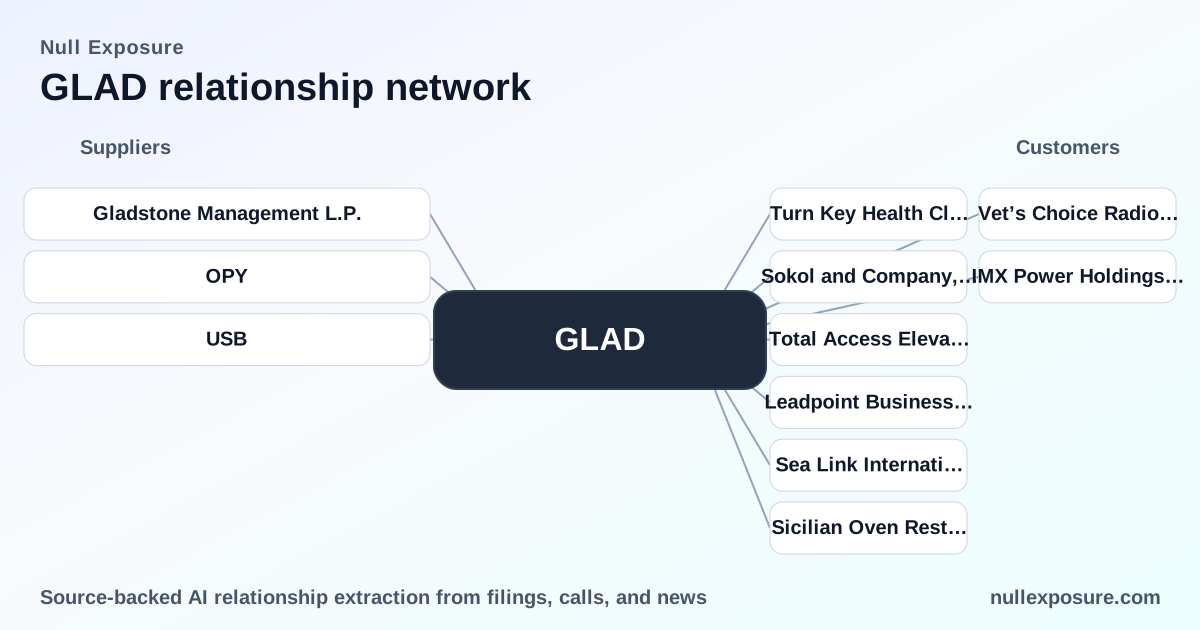
Relationship roster — what GLAD is lending to and where capital realized value
-
Wings ‘N More Restaurants LLC — GLAD provided debt financing to Wings ‘N More as part of a growth investment alongside Goode Partners to support geographic expansion of the brand. According to a RestaurantNews report, the debt financing is intended to accelerate expansion initiatives (RestaurantNews.com, FY2024 press report: https://www.restaurantnews.com/goode-partners-announces-strategic-investment-in-wings-n-more-to-accelerate-growth-120224/).
-
Turn Key Health Clinics — GLAD invested $15.0 million in Turn Key Health Clinics as a secured first‑lien loan in November 2025, reflecting continued support for an existing portfolio company. The company disclosed this transaction in its fiscal reporting (PalmBeachDailyNews press release, March 2026: https://www.palmbeachdailynews.com/press-release/story/13594/gladstone-capital-corporation-reports-financial-results-for-its-fourth-quarter-and-fiscal-year-ended-september-30-2025/).
-
Turn Key Health Clinics (coverage note) — Financial commentary highlighted GLAD’s $15.0 million post‑quarter investment in Turn Key Health Clinics as part of broader post‑quarter financings, and flagged the exposure as representative of GLAD’s lower middle‑market, consumer‑sensitive portfolio companies (24/7 Wall St., March 23, 2026: https://247wallst.com/investing/2026/03/23/federal-reserve-interest-rate-freeze-tests-gladstone-capitals-road-to-recovery/).
-
Sicilian Oven Restaurants — GLAD committed $26.6 million to Sicilian Oven through secured first‑lien debt and preferred equity in November 2025, a larger consumer hospitality exposure that expands GLAD’s restaurant holdings (PalmBeachDailyNews press release, March 2026: https://www.palmbeachdailynews.com/press-release/story/13594/gladstone-capital-corporation-reports-financial-results-for-its-fourth-quarter-and-fiscal-year-ended-september-30-2025/).
-
Sicilian Oven Restaurants (coverage note) — Independent market commentary grouped Sicilian Oven with other discretionary consumer exposures funded post‑quarter, highlighting concentrated credit exposure to sectors sensitive to household budgets (24/7 Wall St., March 23, 2026: https://247wallst.com/investing/2026/03/23/federal-reserve-interest-rate-freeze-tests-gladstone-capitals-road-to-recovery/).
-
Leadpoint Business Services, LLC — GLAD reported that its $28.1 million debt investment in Leadpoint paid off at par in October 2025, realizing capital returned to the fund without impairment (PalmBeachDailyNews press release, March 2026: https://www.palmbeachdailynews.com/press-release/story/13594/gladstone-capital-corporation-reports-financial-results-for-its-fourth-quarter-and-fiscal-year-ended-september-30-2025/).
-
Sea Link International IRB, Inc. — GLAD’s debt investment in Sea Link paid off at par in October 2025, representing another realized repayment event in the portfolio (PalmBeachDailyNews press release, March 2026: https://www.palmbeachdailynews.com/press-release/story/13594/gladstone-capital-corporation-reports-financial-results-for-its-fourth-quarter-and-fiscal-year-ended-september-30-2025/).
-
Sokol and Company, LLC — GLAD completed the sale of its remaining common equity in Sokol and Company in October 2025, returning its $0.5 million cost basis and recording a realized gain of approximately $1.8 million, illustrating the firm’s occasional equity upside capture (PalmBeachDailyNews press release, March 2026: https://www.palmbeachdailynews.com/press-release/story/13594/gladstone-capital-corporation-reports-financial-results-for-its-fourth-quarter-and-fiscal-year-ended-september-30-2025/).
-
Total Access Elevator, LLC — In October 2025 GLAD invested $11.0 million in Total Access through secured first‑lien debt, reinforcing exposure to services businesses with steady cash flow profiles (PalmBeachDailyNews press release, March 2026: https://www.palmbeachdailynews.com/press-release/story/13594/gladstone-capital-corporation-reports-financial-results-for-its-fourth-quarter-and-fiscal-year-ended-september-30-2025/).
-
IMX Power Holdings Inc. — GLAD extended a $6.0 million secured first‑lien loan to IMX in January 2026 and provided undrawn line and delayed‑draw commitments totaling $4.5 million, demonstrating flexible financing structures to support capex or working capital (DesertSun press release covering Q1 results, March 2026: https://www.desertsun.com/press-release/story/80074/gladstone-capital-corporation-reports-financial-results-for-its-first-quarter-ended-december-31-2025/).
-
Vet’s Choice Radiology LLC — GLAD’s $42.8 million debt investment in Vet’s Choice Radiology paid off at par in January 2026 and included a $0.9 million prepayment penalty, representing a material single payoff event returning capital and incremental fee income (DesertSun press release covering Q1 results, March 2026: https://www.desertsun.com/press-release/story/80074/gladstone-capital-corporation-reports-financial-results-for-its-first-quarter-ended-december-31-2025/).
Portfolio implications for investors
GLAD’s activity demonstrates a consistent playbook: secured, first‑lien lending to mid‑market U.S. companies with selective preferred equity participation and active portfolio recycling through payoffs and realizations. Key investor takeaways:
- Yield engine: variable‑rate loans indexed to SOFR underpin current income and protect yield in rising‑rate regimes.
- Concentration risks: sector clustering in consumer discretionary (restaurants) and services creates cyclical exposure; recent investments in Sicilian Oven and Wings ‘N More underscore this.
- Diversification signal: public disclosure that no single investment exceeded 10% of portfolio fair value at 9/30/2025 reduces idiosyncratic tail risk at the portfolio level.
- Active management: recent payoffs and realized gains show GLAD converts positions to liquidity and redeploys capital, supporting dividend sustainability.
Bottom line
Gladstone Capital operates as a disciplined, credit‑focused BDC with a clear lower middle‑market mandate: first‑lien secured lending, selective equity, U.S. services and consumer targets, and active portfolio turnover. Investors should weigh the income profile and realized gains track record against concentration in discretionary sectors and the underlying credit cycle. For a consolidated investor brief and continuous monitoring of GLAD customer relationships, visit https://nullexposure.com/.