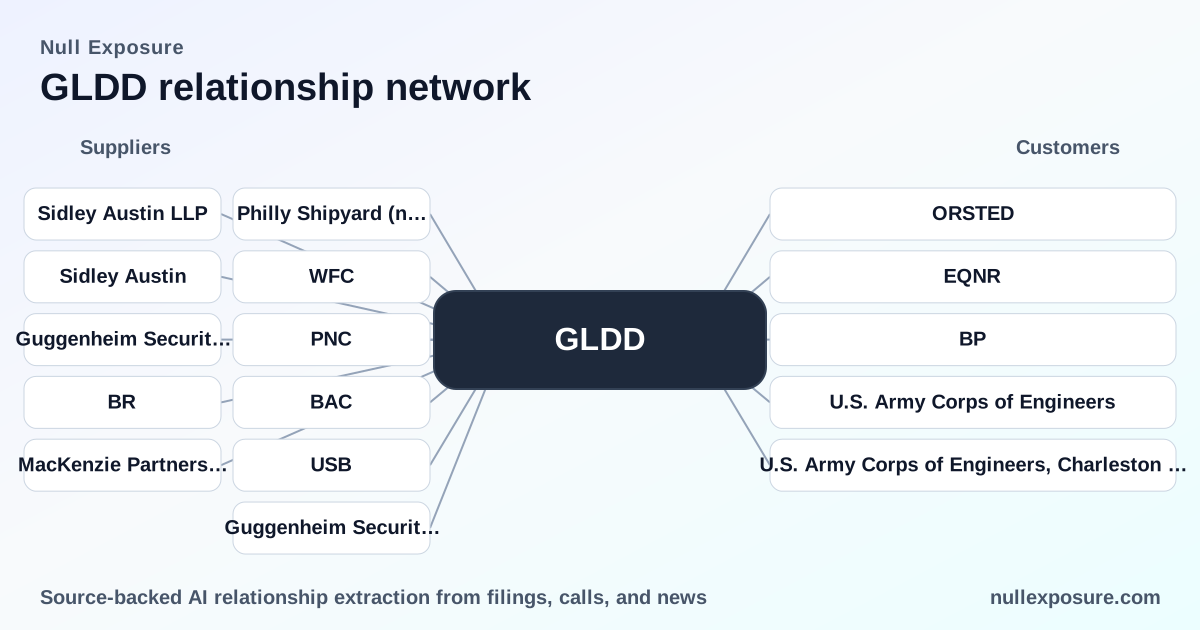
Great Lakes Dredge & Dock (GLDD): customer relationships that shape revenue and risk
Great Lakes Dredge & Dock monetizes heavy marine-construction expertise by contracting onshore and offshore dredging, rock placement and coastal resilience projects—primarily as a service provider to federal, state and private customers. The business converts a mix of short-duration contracts and a large backlog into near-term cash flow; its highest-impact relationships are with government agencies and offshore energy developers whose programs determine backlog and utilization. For a concise view of GLDD’s customer footprint and what it implies for investors, read on or visit https://nullexposure.com/ for our broader coverage.
How GLDD runs the business and why the customer map matters
Great Lakes operates a single services segment focused on dredging and related marine construction. Several company-level operational characteristics drive investment outcomes:
- Contracting posture: short-duration, project-based work. The company states most contracts complete within a year, which limits multi-year revenue visibility but allows rapid redeployment of vessels and crews.
- Counterparty concentration: government-heavy revenue mix. Federal agencies were ~57% of revenue in 2024 and account for over half of backlog, creating revenue stability from appropriations but also exposure to cancelable public contracts.
- Geographic focus: primarily North America. No foreign revenues recognized in 2024; international work is episodic rather than core.
- Materiality and criticality: substantial backlog but cancellable government work. The company reported $1.19 billion of remaining performance obligations at year‑end 2024; government projects are material but can be canceled without penalty, though GLDD can recover committed costs.
- Maturity and role: established service provider with specialized assets. GLDD is the largest U.S. dredging contractor and is critical to coastal resilience and offshore wind foundation works, but its business is fundamentally tied to project cycles.
These attributes explain why backlog composition, appropriations and the offshore wind pipeline are the key drivers of earnings and valuation for GLDD.
Customer relationships that matter — line by line
Below I list each relationship referenced in public sources, with a plain-English summary and a source note for due diligence.
bp — Empire Wind II termination (10‑K, FY2024)
GLDD disclosed that client actions by Equinor and bp led to termination of the Empire Wind II contract, which reset plans for the related wind farm and removed an anticipated revenue stream. According to GLDD’s 2024 Form 10‑K, the termination materially affected project plans (FY2024, 10‑K filing).
OMEX — collaboration for potential offshore mineral lease dredging (Cyprus Shipping News, Dec 2025)
Odyssey Marine Exploration has a collaboration agreement with GLDD to provide dredging services if an offshore mineral-lease project advances, positioning GLDD as the likely service provider should a lease be awarded. Cyprus Shipping News reported the collaboration in late 2025, describing GLDD’s role as contingent on project progress (Dec 18, 2025).
EQNR — rock placement work for Equinor projects (Maritime Executive, Mar 2026)
Maritime Executive reported that GLDD is executing rock placement at South Brooklyn Marine Terminal and on Empire Wind 1 for Equinor, underscoring active offshore-wind scope. The article highlights GLDD’s involvement in foundation and nearshore construction for Equinor projects (Mar 9, 2026).
Equinor — referenced termination and ongoing project activity (Maritime Executive, Mar 2026)
The same Maritime Executive coverage also notes Equinor as a client where GLDD conducts rock placement and related services; Equinor figures in both activity and earlier contract adjustments. Maritime Executive places Equinor at the center of several New York-area works noted in March 2026 (Mar 9, 2026).
ORSTED — vessel Acadia booked to Empire Wind 1 and Sunrise Wind (Maritime Executive, Mar 2026)
Maritime Executive reports GLDD’s vessel Acadia is scheduled to support Empire Wind 1 and then Ørsted’s Sunrise Wind, indicating multi-client scheduling across the offshore wind corridor. The booking demonstrates asset utilization tied to major developers (Mar 9, 2026).
Ørsted — same operational booking for Sunrise Wind (Maritime Executive, Mar 2026)
Ørsted is identified specifically as the Sunrise Wind client following Empire Wind 1 work, confirming GLDD’s bookings with multiple leading offshore-wind operators. The Maritime Executive piece cites the sequential Acadia schedule for these projects (Mar 9, 2026).
OMEX — collaboration mention in MarineLink (MarineLink, FY2025)
MarineLink reiterated the Odyssey–GLDD collaboration, noting GLDD’s contingency role in servicing any future leasing activity, which reinforces GLDD’s positioning for niche offshore opportunities. MarineLink covered the collaboration in early 2026 reporting on Odyssey’s lease request (Mar 10, 2026).
OMEX — collaboration cited in Yahoo Finance summary (Yahoo Finance, FY2025)
A Yahoo Finance article summarized Odyssey’s lease filing and explicitly called out the GLDD collaboration as bolstering Odyssey’s capability to advance a project, signaling market recognition of GLDD’s operational credibility. Yahoo Finance ran the summary alongside the lease announcement in March 2026 (Mar 10, 2026).
U.S. Army Corps of Engineers — East Rockaway Inlet dredging (SimplyWallSt, FY2026)
Simply Wall St highlighted a $14 million East Rockaway Inlet dredging and beach replenishment project using a GLDD cutter-head dredge, which raised investor focus on the company’s contract pipeline. The coverage singled out GLDD’s equipment and contract linkage in early‑2026 commentary (Mar 9, 2026).
U.S. Army Corps of Engineers, Charleston District — North Myrtle Beach renourishment (DredgingToday, Jan 2026)
DredgingToday reported that GLDD’s renourishment work at North Myrtle Beach is fully funded by the Army Corps, illustrating direct federal project funding and coastal-resilience revenue. The article noted this local Corps-funded renourishment nearing completion (Jan 30, 2026).
U.S. Army Corps of Engineers — continued funding underpins demand (The Globe and Mail, FY2026)
The Globe and Mail quoted expectations that continued U.S. Army Corps funding and sustained coastal-resilience activity would support GLDD’s near-term demand and fourth-quarter performance. That market commentary linked federal appropriations to stability in GLDD’s project book (Mar 9, 2026).
Equinor — Empire Wind II termination disclosure (10‑K, FY2024)
GLDD’s 2024 Form 10‑K specifically states that Equinor (and bp) terminated the Empire Wind II contract, resetting the wind-farm plan and affecting GLDD’s expected workload from that project. This appears in the company’s FY2024 10‑K discussion of project cancellations and contract impacts.
EQNR — same 10‑K disclosure for Equinor reference (10‑K, FY2024)
The 10‑K also lists Equinor with ticker EQNR in the termination disclosure, linking the operator by name to the contract change; that filing is the primary source for the Empire Wind II termination narrative (GLDD FY2024 10‑K).
What investors should watch next
- Backlog composition and government appropriations. With $1.19 billion of remaining performance obligations, the real issue is whether federal and state funding remains steady and whether large wind developers sustain project schedules. Continued Corps funding is a near-term stabilizer.
- Offshore wind client mix and contract credo. Relationships with Equinor, Ørsted and vessel bookings like Acadia are value drivers when projects proceed, but GLDD’s exposure to contract terminations (e.g., Empire Wind II) is an execution and timing risk.
- Revenue volatility from short-term contracting. The short contract duration profile gives the company operational flexibility but creates earnings lumpyness; investors should monitor quarterly replenishment of backlog.
- Asset utilization and scheduling conflicts. Multi-project vessel bookings across developers increase utilization but create sequencing risk if projects are delayed or canceled.
If you want more granular mapping of GLDD’s counterparties and program exposure, see our coverage at https://nullexposure.com/ for deeper relationship analytics.
Bottom line
GLDD’s business is a service-led, contract-by-contract model where government funding and offshore-wind project schedules define near-term earnings. The company’s scale and asset base make it the go-to contractor for many federal and developer projects, but the combination of short-duration contracts and cancellable government work imposes revenue volatility that investors must price. Keep an eye on backlog replenishment, Corps appropriations and the recovery of the offshore-wind pipeline when assessing upside from the current valuation.