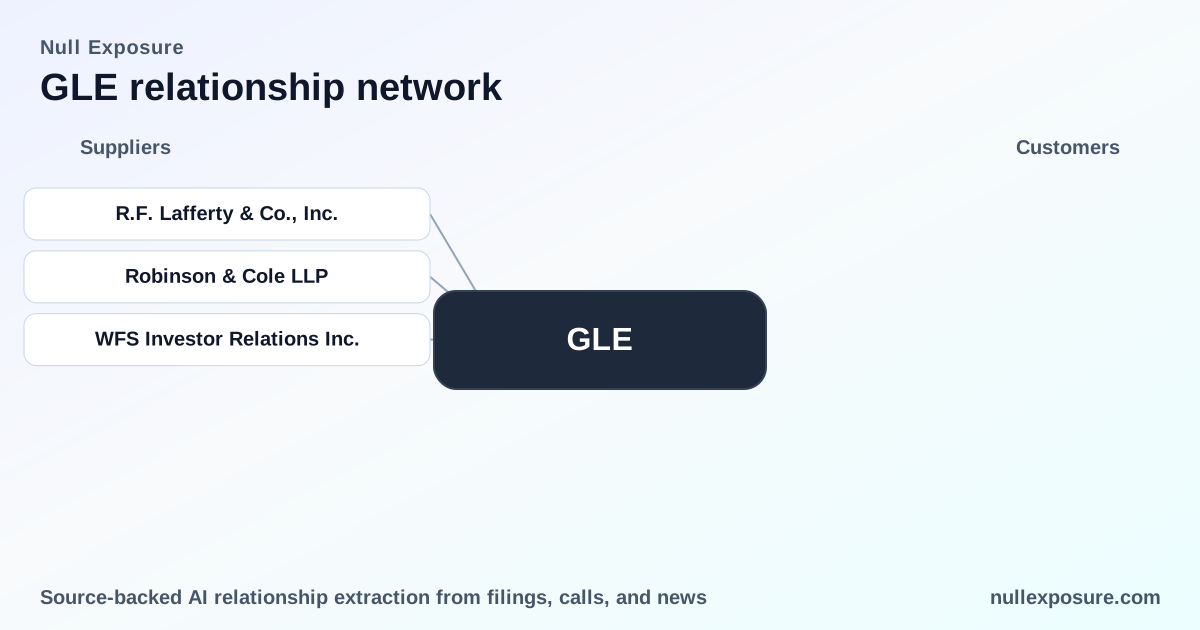
Global Engine Group (GLE): Customer Footprint and Commercial Implications
Global Engine Group Holding Limited (GLE) sells information and communications technology (ICT) systems integration and technical consulting services out of Hong Kong, monetizing through project-based system integration contracts, recurring maintenance/consulting fees, and one-off deployment revenues. Revenue generation is concentrated in mid-sized commercial and public sector ICT projects with recent trailing revenue of roughly $23M and negative operating profitability, indicating a business currently scaling top-line activity while absorbing implementation and SG&A costs. For investors evaluating customer risk and partner concentration, the recorded customer links below provide a window into commercial reach and the financial services channels that intersect with GLE’s client base. Visit https://nullexposure.com/ for full intelligence on relationship mapping and provenance.
How GLE operates in commercial practice
Global Engine operates as a project-centric system integrator: sales cycle lengths are driven by procurement processes typical in Hong Kong ICT deals, delivery is milestone-based, and revenue recognition is closely tied to project completion and maintenance contract renewals. The company’s financial profile—positive gross margin but negative operating margin—signals pricing pressure or elevated operating leverage from implementation teams and overhead during growth phases.
- Contracting posture: Project and contract-based, with revenue spikes tied to large implementations rather than steady subscription streams.
- Customer concentration and criticality: System integrators in this sector often carry medium-to-high client concentration risk because a small number of large projects can dominate annual revenue; GLE’s scale (TTM revenue ~$23M) amplifies that dynamic.
- Maturity and scaling: GLE is in a scaling phase with negative operating margins; profitability depends on converting project backlog into higher-margin recurring services and tightening cost structure.
- Financial channel exposure: Public filings show limited institutional ownership and high insider ownership, indicating governance and capital constraints that can influence commercial negotiations and payment terms.
What the recorded customer links show (catalog)
Below is a concise review of each recorded customer relationship entry in GLE’s customer records, with a plain-English summary and source citation for provenance. These entries are presented verbatim from the intelligence feed and reflect the primary public references captured.
-
TotalEnergies (TTE) — FY2025
The record links GLE’s customer map to TotalEnergies via a press release that discusses Société Générale acting as the registered intermediary for holders of ordinary shares; the captured reference indicates a transactional or registry-level financial services connection in a 2026 release. According to TotalEnergies’ press release (first seen 2026-05-04), Société Générale’s role in the U.S. register is highlighted. Source: TotalEnergies press release (May 2026). -
Legence (LGN) — FY2026
The intelligence lists Legence as a customer-edge relationship where a syndicate of underwriters—led by Morgan Stanley, BMO, MUFG, RBC, Société Générale and others—acted as bookrunners for a secondary offering; the mention situates GLE within a broader capital markets transaction context. The association is recorded in a Yahoo Finance report on the upsized secondary closing (first seen 2026-05-03). Source: Yahoo Finance / press coverage of Legence offering (May 2026). -
National Grid (NGG) — FY2026
The dataset ties National Grid into GLE’s customer landscape through coverage of a planned €500M securities offering where Hargreaves Lansdown and Société Générale are noted as stabilisation coordinators; the capture implies financial-market activity among utilities that intersect with GLE’s commercial map. This was reported on TechS2 summarizing market reaction to gilt yields and National Grid issuance (first seen 2026-03-10). Source: TS2 Tech article on National Grid issuance (March 2026). -
LifeZone Metals (LZM) — FY2025 (Bridge loan announcement)
GLE’s records include LifeZone Metals in relation to a $60M bridge loan transaction and a parallel advancement of project financing discussions with Société Générale for the Kabanga Nickel Project, signaling project-finance activity tied to a mining customer. This linkage appears in a CityBiz press piece covering the bridge loan (first seen 2026-03-10). Source: CityBiz coverage of LifeZone Metals bridge loan (Aug 2025 / reported Mar 2026). -
LifeZone Metals (LZM) — FY2026 (Project finance mandate)
A second entry places LifeZone Metals under long-term project finance structuring led by Société Générale, which was mandated in September 2024 to coordinate a multi-source debt package for Kabanga; this record reinforces a multi-year financing relationship recorded in market intelligence. This was discussed in CruxInvestor’s report on Kabanga positioning (first seen 2026-03-10). Source: CruxInvestor report on LifeZone Metals (March 2026). -
LifeZone Metals (LZM) — FY2025 (additional press republication)
The same bridge-loan language for LifeZone Metals is captured in several syndicated press wires (multiple market outlets republishing the BizWire announcement), reinforcing the public financing narrative with repeated mentions of Société Générale’s involvement in the project financing process. This syndicated pickup appears across FinancialContent outlets (first seen 2026-03-10). Source: FinancialContent/BizWire republication (Aug 2025 / republished Mar 2026).
What these relationships imply for GLE’s commercial posture
- Financial services gatekeepers are prominent in GLE’s recorded links. Several entries highlight Société Générale’s role as intermediary or lead arranger across clients; this suggests GLE’s customers engage with major European banks for capital markets, issuance, and project finance activities—an exposure that influences transaction complexity and payment cycles.
- Diverse end-market exposure but concentrated financial counterparties. The named customers span energy, utilities, and mining—indicative of sector diversification on the demand side—while the repeated appearance of a small set of financial institutions reflects concentration in the financing layer rather than in end customers.
- Operational risk centers on project finance timelines and receivables. Where customers are engaged in large financing events (secondary offerings, bond issuances, project loans), GLE’s contract timing and cash flow are tied to multilateral financing processes, raising the importance of working capital management and contract structuring.
Investor takeaways
- Key strength: GLE’s customer map shows assignments tied to corporates that transact through established financial institutions, implying the company wins work connected to material corporate programs rather than cottage projects.
- Key risk: The company’s small scale relative to the project size of these corporate clients and the negative operating margin present execution and margin-recovery challenges if payment timing aligns with lengthy financing arrangements.
- Actionable step: Validate contract types (fixed-price vs. time-and-materials), invoice payment schedules, and any retainers tied to financing milestones when conducting diligence.
For a full, sourced view of customer relationships and provenance tracking, see the complete offering at https://nullexposure.com/.