Galmed Pharmaceuticals (GLMD): Customer Relationships and Commercial Signals
Galmed Pharmaceuticals is a clinical-stage biopharma focused on therapies for liver disease; it currently generates no product revenue and monetizes through licensing, collaborations, and financing transactions that convert clinical or intellectual property value into working capital. Investors should treat Galmed as an asset-development firm whose near-term value depends on partner deals and capital markets access rather than recurring customer cashflow.
Explore the platform and relationship intelligence that underpins this note at https://nullexposure.com/.
How Galmed's commercial model works in plain terms
Galmed operates as a development-stage biotech: research and clinical progress build assets that are monetized through licensing deals, option structures, and capital raises, rather than through sales or subscription revenue. The company’s balance of zero revenue (RevenueTTM = 0) and negative earnings (EPS = -2.39; EBITDA = -8,427,000) confirms the development-stage posture: R&D and corporate financing drive cash burn, while licensing and partner agreements provide episodic liquidity. With a market capitalization of roughly $3.88 million and limited institutional ownership (3.39%), Galmed has constrained capital-market depth, which elevates the strategic importance of each partner relationship.
Key commercial characteristics: contracting posture favors short-term, convertible financing and licensing instruments; concentration risk is high because episodic deals materially affect liquidity; partnerships are critical to runway; maturity is early—no commercial-stage revenue yet.
Customer and partner relationships: what the facts show
Below I cover every customer/partner relationship pulled from recent reporting. Each entry is a 1–2 sentence plain-English summary with a source reference.
Cantor Fitzgerald & Co.
Galmed granted Cantor Fitzgerald a short-term purchase option that could convert into equity: according to Calcalist Tech reporting on May 3, 2026, Cantor received a 30‑day option to buy up to 329,670 shares as part of a transaction. This option structure functions as a form of contingent financing capacity that can supply immediate capital if exercised and creates potential dilution for existing holders. (Source: Calcalist Tech, May 3, 2026.)
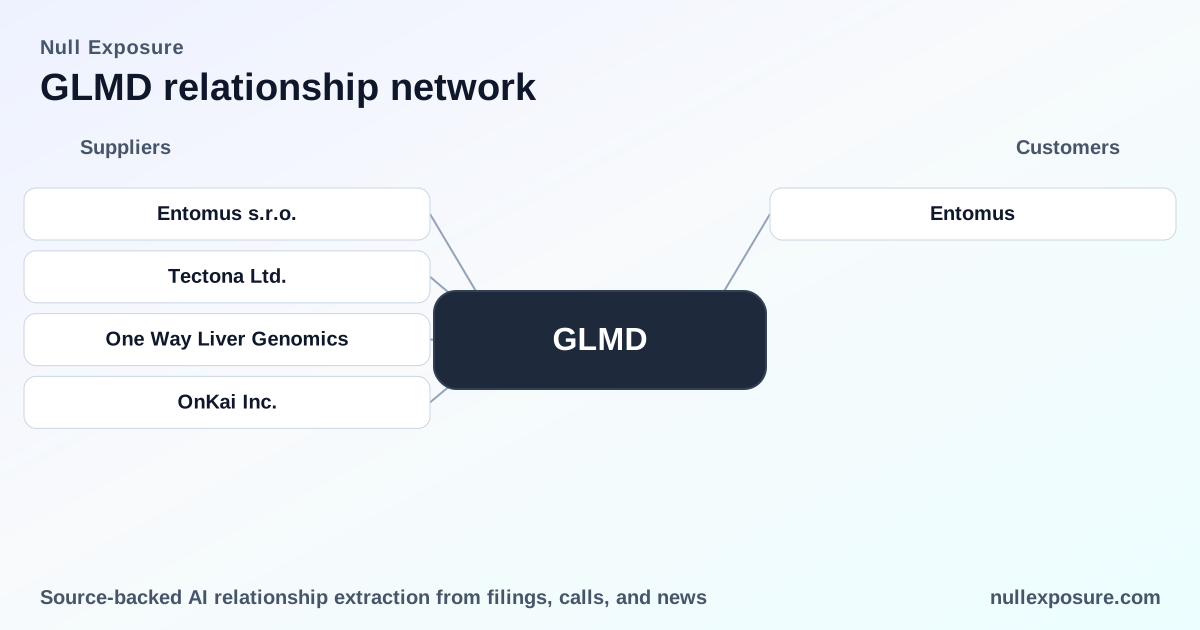
Entomus
Galmed terminated a previously announced licensing arrangement with Entomus: reporting dated March 9, 2026, notes that Galmed ended the original licensing deal on August 25, 2025 after further due diligence. The termination removes a potential near-term commercial or milestone pathway tied to that asset and underscores commercial execution risk tied to partner diligence outcomes. (Source: TS2.Tech, March 9, 2026, referencing the August 25, 2025 termination.)
What these relationships reveal about financing and optionality
- Contingent equity options are part of Galmed’s financing toolbox. The Cantor Fitzgerald option is functionally equivalent to structured access to capital; if exercised, it supplies cash but dilutes shareholders. That trade-off is expected in early-stage biotechs but is material given the company’s small market cap and zero revenue.
- Deal fragility is real. The Entomus termination demonstrates that diligence and contractual complexity can collapse expected cash flows or milestone streams that investors had anticipated. For operators, this elevates the need for backup funding plans and diversified partner pipelines.
- Partner activity directly impacts runway. With no product revenue, each licensing agreement, option exercise, or termination meaningfully reshapes liquidity projections and shareholder value.
Explore analysis tools and historical relationship tracking at https://nullexposure.com/.
Company-level operational signals and constraints
There are no explicit third-party constraints recorded in the source dataset; the following are company-level signals derived from reported financials and ownership data that shape Galmed’s operating model and risk profile:
- Capital dependence and contracting posture: Zero reported revenue and negative EBITDA indicate the company relies on financing instruments and partner deals; the Cantor Fitzgerald option confirms use of contingent equity instruments as a liquidity mechanism.
- Concentration and criticality: With episodic licensing and small market capitalization, individual partner outcomes are critical to solvency and valuation. A terminated deal can meaningfully alter prospects, as seen with Entomus.
- Maturity and operating runway: Clinical-stage profile, limited institutional ownership (3.39%), and small free float amplify funding sensitivity; the firm’s commercial maturity remains pre-revenue and pre-commercialization.
- Dilution risk: Option grants and potential equity conversions are effective tools to raise cash quickly but represent clear dilution pathways for current shareholders.
Risk profile and implications for investors and operators
- Short-term liquidity risk is elevated. The mix of zero revenue and reliance on partner transactions means that balance-sheet events—not organic sales—drive near-term solvency.
- Execution risk is operational and legal. Terminations and renegotiations (Entomus) are not hypothetical—they occur and change the valuation landscape. Legal clarity and robust diligence processes on both sides of a deal are material.
- Catalyst-driven valuation. Share price and investor returns will be event-driven: licensing announcements, option exercises, or clinical readouts. Institutional ownership is low, so market reactions can be outsized relative to fundamentals.
- Governance and capital strategy matter. The presence of structured financing options like the Cantor Fitzgerald arrangement requires investors to monitor dilution schedules and exercise triggers closely.
Bottom line for decision-makers
Galmed is a development-stage biotech whose value is contingent on partner transactions and capital-market access. The Cantor Fitzgerald option represents short-term optionality and potential dilution; the Entomus termination removes a previously anticipated revenue/milestone pathway and highlights counterparty and diligence risk. For investors, position sizing must reflect high catalyst concentration and liquidity sensitivity; for operators, priority should be on diversified partner engagement, clear contract terms that protect milestone payments, and contingency financing.
If you evaluate partner-dependent biotechs regularly, the relationship-level signals documented here are the right starting point for scenario modeling and governance checks. For structured relationship intelligence and ongoing monitoring of counterparties, visit https://nullexposure.com/ to see how these signals are tracked across firms and filings.