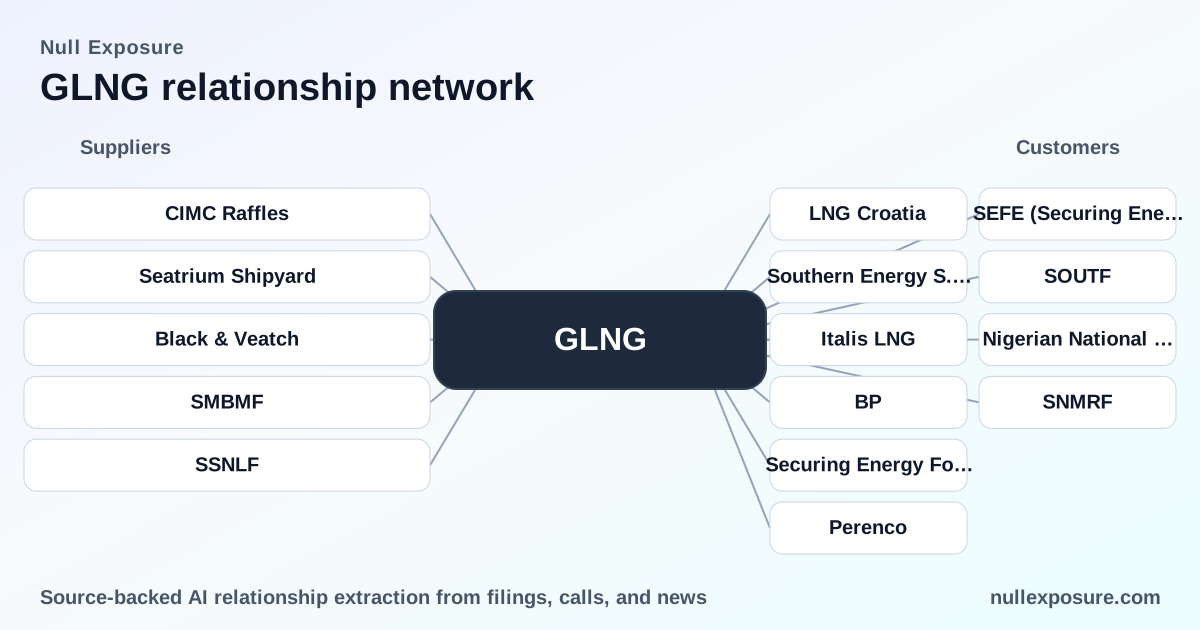
Golar LNG (GLNG): Customer Map and Commercial Implications for Investors
Golar LNG operates and monetizes through ownership and chartering of floating liquefaction (FLNG) and regasification (FSRU) assets combined with project development partnerships; revenue comes from long-term charter hires, commodity-linked tariffs and operating & maintenance contracts. The company's earnings profile is driven by a small number of large, multi‑decade counterparties for FLNG/FSRU charters, plus shorter-term operating revenues from transitional contracts, creating a mix of high-certainty long-term cash flows and near-term contract turnover risk.
For a concise, enterprise-level view of counterparties and implications, see more at https://nullexposure.com/.
What the relationships tell you about Golar's operating posture
Golar’s public disclosures and market reporting show a deliberate commercial model: long-duration, capital‑intensive charters underpin valuation, while opportunistic short-term FSRU/operate‑and‑maintain contracts fill interim revenue. Company commentary for FY2026 highlights both the conclusion of legacy FSRU workstreams and the ramp-up of multi‑decade FLNG charters, indicating a transition from transient operating income toward fixed charter revenue. There are no explicit constraints disclosed in the dataset as company-level exceptions, so the signalling below is drawn from counterparties and timing in the source materials rather than any third‑party covenants.
- Contracting posture: heavy tilt to long‑term charters (notably a 20‑year MKII FLNG charter) supplemented by operate‑and‑maintain FSRU agreements.
- Concentration: revenue is concentrated by large single‑counterparty contracts (e.g., Southern Energy and BP), so counterparty credit and geopolitical execution are material value drivers.
- Criticality: assets are mission‑critical infrastructure for counterparties; contract performance and uptime directly affect cash flows.
- Maturity profile: mix of newly initiated 20‑year agreements and near‑term contract terminations (e.g., LNG Croatia concluded late 2025; Italis LNG expected to end in 1H 2026), producing a transition period in near-term revenue recognition.
Counterparty rundown — each relationship in the public record
Italis LNG
Golar reported that one of its two FSRU operate‑and‑maintain agreements is with Italis LNG and that the Italis LNG contract is expected to terminate within the first half of 2026, representing a near‑term reduction in corporate/other operating revenues. Source: Golar preliminary FY2025/FY2026 results press release (GlobeNewswire, Feb 25, 2026).
LNG Croatia
Golar disclosed an FSRU operate‑and‑maintain agreement with LNG Croatia that concluded in late December 2025, removing that contract from ongoing operating income and reducing short‑term revenue diversity. Source: Golar preliminary FY2025/FY2026 results press release (GlobeNewswire, Feb 25, 2026).
Southern Energy S.A. (SESA) / Southern Energy / SOUTF / SESPf references
Golar satisfied all remaining conditions precedent for a 20‑year MKII FLNG contract with Argentina’s Southern Energy S.A., representing a fixed net charter hire and commodity‑linked tariff structure that materially increases long‑term contracted cash flow visibility. Market reporting (SimplyWall.St, Sahm Capital, and related coverage) highlights the $400M per year fixed net charter hire referenced in deal coverage and the contract’s positive visibility implications. Sources: Company disclosures summarized in market reports (SimplyWall.St and Sahm Capital, early 2026) and related news items (March–May 2026).
BP (bp)
Golar’s FLNG Gimi entered a 20‑year charter with BP for the Greater Tortue Ahmeyim project offshore Mauritania and Senegal, and Gimi is reported to be producing above contracted volumes after commencing the contract in June 2025; the original charter was agreed in 2019. This is a core long‑dated revenue relationship. Sources: LNGPrime reporting (2026) and Q4/2025 earnings call transcript coverage (InsiderMonkey).
SEFE (Securing Energy For Europe)
Golar has a Letter of Intent and reporting links SEFE, a German government subsidiary, as an offtaker for Argentine LNG tied to Southern Energy’s output, indicating potential downstream sales channels tied to Golar’s chartered production. Source: Earnings discussion (InsiderMonkey transcript) and Tradewinds reporting on SEFE purchase agreements (March 2026).
Perenco
Golar’s vessel Hilli is scheduled to finish its Perenco contract in Cameroon in July 2026 before undergoing upgrades and life extension work ahead of its 20‑year charter start in Argentina, reflecting planned asset redeployment from short‑term operating work to long‑term charter service. Source: Q4/2025 earnings commentary (InsiderMonkey).
Stolt‑Nielsen Gas Ltd.
Market reporting records that Stolt‑Nielsen Gas completed acquisition of an additional stake in Avenir LNG from Golar, indicating Golar’s continuing portfolio rotations and non‑core disposals in downstream interests. Source: SimplyWall.St coverage (May 2026).
KOS (Kosmos Energy Ltd.)
Golar is working with the Kosmos partnership on operational improvements and capacity debottlenecking for FLNG projects, a collaboration aimed at extracting value through operational optimization rather than capital transactions. Source: Kosmos earnings call transcript references to Golar collaboration (InsiderMonkey, Q4/2025 coverage).
Nigerian National Petroleum Company Limited / Nigerian National Petroleum Corporation (NNPC)
Golar executed a Project Development Agreement (PDA) with the Nigerian National Petroleum Company Limited for deployment of FLNG offshore the Niger Delta and has earlier Heads of Terms with NNPC for joint development of gas‑field FLNG producers, signaling project development pipeline activity in West Africa. Source: BusinessDay Nigeria and AECWeek reporting (2026 and earlier).
Snam / SNMRF / OLT Offshore LNG Toscana
Snam agreed to acquire the remaining stake in OLT Offshore LNG Toscana from Golar, making Snam the sole owner of the FSRU Toscana operator and reflecting Golar’s disposition of a minority holding as part of portfolio management. Source: LNGPrime reporting (March 2026).
Avenir LNG (referenced via Stolt‑Nielsen transaction)
Stolt‑Nielsen’s acquisition of an additional stake in Avenir LNG from Golar underscores Golar’s active rotation of equity interests in downstream and midstream ventures. Source: SimplyWall.St coverage (May 2026).
What investors should take from this counterparties list
- Revenue visibility has materially improved as Golar transitions assets into 20‑year FLNG charters (notably with Southern Energy and BP), which will dominate cash flow generation versus prior shorter FSRU operating arrangements.
- Near‑term revenue volatility is real: the termination of the LNG Croatia FSRU contract in December 2025 and the expected end of Italis LNG in 1H 2026 remove some shorter‑duration revenue lines before the full earnings impact of the long‑term charters arrives.
- Counterparty concentration is a double‑edged sword: a small number of large counterparties give high‑certainty charter cash flows but concentrate counterparty and geopolitical risk; government‑linked offtakers (e.g., SEFE, NNPC) increase political and regulatory exposure.
- Active portfolio management: disposals (e.g., partial stakes in Avenir LNG to Stolt‑Nielsen) and asset redeployments (Hilli moving from Perenco to Argentina) show management optimizing capital allocation between equity ventures and chartering.
Risks and upside to watch
- Upside: full earnings recognition from the 20‑year MKII charter with Southern Energy and sustained BP production above contracted volume will lift EBITDA conversion and free cash flow predictability.
- Risks: execution and regulatory approvals in Argentina and Nigeria, counterparty credit and commodity‑linked tariff variability, and the timing gap between contract terminations and FLNG commencement create transitional cash‑flow risk.
For a deeper analysis of how these customer relationships affect valuation and credit considerations, explore our research portal at https://nullexposure.com/.
Conclusion: Golar’s customer roster demonstrates a clear strategic pivot toward long‑dated FLNG charters that transform the company from an operator of intermittent FSRU work into a provider of multi‑decade infrastructure income, but near‑term transitions and concentrated counterparties require careful monitoring by investors.