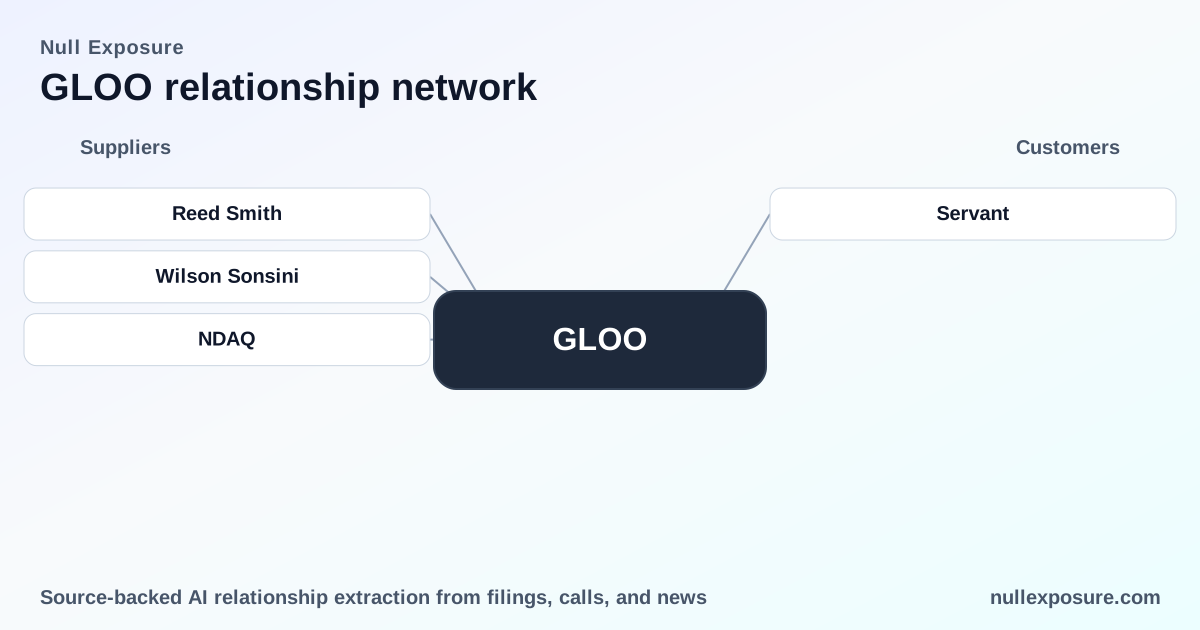
How Gloo Builds a Platform for Faith Organizations — and Where the Customer Base Matters
Gloo operates a vertical technology platform for the faith and flourishing ecosystem and monetizes primarily through recurring platform subscriptions, professional services, and strategic investments that expand go-to-market channels. The company bundles software tools, content and services to sell both seat- or license-based access and higher-margin consulting engagements that drive adoption among churches, ministries and mission-driven institutions. For investors evaluating customer relationships, the combination of a platform-first sales motion and targeted services partnerships is the dominant commercial rhythm to watch.
Explore deeper company relationship intelligence at https://nullexposure.com/.
Why the customer view matters for a vertical SaaS play
Gloo’s economics and risk profile are driven by customer engagement patterns more than by raw scale. High retention among mission-driven clients, the need for embedded services, and channel partnerships that deliver trust determine how quickly revenue scales and whether gross margin converts to positive operating leverage. Gloo’s latest operating snapshot shows Revenue TTM of $94.66M, Gross Profit TTM of $23.11M, and negative EBITDA (-$97.01M), which signals the company is still investing heavily in growth and go-to-market. Those investments amplify the importance of customer relationships: each strategic partner or services tie can accelerate ARR growth while also concentrating execution risk.
The single disclosed customer relationship: what investors need to know
Gloo’s customer-relationship disclosures in the materials provided show one explicit partnership/investment in FY2025: Servant.
- Gloo invested in Servant, a technology and growth consultancy, to pair Servant’s consulting capabilities with Gloo’s platform tools and better serve organizations in the faith and flourishing sector. This creates a channel and services capability that directly supports platform adoption and client transformation. (PR Newswire, March 9, 2026 — https://www.prnewswire.com/news-releases/gloo-invests-in-cutting-edge-technology-and-growth-consultancy-servant-302430718.html)
This relationship is significant in practical terms: it converts a potential sales friction point (professional services demand) into an owned or aligned capability that can increase lifetime value per customer and shorten implementation cycles.
How to interpret the Servant tie from a commercial standpoint
Treat the Servant investment as both a demand-generation and risk-management move. By embedding consulting expertise adjacent to its software offering, Gloo achieves two outcomes that matter to investors:
- Accelerated adoption: Consulting-led implementations reduce time-to-value and increase the probability of up-sell into higher-tier services.
- Control over delivery: Owning or investing in a consultancy reduces reliance on external, third-party implementers whose quality and availability can vary.
The PR Newswire release states the rationale directly: the investment is framed as “an investment in the ecosystem” that brings “world-class consulting services coupled with Gloo tools and capabilities” to customers (PR Newswire, March 9, 2026).
What the absence of other disclosed customer constraints signals
The relationship-level constraints field returned no entries. That absence is a company-level signal worth interpreting rather than ignoring. A lack of granular constraint disclosures commonly indicates Gloo does not publicly report customer-specific contractual limitations, concentration thresholds or bespoke SLAs at the relationship level. For modelers and risk analysts, that implies:
- Contracting posture: Gloo’s public filings and relationship disclosures do not emphasize complex, bespoke contract limits, suggesting a standardized platform subscription model augmented by configurable services rather than dozens of bespoke enterprise contracts.
- Concentration and counterparty risk: With no customer-level constraints disclosed, investors must rely on aggregate metrics and partnership signals (like Servant) to infer concentration risk. Gloo’s shareholder mix—~37% insiders and ~34% institutions—underscores founder/institution influence but does not substitute for customer-concentration transparency.
- Criticality and stickiness: The platform’s vertical focus and the investment in a consultancy partner imply products that are missionally important to clients and therefore sticky; however, that criticality is an operational inference, not a documented contractual fact.
- Maturity of relationships: The company’s financial profile—negative EBITDA, negative EPS (-$7.95 diluted), and mid-nine-figure revenue—points to a business still transitioning from growth-investment mode toward predictable, margin-accretive scale. Services partnerships like Servant are consistent with a company moving from early-stage product-market fit to scaling enterprise adoption.
Key investment implications and risks
- Upside driver — services-led scale: Investing in consulting channels shortens sales cycles and increases ARPU, which can materially improve revenue quality if conversion metrics hold.
- Execution risk — margin pressure: Gloo is still loss-making at the operating level; channel or services expansions can increase near-term spend before delivering durable profitability.
- Transparency risk — concentration blind spots: The lack of customer-level constraints increases reliance on qualitative signals to assess customer concentration; modelers should build conservative scenarios around potential client churn or large-customer dependency.
- Strategic alignment — ecosystem play: The Servant relationship confirms Gloo’s strategic posture: integrate platform and services to deepen market penetration in a vertical niche where trust and relationships drive adoption.
What to watch next as an investor
- Adoption metrics tied to the Servant tie: bookings uplift, implementation time reductions, and service-led ARR expansion. PR Newswire announced the tie in March 2026; follow-up quarters should show whether implementation throughput or conversion improved.
- Customer concentration disclosures or large-account revenue splits in future filings. The current data set provides revenue and margin level detail—Revenue TTM $94.66M, Price-to-Sales 5.93—but not the client-level breakdown investors need to underwrite downside scenarios.
- Profitability trajectory: incremental gross margin and EBITDA improvement as services investments either scale or are rationalized.
Bottom line: platform-first with services acceleration
Gloo’s commercial strategy is platform-led monetization complemented by targeted investments in services and consulting, exemplified by the FY2025 investment in Servant. That combination accelerates adoption in a trust-driven vertical, but it also raises near-term execution and margin risks while leaving some concentration questions unanswered. For investors and researchers, the Servant relationship is a clear positive for go-to-market effectiveness; the absence of broader customer constraints requires conservative modeling and active monitoring of subsequent operational disclosures.
Learn more about relationship-driven intelligence for investors at https://nullexposure.com/.