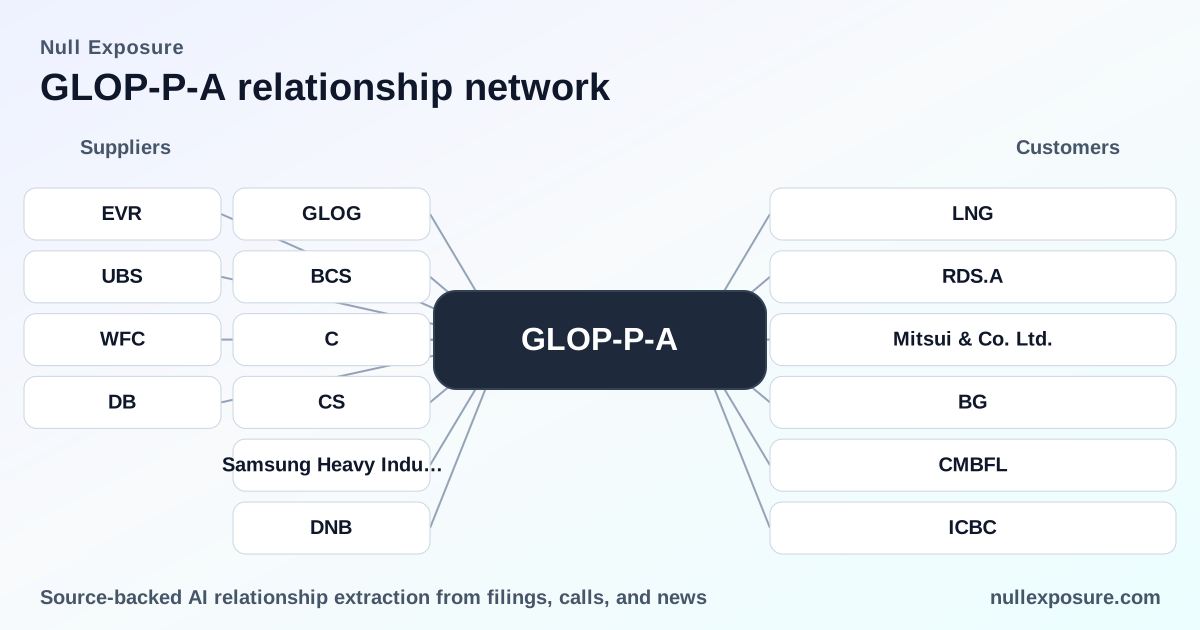
GLOP-P-A customer map: charter counterparties, financing partners, and what they mean for holders
GasLog Partners LP’s Series A preference units (GLOP-P-A) derive value from a portfolio of modern LNG carriers that are overwhelmingly monetized through multi-year time and bareboat charters to major energy and trading firms. The security’s payoff is driven by the stability of long-term charter cashflows, built-in cumulative dividends, and the credit quality and contractual tenure of charter counterparties. For investors evaluating counterparty concentration and operational risk, the relationship landscape — dominated by names like Shell, Cheniere, BG and strategic finance counterparties such as Mitsui, ICBC and CMBFL — is the primary determinant of dividend durability and downside protection. For a concise overview of our broader coverage and methodology, visit https://nullexposure.com/.
How GasLog Partners monetizes operations and why the preference units matter
- GasLog Partners operates a fleet of high-capacity LNG carriers and monetizes through long-term charter contracts (time charters and bareboat charters) that convert ship operating capacity into contracted cashflow.
- The Series A preference units provide cumulative dividends that take priority over common distributions, making them attractive to yield-seeking institutional investors when charter counterparties and tenors support predictable cash generation.
- Capital structure and financing activity (sale-and-leaseback transactions and vessel acquisitions) are recurring components of the business model, indicating an integrated approach combining operational charters with asset-level financing.
A quick operational signal: charter tenors and counterparties are central
- Long-term charters to major oil & gas companies increase revenue predictability, but they also concentrate counterparty exposure; monitoring contract expiry windows and recharter risk is essential.
- Asset finance via sale-and-leaseback to institutional investors or trading houses is an equally important lever of liquidity and balance-sheet management for the partnership.
Relationship roll call — every documented counterparty and what they contractually deliver
- GasLog Partners and a Cheniere subsidiary: GasLog Partners executed a time charter for the Methane Heather Sally with a wholly owned subsidiary of Cheniere Energy, Inc., demonstrating an LNG-trader counterparty relationship supportive of multi-year revenue. A June 2021 article on LNG Industry reported the charter (FY2021): https://www.lngindustry.com/lng-shipping/22062021/gaslog-partners-and-cheniere-sign-charter-agreement/.
- GasLog Partners and Cheniere Energy, Inc.: The same LNG Industry coverage identifies Cheniere’s wholly owned subsidiary as charterer of the Methane Heather Sally, underlining Cheniere’s role as a direct commercial counterparty (FY2021): https://www.lngindustry.com/lng-shipping/22062021/gaslog-partners-and-cheniere-sign-charter-agreement/.
- GasLog Partners and RDS.A (Royal Dutch Shell plc) — FY2019: MarineInsight reported that the GasLog Glasgow was on a multi-year time charter to a Shell subsidiary through June 2026, illustrating long-dated contracted cashflows with a supermajor (FY2019): https://www.marineinsight.com/shipping-news/gaslog-partners-to-acquire-gaslog-glasgow-from-gaslog-ltd-for-214-million/.
- GasLog Partners and Royal Dutch Shell plc: The MarineInsight piece explicitly cites a wholly owned Shell subsidiary as the charterer through mid-2026, reinforcing Shell’s significance in the partner’s charter book (FY2019): https://www.marineinsight.com/shipping-news/gaslog-partners-to-acquire-gaslog-glasgow-from-gaslog-ltd-for-214-million/.
- GasLog Partners and BG (BG Group-related counterparties): A June 2015 LNG Industry item noted that three vessels were operating under long-term time charters with BG with several years remaining, highlighting legacy contracted volumes to integrated gas majors (FY2015): https://www.lngindustry.com/lng-shipping/23062015/GasLog-Partners-announces-acquisition-of-three-vessels-from-GasLog-Ltd-938/.
- GasLog Partners and RDS.A (Shell) — FY2018 acquisition note: VesselFinder reported that GasLog Partners agreed to acquire the Methane Becki Anne in a transaction where the vessel was chartered to Shell, underscoring repetitive shell counterparty relationships across acquisitions (FY2018): https://www.vesselfinder.com/news/13705-GasLog-Partners-LP-announces-Acquisition-of-the-Methane-Becki-Anne.
- GasLog Partners and Shell — FY2018: The VesselFinder item ties the Methane Becki Anne acquisition to an existing charter to Shell, further illustrating strategic fleet expansion that preserves existing charters (FY2018): https://www.vesselfinder.com/news/13705-GasLog-Partners-LP-announces-Acquisition-of-the-Methane-Becki-Anne.
- GasLog Partners and RDS.A (Shell) — alternate FY2019 mention: VesselFinder’s separate coverage of the GasLog Glasgow acquisition repeats that the vessel is on a multi-year time charter to Shell’s subsidiary through June 2026, confirming consistency across reporting sources (FY2019): https://www.vesselfinder.com/news/14850-GasLog-Partners-LP-announces-acquisition-of-GasLog-Glasgow-for-214million.
- GasLog Partners and Royal Dutch Shell plc — duplicate FY2019 note: The VesselFinder re-reporting again identifies Royal Dutch Shell as the long-term charter counterparty for GasLog’s acquired vessel, signaling a pattern of charters to supermajors (FY2019): https://www.vesselfinder.com/news/14850-GasLog-Partners-LP-announces-acquisition-of-GasLog-Glasgow-for-214million.
- GasLog Partners and CMBFL (FY2021 sale-and-leaseback): Yahoo Finance reported that three vessels were sold to a subsidiary of Mitsui & Co., to CMBFL and to ICBC respectively, and then leased back to GasLog under long-term bareboat charters — this demonstrates active asset-level financing and counterparty diversification beyond commercial charters (FY2021): https://finance.yahoo.com/news/gaslog-ltd-gaslog-partners-lp-110000327.html.
- GasLog Partners and ICBC (FY2021 financing): The same Yahoo Finance release cites ICBC as one of the purchasers in a sale-and-leaseback arrangement with GasLog, showing institutional and bank investors participating in vessel financing (FY2021): https://finance.yahoo.com/news/gaslog-ltd-gaslog-partners-lp-110000327.html.
- GasLog Partners and Mitsui & Co. Ltd. (FY2021 financing): Yahoo Finance also notes Mitsui’s subsidiary as a buyer in the sale-and-leaseback transactions, indicating strategic industry investors are financing LNG shipping assets under bareboat structures (FY2021): https://finance.yahoo.com/news/gaslog-ltd-gaslog-partners-lp-110000327.html.
- GasLog Partners and Royal Dutch Shell plc (FY2016 fleet table): A GasLog Ltd. press release published via GlobeNewswire lists multiple vessels and associated time charters to Shell, including tenors that extend into the mid-to-late 2020s, emphasizing multi-year charter tenure to Shell across the fleet (FY2016): https://www.globenewswire.com/de/news-release/2017/02/17/918464/0/en/GasLog-Ltd-Reports-Financial-Results-for-the-Quarter-and-the-Year-Ended-December-31-2016.html.
What these relationships imply about contracting posture, concentration and maturity
- Contracting posture: predominantly long-term. The record shows a strategic reliance on multi-year time charters and bareboat arrangements that lock-in revenue for extended periods, supporting dividend stability for preference holders.
- Concentration: material exposure to supermajors and large traders. Shell and Cheniere surface repeatedly as key charterers; this concentration is a source of both credit strength and recharter risk if multiple contracts roll off in the same window.
- Criticality: high for asset utilization, moderate for earnings variability. LNG carriers are specialized assets and the counterparty roster demonstrates that charterers are critical to utilization; however, negotiated contract structures and fixed tenors reduce near-term earnings volatility.
- Maturity: staggered but with identifiable expiry clusters. Reporting references tenors through mid-2026 on certain vessels; investors must monitor expiry calendars and the pairings of financing covenants to recharter outcomes.
Operational and credit risks to prioritize in diligence
- Counterparty concentration risk — large charters to a small number of energy majors compress counterparty diversification.
- Recharter timing and market exposure — expiries clustered in similar windows create re-letting risk into potentially less favorable market conditions.
- Financing structures — sale-and-leaseback and bareboat arrangements transfer asset ownership and introduce lessor-credit and covenant dynamics that affect cash available for preferred dividends.
- Asset-specific operational risk — LNG carriers’ technical performance and regulatory compliance are directly tied to charter acceptance and revenue flow.
Bottom line for investors
- GLOP-P-A’s security strength derives from long-term charters to creditworthy counterparties and a cumulative dividend structure. Monitor the charter expiry schedule, concentration to Shell and Cheniere, and the role of sale-and-leaseback financing as the principal operational levers that will determine dividend sustainability. For further analysis and ongoing tracking of relationship-level exposures, visit https://nullexposure.com/.