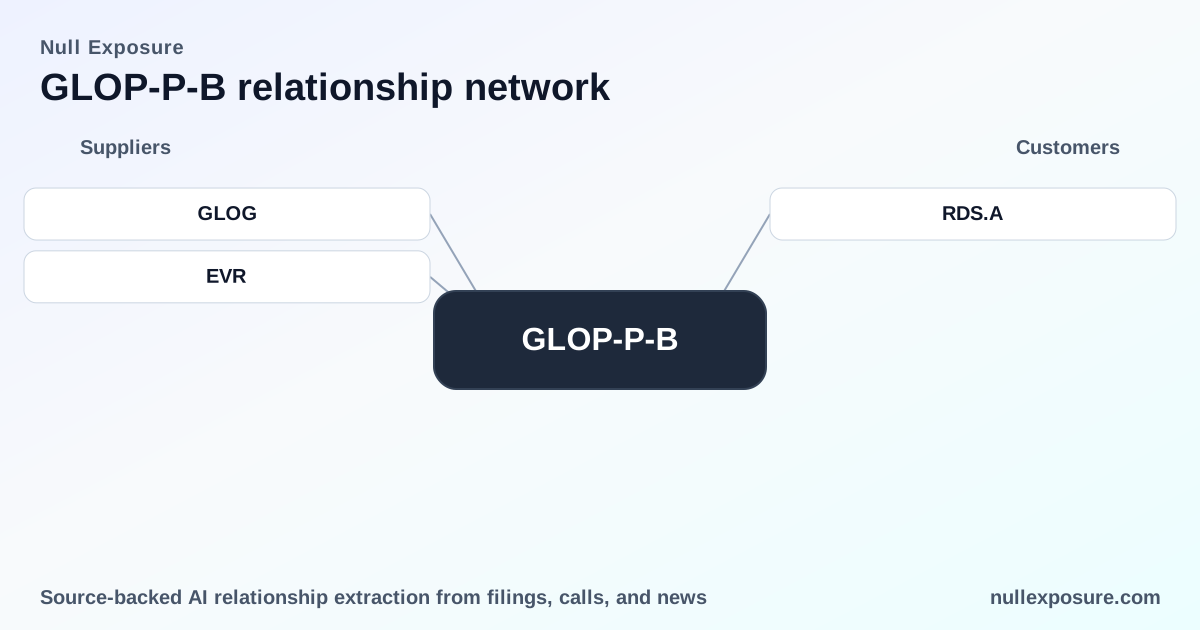
GLOP-P-B: Charter Exposure and Counterparty Risk for Income Investors
GasLog Partners LP’s GLOP-P-B preference units provide exposure to LNG shipping through an 8.200% Series B fixed-to-floating preference instrument that captures cash yield generated by owning and operating LNG carriers and assigning them on time-charter contracts. The Partnership monetizes via long-term charter hire and vessel redelivery economics while offering a redemption option that can convert fixed yield into floating rate exposure; understanding customer counterparties — the charterers — is the single most important lens for credit and cash-flow analysis. For a structured view of counterparty and customer relationships, visit https://nullexposure.com/.
Why charter counterparties determine value more than the hull
Operators like GasLog Partners convert capital-intensive assets into predictable cash through charter contracts. Long-term time charters translate vessel ownership into contracted revenue streams, reducing spot-cycle volatility and supporting the fixed leg of preference distributions. At the same time, charter concentration — a small number of large energy majors accounting for a significant share of charter days — becomes the principal credit and renegotiation risk for preferred security holders.
- Contracting posture: predominantly multi-year time charters in the public record, which signals structural revenue stability rather than reliance on short-term spot markets.
- Counterparty concentration: evidence shows direct exposure to major oil & gas companies, increasing counterparty credit sensitivity but reducing counterparty dispersion risk.
- Criticality: LNG carriers are critical infrastructure in the LNG supply chain, which supports contract enforceability and charterer willingness to honor long-term commitments.
- Maturity and cyclicality: LNG shipping is an established market with cyclical freight rates; however, charter duration and counterparty credit override short-term freight cycles for preferred unit cash flows.
The relationships identified — full and complete
Below are every customer relationship identified in the sourced records for GLOP-P-B, each summarized and sourced.
RDS.A (inferred symbol)
GasLog Partners agreed to acquire the entity that owns and charters the GasLog Seattle, a vessel under a multi-year time charter with a wholly owned subsidiary of Royal Dutch Shell through December 2020, tying a specific asset’s cash flow to a major energy incumbent. According to LNG Industry (October 2016), this purchase transferred ownership and charter income to GasLog Partners for the duration of the charter. (LNG Industry, Oct 2016)
Royal Dutch Shell plc
The GasLog Seattle was contracted on a multi-year term with a Shell subsidiary, representing a direct counterparty relationship between GasLog Partners and a global energy major, which anchors anticipated charter revenue for the vessel through December 2020. A news report on LNG Industry in October 2016 documented the vessel’s time charter with Shell and the transfer of ownership to GasLog Partners. (LNG Industry, Oct 2016)
What the relationships imply for holders of GLOP-P-B
The sourced relationships point to direct, high-quality charter counterparties for at least one named vessel that became part of GasLog Partners’ fleet. The presence of a major energy company as the charterer translates into two practical consequences for investors in the preference units:
- Revenue predictability: Multi-year charters with investment-grade or large integrated energy companies supply reliable cash flow for distribution servicing.
- Counterparty concentration risk: Heavy reliance on a few majors increases sensitivity to those counterparties’ credit and commercial decisions.
Constraints and company-level operating signals
No explicit contractual constraints, covenants, or third-party limitations were extracted from the customer relationship records reviewed. The absence of identified constraints in the available customer-scope data is itself a company-level signal: the public customer record reviewed does not flag third-party-imposed operational restrictions on chartering or vessel employment. Investors should treat this as an information-gap signal rather than a guarantee of unconstrained operations.
Operationally, the partnership exhibits the following characteristics relevant to credit and commercial assessment:
- Contracting posture: leans toward long-duration charters, converting capital assets into contracted revenue.
- Concentration: material exposure to major energy companies, which improves counterparty quality but elevates single-name risk.
- Criticality: Vessels are operationally critical assets in LNG logistics, supporting enforceability and stable charter flows.
- Maturity: The business model is mature within the LNG shipping sector, with performance tied to charter renewal markets and macro energy demand.
Key risks that drive investor focus
For holders of GLOP-P-B, these relationship findings crystallize several risk vectors that determine upside and downside:
- Charter renewal risk: When multi-year charters expire, renewal economics can shift materially and affect distribution coverage.
- Counterparty credit risk: Dependence on a small set of large charterers concentrates exposure to their balance-sheet and commercial health.
- Refinancing and liquidity risk: The preferred security is anchored to an asset-heavy sponsor; sponsor-level balance-sheet stress affects distribution priorities.
- Rate reset and interest risk: The fixed-to-floating feature exposes holders to interest-rate repricing dynamics when the instrument converts.
Bottom line and next steps for investors
GLOP-P-B’s value proposition is anchored in contracted charter income to major energy companies, which provides a stable revenue base for preference distributions while concentrating counterparty risk. The uncovered relationships — specifically the transfer of the GasLog Seattle and its charter to a Shell subsidiary — confirm that the Partnership pursues asset acquisitions that immediately monetize through established charter contracts.
For more detailed counterparty maps and to monitor changes in charter counterparties and vessel employment over time, consult the curated coverage at https://nullexposure.com/.
Note: The customer relationship records cited in this analysis derive from contemporaneous press coverage of asset acquisitions and time-charter arrangements (LNG Industry, October 2016).