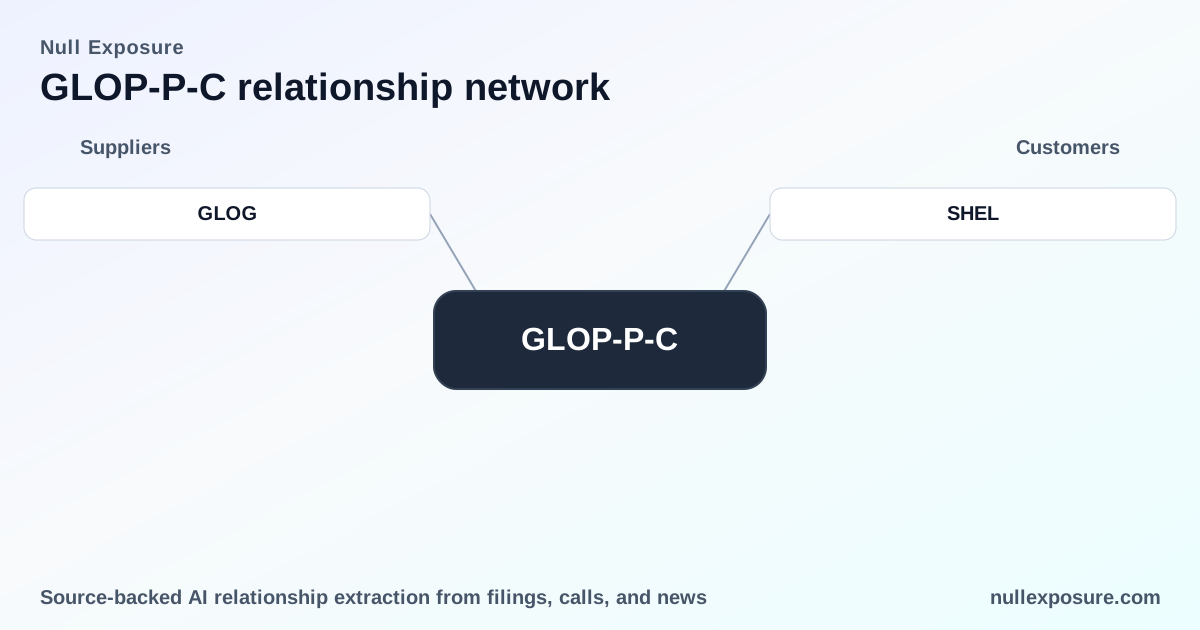
GasLog Partners (GLOP-P-C): Customer Map and Commercial Read Across
GasLog Partners LP operates as an owner/operator of liquefied natural gas (LNG) carriers that it monetizes primarily through long-term time charters and sale-leaseback style ownership of vessels. The Series C perpetual preferred units (GLOP-P-C) provide investors with a hybrid fixed/floating coupon that is funded by charter cash flow and the partnership’s asset-backed cash generation. For investors and operators evaluating counterparty exposure, the commercial picture is straightforward: revenue is charter-driven, counterparty concentration matters, and major energy supermajors are primary demand anchors.
Explore a concise mapping of customer links and what they imply for preferred-unit holders: https://nullexposure.com/
How GasLog monetizes fleet economics and why customer relationships matter
GasLog Partners’ cash flows originate from charter agreements—contracts that convert vessel ownership into predictable income streams. Long-term time charters lock in utilization and rates, lowering volatility for preferred distributions, while shorter-term or spot employment increases upside and operational risk. The pairing of a modern fleet with secured charters drives the credit profile for a preferred instrument like GLOP-P-C: investors trade off yield for the stability of contracted charter revenue and the embedded residual value of the ships.
From an underwriting and operational perspective, five characteristics define the business model:
- Contracting posture: Heavy reliance on long-term time charters with major energy companies stabilizes cash flow and supports fixed/floating preferred coupons.
- Concentration: A small number of large charterers can represent a meaningful share of revenue, concentrating counterparty risk.
- Criticality: LNG shipping is mission-critical logistics for producers and buyers; interruption risks translate directly into charter enforcement and priority in operations.
- Maturity and asset quality: A modern, fuel-efficient fleet enhances charter attractiveness and residual values, supporting preferred security.
- Counterparty credit exposure: Credit strength of charterers directly affects payment certainty for preferred distributions and refinancing flexibility.
Who GasLog Partners serves: documented customer links
Below are every customer-related mention in the available records, reproduced in plain language with source citations.
Shell PLC — GasLog Glasgow scheduled to deliver Asian cargo (FY2025)
GasLog Glasgow is reported as chartered by Shell and arriving at Kitimat to load Canada’s first large-scale LNG cargo destined for Asia; this indicates active employment of a GasLog vessel under a Shell charter during FY2025. According to a Financial Post article dated May 3, 2026, the vessel under Shell charter was preparing to move a milestone cargo to Asian buyers. (Financial Post, May 3, 2026)
Royal Dutch Shell — ownership/charter history for GasLog Gibraltar (FY2018)
A MarineLink report documents that GasLog Partners agreed to buy the entity owning and chartering GasLog Gibraltar, a vessel that was on a long-term time charter with a wholly owned Royal Dutch Shell subsidiary through October 2023, reflecting a historical long-duration commercial link between GasLog assets and Shell interests. (MarineLink, March 9, 2026; referencing the FY2018 transaction)
SHEL (duplicate entry) — repeat of GasLog Gibraltar charter detail (FY2018)
A separate record reproduces the MarineLink reference to the GasLog Gibraltar being on a long-term time charter with a Shell affiliate through October 2023, reinforcing that the Gibraltar transaction and its chartering arrangements are documented multiple times in public reporting. (MarineLink, March 9, 2026; referencing the FY2018 transaction)
What these customer relationships imply for preferred-unit holders
- Shell as a material counterparty: Multiple mentions connecting GasLog vessels to Shell underline that supermajors are core customers, providing secure, long-duration employment for assets—this supports preferred coupon stability. The FY2025 and FY2018 references both show repeated commercial interactions with Shell entities, reinforcing counterparty continuity rather than one-off charters.
- Long-term charters de-risk distributions: The GasLog Gibraltar example explicitly cites a long-term charter through October 2023; long tenors reduce immediate revenue volatility, which is positive for holders of GLOP-P-C.
- Duplication of reporting reinforces visibility: The duplicate MarineLink entry signals that the market has repeatedly captured the same commercial relationship, improving transparency around which vessels are tied to which charterers.
Operational and portfolio constraints as company-level signals
With no explicit constraint excerpts attached to named counterparties, present-day signals at the company level are actionable:
- Contracting concentration: Public reporting points to reliance on a small set of large energy buyers (notably Shell), which concentrates credit risk but also brings high counterparty quality.
- Counterparty criticality: LNG shipping is a non-discretionary service in the supply chain; major charterers are incentivized to keep contracted vessels operating, improving revenue durability.
- Maturity of contracts: Historical long-term time charters (as cited for GasLog Gibraltar) indicate the company has used the market’s appetite for multi-year commitments to stabilize cash flow.
- Asset-backed resilience: A modern, efficient fleet supports both charter demand and residual value, which underpins the credit support for a perpetual preferred instrument.
Risk considerations and what investors should watch next
- Concentration risk: Strong ties to a handful of charterers create dependence; monitor charter rollovers and renewal pricing as key risk triggers for preferred coupon coverage.
- Charter expiries: Vessel-specific expiry dates (like the October 2023 end for Gibraltar’s charter) are event points—future expiries require either rechartering at acceptable rates or repositioning into more volatile markets.
- Market cycles and fuel/technological regulations: Fleet efficiency mitigates regulation risk, but sector-wide rate cycles will affect available coverage for floating-rate components of GLOP-P-C.
Bottom line and next steps for underwriters and investors
GasLog Partners’ customer links—most notably to Shell—translate into a profile of concentrated but high-quality charter counterparties and a predominantly charter-driven revenue model that supports preferred distributions. Investors in GLOP-P-C should prioritize monitoring charter tenor rollovers, concentrated counterparty exposures, and vessel employment schedules as primary drivers of distribution sustainability.
For a concise briefing on commercial relationships and counterparty exposure models, see our platform: https://nullexposure.com/.
Sources referenced in this commentary include a Financial Post report on the GasLog Glasgow’s employment (May 3, 2026) and a MarineLink report detailing the GasLog Gibraltar purchase and its long-term time charter history (reported March 9, 2026, referencing FY2018).