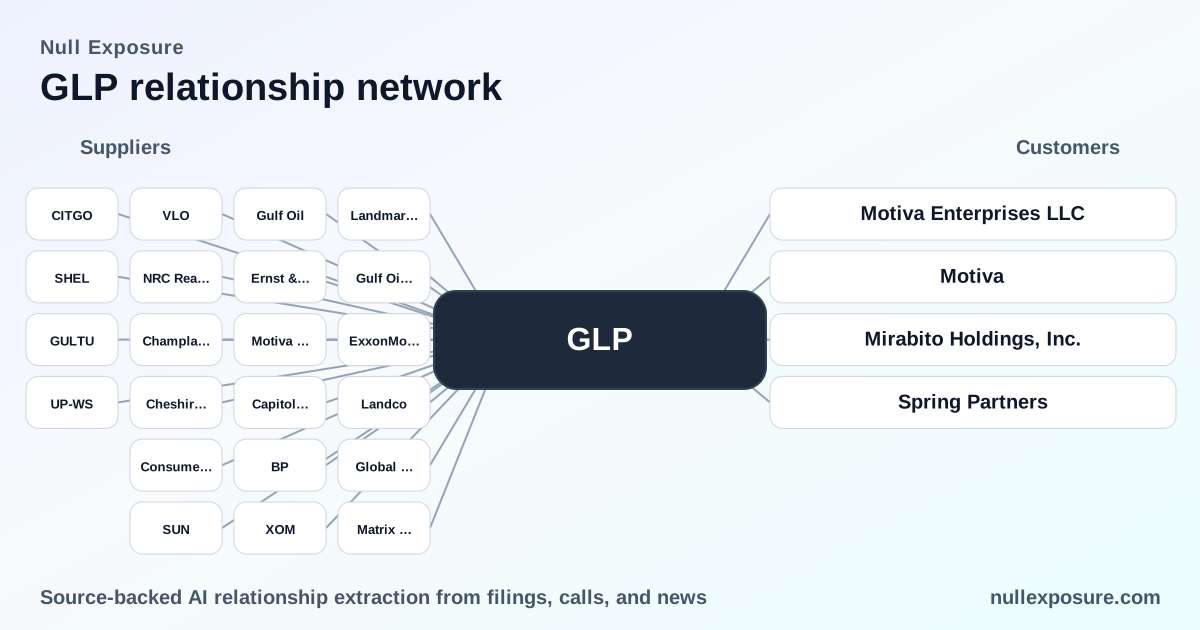
GLP Customer Relationships: Who Fuels Global Partners' Revenue Engine
Global Partners LP operates a vertically integrated distribution and retail platform in the Northeast U.S., monetizing through wholesale supply contracts, retail site operations and branded supply agreements that lock in throughput and margin across terminals, truck racks and convenience stores. Revenue derives from product sales, minimum-throughput commitments at terminals and long‑term supply relationships with retail and wholesale customers, with supplemental cash flow from asset sales and joint ventures. For investors, the customer book is a mix of large commercial counterparties, government accounts and regional retail partners concentrated in the Northeast — a set of relationships that supports predictable volumes but exposes the partnership to regional demand and contract renewal cycles. Learn more about how we compile relationship intelligence at https://nullexposure.com/.
How GLP makes money from customers — a concise operating thesis
Global Partners aggregates inventory, logistics and retail distribution to convert refined product availability into recurring cash flow. Commercial customers buy fuel and distillates; retail JV partners operate sites under supply or joint-venture arrangements; and terminal anchor tenants underwrite long-dated throughput commitments that de-risk capital deployed into terminal and rack capacity. That revenue mix positions the company as a distributor-seller with transactional margins on fuels and contractual minimums that smooth cyclical swings.
Notable customer and partner relationships (documented signals)
Below are every relationship captured in the provided results, with a plain-English summary and the original source noted.
Motiva Enterprises LLC — terminal anchor with long-term take-or-pay
Global Partners' acquisition of Gulf Oil terminals is supported by a 25‑year take‑or‑pay throughput agreement with Motiva Enterprises LLC, which includes minimum annual revenue commitments that anchor terminal economics. This was reported in Rigzone coverage of the transaction in April 2024 and referenced in follow-up industry press. (Rigzone, April 11, 2024.)
Motiva — anchor tenant cited across reporting on the terminal deal
Industry outlets repeated that the terminal transaction is underpinned by a 25‑year anchor throughput agreement with Motiva, reinforcing that the terminals have a long‑dated customer commitment providing predictable cash flow. (CSP Daily News, coverage tied to FY2023 transaction disclosure.)
Mirabito Holdings, Inc. — buyer of non-strategic retail sites with ongoing supply links
Global Partners sold 30 non‑strategic gasoline stations and convenience stores to Mirabito Holdings for roughly $40 million, including long‑term supply contracts for branded and unbranded gasoline and other petroleum products, indicating a retained commercial relationship even after the asset sale. (Fuels Market News, transaction announced in FY2016.)
ASST / Asset Entities Inc. — financing and ATM waiver interaction
An SEC‑filing news summary noted an Amended and Restated Waiver and Consent that allows Asset Entities Inc. to conduct ATM (at‑the‑market) stock transactions through A.G.P./Alliance Global Partners (NYSE: GLP) without triggering prohibitive terms from earlier arrangements with Ionic, reflecting capital‑markets interactions between GLP and financing counterparties. (Investing.com, SEC filings coverage, FY2025.)
Spring Partners — retail joint‑venture operator for dozens of sites
Management disclosed that GLP operates or supplies 67 sites under a Spring Partners retail joint venture, signaling a meaningful JV footprint in the retail channel and an ongoing supplier/operator role for GLP within that partnership. (The Globe and Mail, FY2026 earnings/transcript coverage.)
Dunkin' — tenant presence at certain convenience locations
A 2020 report on store divestitures noted that some convenience locations sold or operated by GLP include third‑party tenants such as Dunkin', highlighting cross‑selling and in-store revenue dynamics at retail sites. (CSP Daily News, FY2020 reporting.)
What the constraints tell investors about GLP's customer posture
The extracted constraint signals describe how GLP structures and risks its customer base; these are company‑level signals rather than relationship‑specific assertions.
- Contracting posture — renewal and renegotiation central to model. GLP states most customer arrangements are periodically renegotiated or replaced, indicating revenue is partially subject to contract renewals and market terms. This makes contract management and rate negotiation capabilities key operational competencies.
- Counterparty mix — large enterprises and government accounts are present. GLP serves large commercial and public‑sector end users in its Commercial segment, implying counterparty sophistication and credit considerations matter for collections and contract design.
- Geographic concentration — Northeast U.S. focus. The Partnership is predominantly active in the Northeast (New England, New York, New Jersey, Pennsylvania) with Maryland and Virginia exposure; regional demand drivers and weather patterns will materially influence volumes.
- Materiality profile — no single customer above 10% historic sales, but customer loss is material in aggregate. GLP reports that no individual customer exceeded 10% of sales for recent years, a positive signal for customer concentration; however, management also highlights that failure to compete for or retain customers could have a material adverse effect on results, emphasizing sensitivity to customer churn.
- Relationship roles and segment alignment — distributor / seller across wholesale and retail. GLP functions as both a distributor to wholesalers/retailers and a seller through its Wholesale reporting segment, reinforcing multi‑channel customer exposure.
- Relationship maturity — many arrangements are renewing. The recurring renegotiation cadence suggests contracts are neither endlessly evergreen nor uniformly long‑dated (except where take‑or‑pay anchors exist, as with Motiva).
Strategic implications for investors
- Upside from long-dated throughput agreements. Anchor contracts like the Motiva take‑or‑pay provide predictable terminal revenues that support capital returns and reduce volume volatility risk at those assets.
- Operational risk remains regional and contractual. The Northeast concentration is a double‑edged sword: strong market position in a defined geography but exposure to local demand, regulatory changes and weather swings.
- Diversified counterparties but not immune to churn. While no single customer dominates revenue, the need to renew many agreements means commercial execution and pricing power remain central to sustaining margin and cash available for distribution.
What to watch next
- Contract renewals for major wholesale customers and JV terms with retail partners (Spring Partners) — these will determine volume stability.
- Performance of terminal assets under the Motiva throughput agreement and any enforcement or amendment notices.
- Any incremental divestitures with supply‑back arrangements (Mirabito‑style deals) that shift capital allocation while preserving supply revenue.
For a structured, investor‑grade view of counterparty exposures and their contractual contours, visit https://nullexposure.com/ for more on how these relationship signals are organized and prioritized.
Bottom line
Global Partners monetizes logistics, supply and retail presence through a combination of spot sales, long‑dated throughput commitments and retail JV supply arrangements. The customer book combines large enterprise and government accounts within a Northeast geographic core, with take‑or‑pay terminal contracts serving as the most notable source of revenue durability. Investors should value the stability that anchor tenants provide while monitoring contract renewals and regional demand trends that drive volumes and margins.