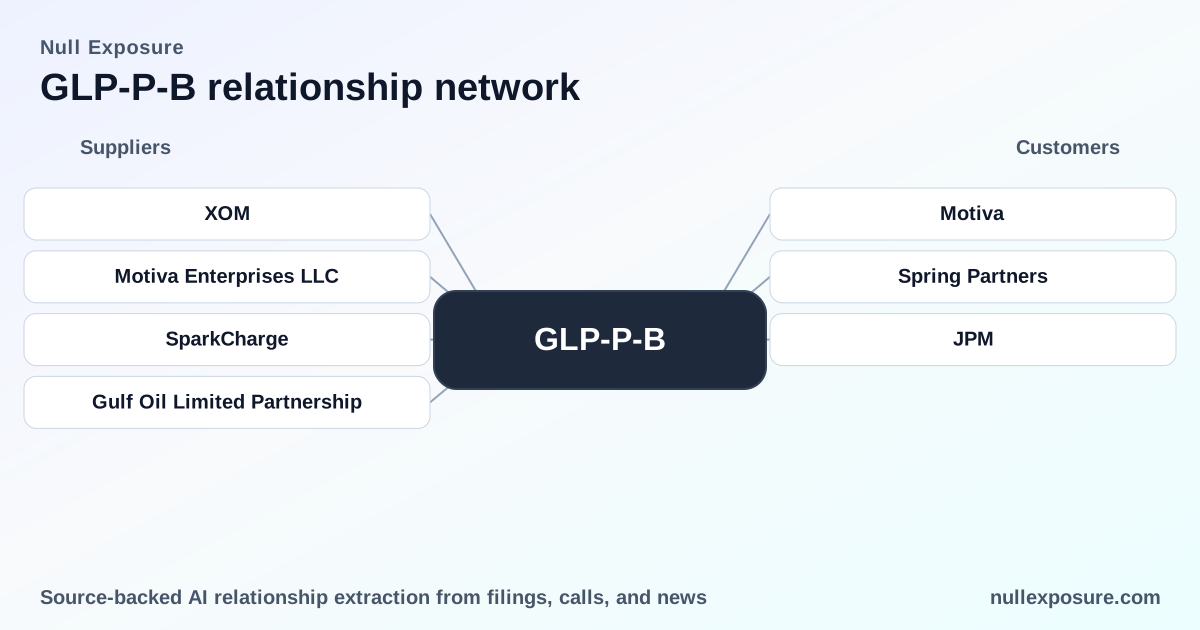
GLP-P-B: Counterparties That Anchor Terminal Cashflow and Retail Distribution
Global Partners LP (GLP) operates as an owner, supplier, and operator of fueling terminals, wholesale distribution channels, and convenience retail sites. The company monetizes through long‑dated throughput agreements and retail margins, supplemented by capital markets financing to fund acquisitions and working capital. Key drivers are long-term contractual cashflows at terminals, a retail joint‑venture footprint that supports downstream margins, and active debt issuance to lever balance sheet capacity. For further background and disclosures visit https://nullexposure.com/.
What these customer and capital relationships reveal about the business model
Global Partners’ relationships reveal an operating posture built around contractual revenue stability and retail diversification, with capital markets access to finance growth. A 25‑year take‑or‑pay throughput agreement provides strong revenue visibility for terminal assets, while a joint venture network of retail sites supplies downstream demand and margin capture. The company supplements operating cash with private note issuances underwritten by major securities firms, signaling market confidence in execution and the need for external funding to support scale.
- Contracting posture: Long-term, supplier‑anchored arrangements at terminals (take‑or‑pay) lock in minimum revenue commitments and reduce near‑term volume sensitivity.
- Concentration and criticality: Anchor tenants at terminals concentrate counterparty importance and make terminal cashflows critical to asset-level coverage.
- Maturity and financing: Use of long‑dated senior notes demonstrates reliance on wholesale debt markets for capital and extends cash‑flow maturity matching.
Explore more detailed counterparties and relationship excerpts at https://nullexposure.com/.
Relationship snapshots: how each counterparty fits
Motiva: anchor tenant with a long-term throughput commitment
Global Partners’ terminal transaction is backed by a 25‑year take‑or‑pay throughput agreement with Motiva, which functions as the anchor tenant and includes minimum annual revenue commitments that underpin terminal economics. This structure gives GLP strong cashflow visibility at those terminals. (Rigzone coverage of the terminal acquisition, November 2024.)
Spring Partners: retail joint venture supplying 67 sites
Global Partners operates or supplies 67 retail sites through the Spring Partners joint venture, providing a distributed downstream channel for fuel and convenience sales that contributes retail margins and customer access. This JV presence diversifies revenue sources beyond wholesale terminal throughput. (Q4 2025 earnings call transcript, Investing.com; also reported in CSP Daily News, Q4 2025 coverage.)
J.P. Morgan Securities LLC / JPM: lead underwriter for private note placement
GLP and GLP Finance Corp. executed an upsized private placement of $450.0 million aggregate principal amount of 7.125% senior notes due 2033, sold to a syndicate led by J.P. Morgan Securities LLC as representative of the initial purchasers. This transaction demonstrates GLP’s access to institutional capital and the use of fixed‑rate debt to finance operations and acquisitions. (Vinson & Elkins press release reporting the transaction, FY2025.)
Why each relationship matters to investors
The Motiva agreement is the cornerstone for terminal-level cashflow — a 25‑year take‑or‑pay contract translates into durable minimum revenue streams that support valuation multiples for terminal assets and reduce short‑term volume risk. The Spring Partners JV gives GLP retail footprint and margin capture, but at modest scale (67 sites) it is a complementary distribution channel rather than the dominant revenue engine. The J.P. Morgan–led private placement shows institutional financing capacity but also commits the company to fixed interest costs over a long tenor, which influences leverage dynamics and interest coverage sensitivity.
Risk and concentration map for GLP’s customer strategy
- Counterparty concentration risk: Long‑dated anchor relationships provide predictability but concentrate exposure to a small number of counterparties at key terminals; loss or renegotiation of such contracts would have outsized earnings impact.
- Operational criticality: Terminals underpinned by take‑or‑pay arrangements are critical assets; performance and uptime are essential to realizing contracted throughput.
- Financing sensitivity: The $450 million private note issue at 7.125% due 2033 locks in funding but increases fixed interest obligations and refinancing risk at maturity horizons. (Vinson & Elkins, FY2025.)
- Retail scale tradeoff: Operating 67 Spring Partners sites improves market access and margin capture but does not eliminate commodity price or volume cyclicality inherent in downstream fuel retailing. (Q4 2025 earnings call transcript; CSP Daily News, Q4 2025.)
Practical investing takeaways
- Stable terminal cashflows: Investors should value GLP’s terminal assets with the premium warranted by multi‑decade take‑or‑pay contracts, which materially reduce short‑term volume risk relative to spot exposure.
- Retail as diversification, not replacement: The Spring Partners JV augments revenue streams and distribution, but GLP’s core earnings sensitivity remains linked to wholesale throughput and fuel margin volatility.
- Capital markets are integral to strategy: The sizeable private placement executed with J.P. Morgan underscores reliance on institutional funding to finance acquisitions and growth; bond yield and access conditions will shape balance‑sheet flexibility going forward.
For a concise view of counterparty exposure and to track new filings and market activity, visit https://nullexposure.com/.
Bottom line
Global Partners’ customer and capital relationships illustrate a business built on long‑dated, contracted terminal cashflow, retail joint‑venture distribution, and active use of debt markets to fund strategy. These relationships create a durable revenue base with concentrated counterparty dependence and fixed financing commitments that investors should weigh when assessing valuation and credit risk.