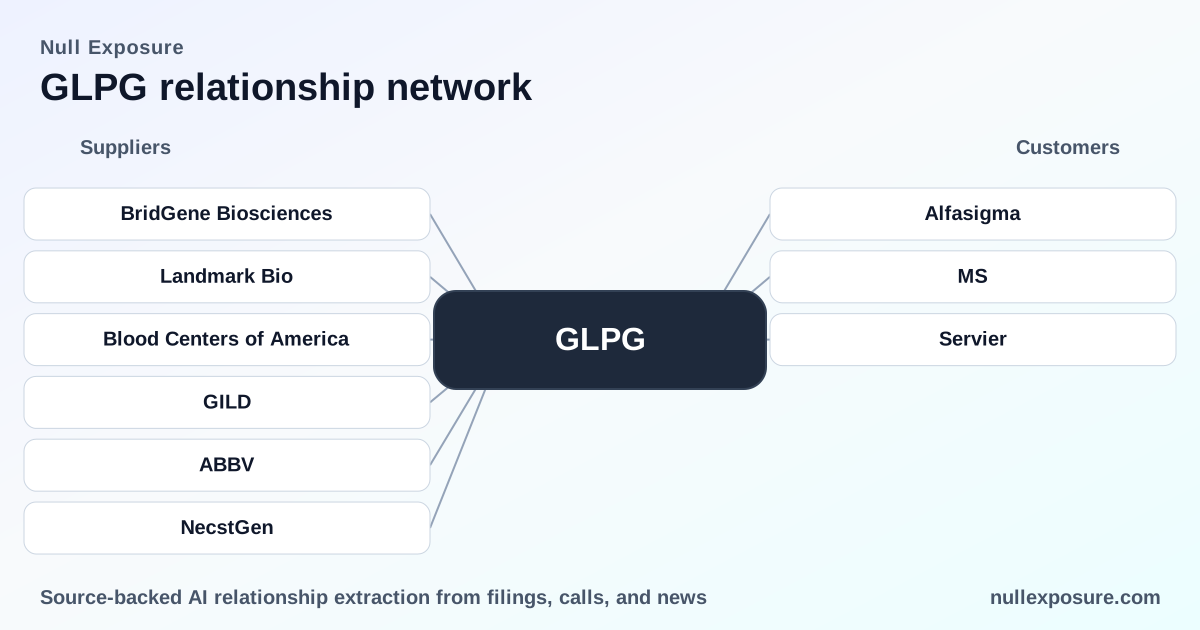
Galapagos NV (GLPG) — Customer relationships that shape revenue and risk
Galapagos NV builds and monetizes value by discovering and developing small-molecule drugs and then capturing revenue through collaborations, licensing fees, milestone payments and royalties alongside selective commercialization. The company’s monetization profile is dominated by partnership economics—research and development risk shared with larger biopharma partners and sizeable collaboration revenue that materially impacts reported top-line performance. For a concise institutional lens on partner risk and contractual exposure, visit https://nullexposure.com/.
Executive summary: how partnerships drive the P&L
Galapagos is a clinical-stage biotech that converts discovery-stage assets into cash through strategic alliances. The firm reported $1.112 billion in trailing twelve‑month revenue and strong operating margins, but a substantial portion of recognizable revenue is collaboration-related rather than pure product sales. Partnership concentration and commercialization handoffs—most notably with Gilead—are the defining characteristics of Galapagos’s operating model.
Key operating characteristics to weigh:
- Contracting posture: Galapagos structures deals that include upfront license fees, milestone payments and tiered royalties while ceding commercialization responsibilities in many territories. This reduces commercialization capital intensity but transfers downstream revenue capture to partners.
- Concentration: Collaboration revenue is highly concentrated; large payments from a single partner can dominate quarterly results.
- Criticality: For headline revenue and late‑stage commercial execution, a small number of partners are mission-critical to Galapagos’s near-term cash generation.
- Maturity: The company’s model blends early-stage discovery risk with later-stage de‑risking via partners—mature programs have been licensed out, while newer modalities remain internally advanced.
Customer relationships — the items you need to know, one by one
Gilead Sciences — sizable collaboration revenue recognized in FY2025
Galapagos recognized €900.2 million in collaboration revenue during the quarter, contributing to roughly €1.11 billion recognized in fiscal 2025 under the partnership with Gilead. This line item is a major driver of recent revenue volatility and illustrates the cash significance of the Gilead relationship. (Investing.com report, May 3, 2026)
Gilead Sciences — binding framework on T‑cell engager program and commercialization economics
Galapagos entered a binding agreement with Gilead on a first‑in‑class T‑cell engager program where Gilead will handle commercialization outside certain territories and pay Galapagos tiered royalties of 20–23% on net sales of gamgertamig upon commercial launch. This structure preserves high-margin royalty upside for Galapagos while assigning global commercialization responsibilities to Gilead. (GlobeNewswire / Manila Times syndicate, March 31, 2026)
Gilead Sciences — funding profile for early‑ versus late‑stage development
In the T‑cell engager collaboration, Galapagos will fund early-stage development while later-stage costs are shared with Gilead, a common risk‑allocation approach that reduces Galapagos’s late‑stage capital burden in exchange for downstream royalty participation. (InsiderMonkey summary of March 31, 2026 announcement)
Gilead Sciences — temporary waiver of rights enabling external partnering options
Gilead has temporarily waived certain rights under its agreement with Galapagos, enabling Galapagos to explore external partnering options for select assets—an operational opening that increases Galapagos’s flexibility to seek alternate commercialization paths. (Investing.com coverage, 2026)
Gilead Sciences — contextual analyst commentary on partnership-driven modeling
Analyst notes and market commentary repeatedly tie Galapagos’s valuation and near‑term guidance to its dealings with Gilead, with broker modeling updates reflecting the materiality of collaboration payments and commercialization assumptions. Such commentary underscores that investor models must explicitly incorporate partner economics rather than treating revenue as organic product sales. (RBC and other analyst coverage cited via financial news, March–May 2026)
Alfasigma — transfer of Jyseleca and associated workforce movement
Galapagos transferred the JAK inhibitor Jyseleca to Italy’s Alfasigma and disclosed that roughly 400 employees would move with the drug while an additional ~100 positions were to be trimmed as part of the transition. This is evidence of asset divestiture that carries both cost and operational headcount implications. (FierceBiotech reporting, October announcement referenced in March 2026 article)
Servier — earlier license and milestone economics on an OA program
Servier exercised an option to develop GLPG1972/S201086 and paid Galapagos a €6 million license fee with eligibility for up to €290 million in success‑based milestones, showing the classic biotech model of license fees plus contingent future payments for partnered programs. (BioSpace recap of the 2017 option exercise; referenced in reporting)
Morgan Stanley / MS — historical follow‑on financing led by Morgan Stanley (2017)
Galapagos executed a follow‑on ADS offering in 2017—3,750,000 ADSs priced at $90 per ADS—led by Morgan Stanley, an example of how capital markets activity has historically been used to finance the company’s growth. While historical, this financing event explains legacy investor base dynamics and past dilution context. (European Biotechnology reporting on the 2017 offering)
Morgan Stanley — duplicate reporting entry reflecting the same 2017 financing role
A separate result reiterates that Morgan Stanley led the 2017 follow‑on ADS placement, confirming the bank’s role in that capital raise and the company’s prior access to major syndicate channels. This duplicate entry reinforces the financing history rather than a new commercial relationship. (European Biotechnology, 2017)
What the relationship map implies for investors
- Revenue sensitivity is binary: a handful of partner transactions—particularly with Gilead—drive quarter‑to‑quarter revenue outcomes; investors should model collaborations explicitly and treat reported revenue as partner‑dependent.
- Capital allocation trades risk for upside: Galapagos’s choice to fund early development while trading later commercialization in exchange for royalties reduces capital intensity but concentrates execution risk with partners.
- Operational concentration is both strength and risk: Deep, high‑value relationships accelerate cash recognition via licenses and milestones, but create counterparty concentration risk if those partners change strategy or waive rights.
Constraints and corporate signals
There are no explicit constraints recorded in the relationship payload provided. As a company‑level signal, this absence means the analysis must rely on public partnership disclosures and historical deal terms to infer contracting posture and counterparty exposure rather than on a formal constraint registry. The observable corporate pattern—large licensing fees, milestone streams and high royalty rates in partnership agreements—constitutes the primary evidence of Galapagos’s commercial model and contracting behavior.
Bottom line for investors
Galapagos’s commercial profile is partnership-first: large collaboration payments and royalty arrangements with a small set of partners, led by Gilead, determine near‑term top-line performance and valuation sensitivity. For portfolio and credit analysts, the critical next steps are to stress‑test scenarios around partner milestone timing, royalty realization, and potential shifts in commercialization responsibilities. For a structured look at counterparty exposures and contractual economics, visit https://nullexposure.com/ for more investor‑grade intelligence.
Overall, treat Galapagos as a discovery engine monetized through strategic alliances—rewarding when partners execute and concentrated if they do not.