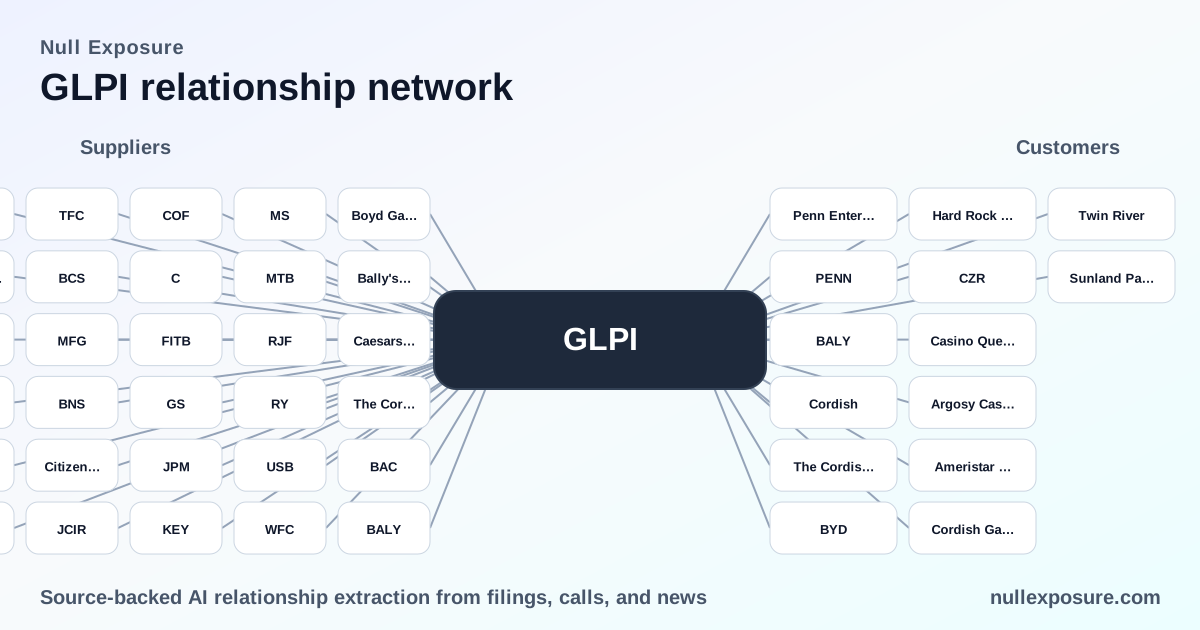
GLPI: A lease-first REIT betting on gaming operators to underwrite stable cash flow
Gaming & Leisure Properties (GLPI) acquires, finances and owns casino and leisure real estate and monetizes through long‑term, triple‑net leases that convert development and acquisition activity into predictable rental cash flow and dividends. The company’s strategy is capital‑intensive and tenant‑driven: GLPI funds land and construction for operators, secures long maturities and collects rent while tenants run gaming operations. For investors, the investment thesis is clear—real estate yield with concentrated tenant credit exposure—and due diligence must focus on tenant health and GLPI’s active development commitments.
Visit https://nullexposure.com/ for primary research and relationship analytics.
How GLPI makes money and deploys capital
GLPI operates as a specialty REIT that targets destination gaming and leisure properties, then converts operator balance‑sheet needs into landlord economics. The company commonly purchases real estate, funds construction or provides mortgage financing, and places assets on triple‑net leases so tenants assume operating and capital obligations while GLPI retains ownership and collects rent. This model produces high funds‑from‑operations visibility and enables GLPI to recycle capital into additional development and sale‑leaseback opportunities.
Key commercial drivers: high lease coverage on stabilized assets, recurring triple‑net rent, and active project finance for marquee developments that expand the rent roll. GLPI’s operating play is scale plus select development risk—it trades some upside to operators in exchange for durable leasing economics.
Operational constraints investors should price in
GLPI’s public disclosures and filing excerpts reveal structural characteristics you must incorporate into underwriting:
- Contracting posture — long‑term, triple‑net leases. GLPI’s leases commonly extend a decade-plus with renewal options and tenant responsibilities for maintenance, insurance and taxes; this underpins revenue predictability (GLPI 2024 Form 10‑K).
- Counterparty concentration — large enterprise tenants dominate revenue. Public gaming operators account for the bulk of cash rent; GLPI’s exposure is concentrated in a handful of large, listed counterparties (10‑K disclosures).
- Geographic diversification with U.S. focus. Properties are spread across roughly 20 states, reducing single‑market shock but leaving GLPI exposed to U.S. gaming cycles.
- Materiality and criticality. GLPI reports that a handful of tenants generate a material share of income—61% from PENN alone in 2024—which makes tenant health a critical valuation input (GLPI 2024 Form 10‑K).
- Active development posture and large-ticket commitments. GLPI is funding multi‑hundred million dollar projects (e.g., up to $940m for Bally’s Chicago), which increases short‑term funding needs and execution risk but should boost long‑term rent streams if projects stabilize.
- Single reportable segment and mature, asset‑centric portfolio. The business is essentially one segment—casino real estate—with homogeneous lease economics.
If you want a concise, relationship‑level readout for portfolio construction, our platform aggregates these linkages in a single view. Learn more at https://nullexposure.com/.
Relationship map — every counterparty disclosed in the results
Below is a plain‑English summary of each counterparty referenced in GLPI’s customer relationship results, with source context for validation.
Penn Entertainment / PENN / Penn Entertainment, Inc.
GLPI receives a significant portion of revenue from several wholly‑owned Penn subsidiaries that lease many GLPI properties under long‑term triple‑net master leases; those leases are central to GLPI’s cash flow profile (GLPI 2024 Form 10‑K). Source: GLPI 2024 Form 10‑K (filed FY2024).
In addition, GLPI committed project funding to support Penn’s Hollywood Casino Aurora and an M Resort tower expansion, including a $225m tranche for Aurora and $150m for M Resort construction (earnings call reporting, Q1 2026). Source: Penn earnings call transcript and Q1 2026 press coverage (Investing.com; MyChesco).
Bally’s / BALY / BALY‑T / Bally’s Corp.
Bally’s is GLPI’s most active development partner: GLPI has funded and financed a multi‑billion dollar package for Bally’s projects (including $940m allocated to Bally’s Chicago) and executed sale‑leasebacks that add immediate rent exposure and concentrated tenant risk. Source: IGamingBusiness, ENR, AlphaStreet (FY2026 coverage).
Specific property actions include GLPI purchases and master lease inclusions for Bally’s Chicago, Kansas City, Shreveport, Lincoln (Twin River) and others, with multiple funding tranches and sale‑leasebacks that increase Bally’s cash rent obligations. Source: Bally’s filings and multiple media reports (SEC filing referenced in news_sentiment; TheGamingBoardroom; Bisnow).
Bally’s Chicago (project)
GLPI provided development funding of $201.6m in Q4 and reported a remaining $738.4m on a $940m commitment as of year‑end, positioning GLPI as the principal real‑estate financier of the downtown Chicago casino. Source: MyChesco and AlphaStreet (Q4 2025 / FY2026 press).
Bally’s Dover Casino Resort; Bally’s Kansas City; Bally’s Shreveport; Bally’s Lincoln; Bally’s Baton Rouge; Bally’s Twin River; Bally’s Dover
GLPI has acquired or financed the underlying real estate for these Bally’s properties and folded them into master lease agreements that increase GLPI’s annual cash rent; individual transactions include sale‑leasebacks and commitments that lift Bally’s annual rent obligations (coverage across FY2025–FY2026 news). Source: SEC filing excerpts and news reports (SEC filing linked in results; Bisnow; TheGamingBoardroom).
Cordish / The Cordish Companies / Cordish Gaming / Cordish Live! Virginia
GLPI committed up to $467m (including a $27m land purchase) to support Cordish’s Live! Virginia project and closed on the real‑estate transaction as part of GLPI’s development pipeline. Source: GLPI earnings call transcript and MyChesco coverage (FY2026).
Caesars Entertainment / CZR / Caesars
GLPI leases multiple regional casinos to Caesars and reported ongoing development activity at certain Caesars‑operated projects; GLPI publicly commented on lease coverage and its neutral stance on takeover speculation during Q1 2026 reporting. Source: Casino.org and GLPI Q1 2026 news coverage.
Boyd Gaming / Boyd / BYD / Boyd Gaming
GLPI entered a mortgage loan agreement in connection with Boyd’s acquisition of Belterra Park, reflecting financing relationships beyond simple landlord leases and demonstrating GLPI’s flexibility as a financing counterparty. Source: GLPI 2024 Form 10‑K (FY2024 excerpt).
Ameristar Black Hawk
Ameristar is listed among GLPI’s portfolio properties; GLPI’s relationship is lease ownership and rent generation consistent with triple‑net arrangements across the portfolio. Source: Intellectia.ai summary of GLPI’s property list (FY2026 news).
Argosy Casino Alton
Argosy Casino Alton is named in GLPI property listings and subject to the same triple‑net leasing framework that defines GLPI’s operating income. Source: Intellectia.ai / GLPI press summaries (FY2026).
Casino Queen Marquette
Casino Queen Marquette is included in GLPI’s property portfolio and contributes to rental revenues under GLPI’s lease model. Source: Intellectia.ai coverage (FY2026).
Hard Rock Casino Rockford
Hard Rock Casino Rockford is part of GLPI’s owned properties and thus generates lease income under GLPI’s standardized operating leases. Source: Intellectia.ai portfolio listing (FY2026).
Sunland Park
Sunland Park is among the properties GLPI lists as leased to gaming operators, contributing to overall occupancy and rent coverage. Source: Intellectia.ai summary (FY2026).
Hollywood Casino Aurora
This under‑construction property is a joint funding project with Penn and GLPI funding a substantial portion; GLPI expects funding tranches timed with project opening to convert development funding into stabilized rent. Source: Casino.org and Penn reporting (Q1 2026).
M Resort (Las Vegas)
GLPI provided funding for an M Resort hotel tower and conference expansion, reflecting GLPI’s practice of financing tenant capital projects and converting them into leased real estate. Source: Penn earnings call transcript and Q4 2025 reporting (FY2026 coverage).
Twin River
Twin River featured in GLPI’s transactions and financing discussions (including sale‑and‑leaseback actions and revolver draws tied to tax benefits), underscoring GLPI’s role in complex capital transactions with operators. Source: GLPI earnings call transcript (InsiderMonkey; FY2026).
Investment implications and the concentrated risk trade
GLPI’s portfolio delivers predictable rental income and a reliable dividend profile when tenants perform. The trade for investors is concentration versus yield: large tenants like PENN and Bally’s produce outsized revenue contributions and development optionality, which both enhance growth prospects and concentrate counterparty credit risk. Investors must underwrite tenant credit cycles, the execution of GLPI’s development pipeline, and short‑term funding requirements tied to multi‑hundred‑million dollar commitments.
Bottom line: GLPI’s model is a disciplined, lease‑centric real estate play with measurable upside from active deployment—but total return and dividend durability are contingent on a few large gaming operators. For a practical, relationship‑level diligence pack that maps these linkages and evidence, visit https://nullexposure.com/.