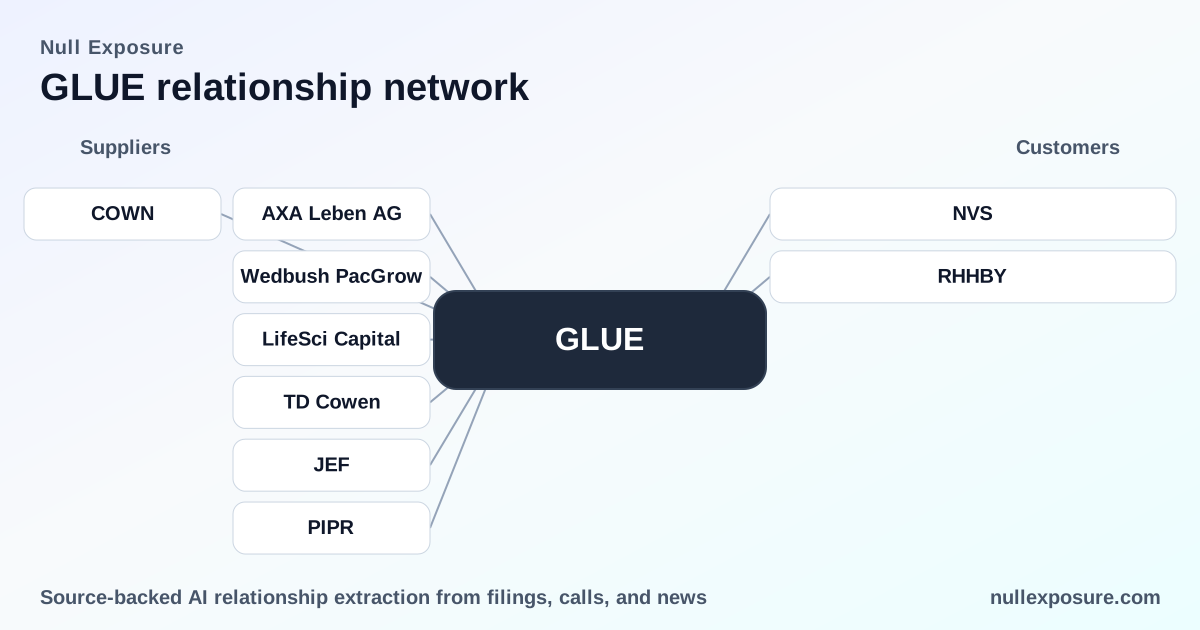
GLUE customer relationships: how collaboration licensing funds R&D and de-risks the pipeline
GLUE operates as a clinical-stage innovator focused on modular, novel therapeutics and monetizes primarily through collaboration and licensing agreements with large pharmaceutical partners that deliver upfront payments, milestone receipts and collaboration revenue as the company advances its core product candidates. Investors should value GLUE as a platform that converts early scientific value into cash inflection points via strategic partner deals rather than through product sales today.
If you want structured, repeatable monitoring of partner activity and deal receipts, visit https://nullexposure.com/ for coverage and tracking tools.
Why big-pharma partnerships are GLUE’s principal revenue engine
GLUE’s reported commercial activity in the public releases centers on two types of cash flows: non-refundable upfronts and milestone-triggered payments tied to development progress under license and collaboration agreements. Public statements explicitly describe collaboration revenue as amounts earned from those agreements, confirming that partner economics — not product sales — drive near-term top-line recognition. That structure converts scientific milestones into discrete, bankable events that investors can calendar and stress-test.
Operating model signals that matter to investors
Investors should interpret the following as company-level operating signals rather than relationship-level assertions:
- Contracting posture — licensing-focused: Public excerpts note that GLUE has entered into license agreements, which positions the company to monetize intellectual property and development programs through partner-funded development rather than capital-intensive internal commercialization.
- Concentration and criticality — single-segment developer: The company reports operations as a single operating and reportable segment committed to developing a portfolio of MGDs, indicating concentrated execution risk but also clarity of management focus on a single platform.
- Geography — EMEA revenue footprint: Disclosures state that all of the company’s revenue has been generated in Switzerland, signaling an EMEA revenue concentration for recognized collaboration receipts.
- Role flexibility — licensee dynamics present: At least one company excerpt indicates GLUE functions as a licensee under an exclusive, royalty-bearing, sublicensable and transferable agreement for certain VAV1-directed programs, which implies GLUE’s contractual posture can include being both a licensor of IP and a licensee in different contexts.
- Magnitude of partner funding — material upfronts: Company disclosures record a $150 million non‑refundable upfront payment received in December 2024, establishing that GLUE’s partner engagements can deliver nine‑figure cash injections to the balance sheet.
These signals together indicate a capital-efficient commercialization pathway for GLUE: scientific progress translates into partner-funded milestones and licensing receipts, but the business is sensitive to the timing and structure of those partner agreements.
Customer relationships: Novartis — a direct license and material upfronts
GLUE has a material, exclusive license relationship tied to VAV1‑directed modulators and received significant upfront compensation related to that partnership. According to Monte Rosa’s third-quarter 2025 financial release, the company recognized an increase primarily due to a $120.0 million non‑refundable upfront payment received from Novartis in September 2025 (GlobeNewswire, Nov 6, 2025 — https://www.globenewswire.com/news-release/2025/11/06/3182394/0/en/Monte-Rosa-Therapeutics-Announces-Third-Quarter-2025-Financial-Results-and-Business-Updates.html). In the company’s full‑year 2025 update, management reiterated that it holds a global exclusive development and commercialization license agreement with Novartis to advance VAV1‑directed MGDs, including MRT‑6160, framing Novartis as a strategic commercialization partner (GlobeNewswire, Mar 17, 2026 — https://www.globenewswire.com/news-release/2026/03/17/3256993/0/en/monte-rosa-therapeutics-announces-fourth-quarter-and-full-year-2025-financial-results-and-business-updates.html).
Customer relationships: Roche — milestone payments and collaboration revenue
Roche is an active collaborator that contributes milestone receipts and ongoing collaboration revenue to GLUE’s reported results. Company disclosures explicitly state that collaboration revenue represents amounts earned from our collaboration and license agreements with Roche and Novartis, signaling Roche’s role as a revenue-generating partner (GlobeNewswire, Nov 6, 2025 — https://www.globenewswire.com/news-release/2025/11/06/3182394/0/en/Monte-Rosa-Therapeutics-Announces-Third-Quarter-2025-Financial-Results-and-Business-Updates.html). In its full‑year 2025 release, Monte Rosa reported that a preclinical milestone under the strategic collaboration with Roche triggered a $7 million milestone payment in December 2025, demonstrating how R&D progress with Roche converts into near‑term cash (GlobeNewswire, Mar 17, 2026 — https://www.globenewswire.com/news-release/2026/03/17/3256993/0/en/Monte-Rosa-Therapeutics-Announces-Fourth-Quarter-and-Full-Year-2025-Financial-Results-and-Business-Updates.html).
What these relationships imply for valuation and risk
- Cash visibility: The combination of large non‑refundable upfronts and discrete milestone receipts materially improves short‑term liquidity and reduces the need for dilutive capital events while programs are de‑risked by partner investment.
- Event-driven equity sensitivity: Valuation will be highly sensitive to development milestones and partner timelines — investors should model discrete milestone schedules rather than steady-state sales growth.
- Concentration risk: Dependence on a small number of large pharma partners concentrates counterparty and execution risk; a delayed milestone or partnership change has outsized balance‑sheet and revenue implications.
- Geopolitical and accounting considerations: Revenue recognition tied to license and collaboration agreements is influenced by contract structuring and where revenue is generated; GLUE’s Switzerland revenue concentration warrants attention to EMEA regulatory and tax regimes.
Key takeaway: GLUE’s business monetizes science through strategic licenses and collaborations that deliver large, discrete cash events; the company’s near-term financial trajectory is tightly coupled to partner milestones and deal economics.
If you want continuous monitoring of partner announcements and milestone receipts for GLUE, explore coverage at https://nullexposure.com/.
Final read: how to watch the story unfold
Track three items to stay ahead of the GLUE thesis: timing and size of future partner upfronts, the cadence of milestone triggers from Roche and Novartis, and any changes to contractual roles or geographic revenue mix. If partner receipts continue at current scale, GLUE’s capital runway and optionality expand materially; conversely, missed milestones or partner reprioritization would create immediate valuation pressure.
Bottom line: GLUE is a deal‑driven clinical developer whose valuation is set by partner economics and milestone execution — investors should underwrite the company as a monetization platform that translates scientific progress into large, discrete cash events.