Corning (GLW): Customer Relationships Driving an AI and Mobile Materials Re‑rating
Corning monetizes advanced glass, ceramics and fiber‑optic products by manufacturing and selling engineered materials to large OEMs, hyperscalers and carriers under a mix of long‑term supply agreements and direct sales, with incremental royalty/licensing income. The company's recent re‑rating is driven by multiyear fiber contracts with hyperscalers and expanded U.S. glass production for Apple, translating manufacturing scale into durable revenue visibility and capital deployment optionality. For deeper coverage of counterparty exposures and customer signal intelligence, visit https://nullexposure.com/.
How Corning’s customer relationships translate into cash and risk
Corning operates as a global manufacturer and seller: the core revenue engine is product delivery recognized at a point in time, while certain lines are supported by non‑refundable deposits and long‑term supply agreements that improve cash visibility. Corning’s customer base is concentrated in large enterprises and hyperscalers, and sales are geographically diversified—North America, EMEA and APAC are material to top‑line mix—so commercial risk is a function of contract tenure, product criticality and regional deployment cycles. The company also conducts annual credit reviews for significant customers, indicating a mature credit governance layer rather than opportunistic spot selling.
- Contracting posture: Evidence of deposits and long‑term agreements points to a tilt toward multi‑year commitments that lock capacity and cash.
- Concentration: Large hyperscaler and OEM contracts introduce customer concentration as a key revenue driver.
- Criticality: Products sold to data centers and flagship smartphones are mission‑critical to buyers and thus command priority allocation.
- Maturity: Corning’s business model blends mature manufacturing economics with strategic, higher‑value partnerships (licensing is currently immaterial to results but present).
The relationship inventory — what institutions and OEMs matter today
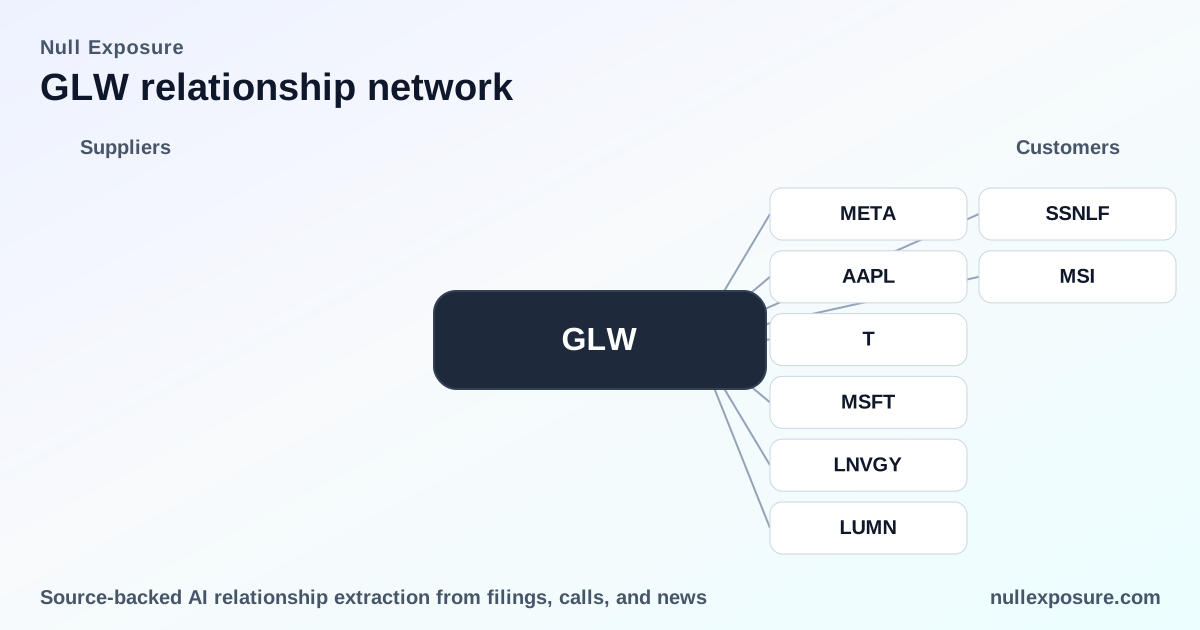
Below are the counterparties cited in public sources and management remarks. Each entry is a concise, plain‑English read on the tie and a short source note.
Apple (AAPL)
Corning is manufacturing 100% of iPhone and Apple Watch cover glass in the U.S., supported by an Apple commitment to expand domestic supplier spending and a multibillion‑dollar supply arrangement centered on Corning’s Kentucky facility. According to Corning management and Apple’s Q1 2026 remarks, Apple committed funding enabling full U.S. production of cover glass (FY2026, GLW and Apple earnings call coverage).
Source: Corning earnings calls and Apple Q1 2026 commentary; news reports summarizing the supply agreement (March–May 2026).
Meta Platforms (META)
Meta signed a multiyear agreement, up to $6 billion, to buy Corning’s optical fiber and cable for AI data centers, creating a multi‑year revenue stream that materially increased investor confidence and drove a re‑rating. Multiple media accounts and Corning’s disclosures tied this deal directly to heightened demand for AI‑grade connectivity (FY2026).
Source: Company announcements and media coverage of the $6 billion Meta agreement (January–May 2026).
Microsoft (MSFT)
Corning and Microsoft expanded a longstanding relationship with a collaboration to accelerate production of hollow‑core fiber, positioning Corning as a supplier for Microsoft’s next‑generation connectivity needs. Management referenced this collaboration on Corning’s Q3 2025 earnings call as an example of deepening enterprise ties.
Source: GLW Q3 2025 earnings call transcript (March 2026).
GlobalFoundries (GFS)
GlobalFoundries identified a collaboration with Corning around detachable fiber attach for silicon photonics, signaling Corning’s role in advanced packaging and photonics ecosystems beyond pure cable and cover glass. GFS referenced the partnership in its Q4 2025 earnings commentary.
Source: GlobalFoundries Q4 2025 earnings call (March 2026).
Lumen Technologies (LUMN)
Lumen reserved capacity via a multiyear deal that reportedly earmarked ~10% of Corning’s global fiber production capacity for two years—positioning Lumen as a priority carrier customer and demonstrating scarcity of manufacturing bandwidth. Lumen and Corning cited expanded partnership on carrier business during earnings coverage.
Source: Lumen and Corning call coverage and sector press (mid‑2024 deal cited in FY2026 commentary).
AT&T (T)
Corning cites sales to large carriers including AT&T when discussing its carrier business, reflecting the company’s role as a supplier into telecommunications network builds and upgrades. Management included AT&T as an example when describing the carrier sales channel.
Source: GLW Q4 2025 earnings call transcript (March 2026).
CTBB and CTDD (corporate customers using Corning fiber)
Multiple caller transcripts (CTBB and CTDD) referenced expanded partnerships with Corning to secure priority access to state‑of‑the‑art fiber for AI backbone deployments, indicating Corning’s role as a prioritized supplier for enterprise and carrier partners building AI‑grade infrastructure.
Source: CTBB and CTDD Q4 2025 earnings call excerpts (March 2026).
TE (TE)
TE’s releases and related industry notices reference domestic wafers from Corning as part of a U.S.‑centric supply chain for energy and cell manufacturing projects, demonstrating Corning’s upstream role in specialized wafer supply for energy/EV‑adjacent projects (FY2025–FY2026).
Source: GlobeNewswire and energy sector releases citing Corning wafers (Dec 2025–Feb 2026).
QuantumScape (QS)
QuantumScape and Corning announced an agreement for ceramic separator development and commercialization, indicating Corning’s strategic reach into battery materials for high‑volume EV battery production and commercialization support (announcement dated Q3 2025).
Source: QuantumScape corporate announcement and subsequent press mentions (Sept 2025–Mar 2026).
Motorola (MSI / LNVGY)
Motorola is an early adopter for Corning’s Gorilla® Glass Ceramic 3, planning to use the material on its next‑generation foldable device (the Razr fold), which signals commercial adoption in a high‑visibility OEM channel for cover glass innovations.
Source: Product launch coverage and Corning press summaries (Mobile World Congress and March 2026 reporting).
Samsung (SSNLF / Samsung)
Samsung continues to use Corning’s Gorilla Glass in premium flagships, representing another major OEM channel for Corning’s cover glass franchise and reinforcing the company’s broad OEM penetration in smartphones.
Source: Market press coverage and investor summaries referencing Samsung’s use of Gorilla Glass (March 2026).
Dell, Google (GOOGL), HP Inc. (HPQ)
Corning indicated expanding relationships with major OEMs across computing and mobile — Dell, Google and HP are named among the OEMs increasing use of Corning materials, signaling diversified OEM demand beyond smartphones into broader consumer and enterprise devices.
Source: Analyst write‑ups and trading commentary summarizing OEM relationships (March–May 2026).
What investors should watch next
- Capacity allocation and margin leverage: Multiyear hyperscaler contracts lock revenue but require capex and disciplined execution—monitor capital intensity and gross margin trends.
- Customer concentration risk: Large deals (Meta, Apple) materially move revenue mix and investor sentiment; downside in demand from these partners would have outsized impact.
- Geographic exposure: With roughly 57%–61% of sales outside the U.S. (2024–2025 disclosures), FX and regional demand cycles will continue to shape quarterly results.
For a concise, ongoing feed of counterparty intelligence and to map these relationships into commercial and supply‑chain risk models, visit https://nullexposure.com/.
Bold takeaway: Corning’s 2026 re‑rating is the product of large, multi‑year hyperscaler fiber contracts and a secured, U.S.‑based cover glass pipeline for Apple, converting manufacturing scale into predictable, higher‑value cash flows.