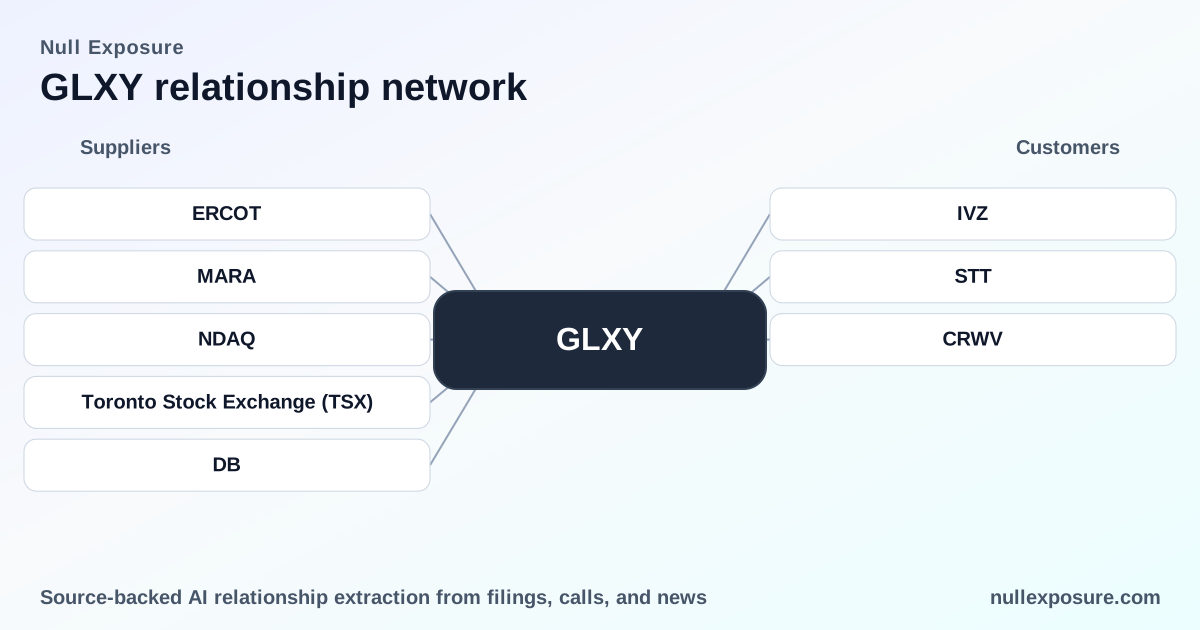
Galaxy Digital (GLXY) — Customer Relationships: who pays, who borrows, who relies
Investor thesis: Galaxy monetizes through a triad of business lines — lending and structured credit against crypto treasuries, institutional custody and asset management for tokenized assets, and data‑center hosting/AI infrastructure leasing — extracting fees, interest spread and long‑term contracted revenue from customers that use Galaxy as lender, custodian, strategic advisor, and host. For allocators and operators evaluating GLXY, the most actionable signal is the mix of short‑duration, collateralized lending relationships alongside a growing pipeline of multi‑year infrastructure leases that together shape cash flow profile and counterparty concentration. Learn more at https://nullexposure.com/.
Market snapshot and what to watch
- Galaxy is executing a hybrid model: short‑term, high‑turnover digital‑asset loans and advisory services that generate fee and interest income, paired with capital‑intensive, longer‑dated Helios data‑center leases meant to create recurring revenue.
- Risk vectors are twofold: credit exposure to borrowers secured in volatile crypto assets, and capital commitments for Helios that depend on successful lease ramp to customers such as CoreWeave.
- Opportunities: custody and staking services for institutional treasury managers (BlackRock, Sui Group, FG Nexus) provide scalable fee pools with low marginal cost.
A mid‑report action: if you need ongoing monitoring of these counterparty dynamics, consider tracking Galaxy’s customer flows and filings at https://nullexposure.com/ for updated alerts.
Customer relationship roll call — concise takeaways and sources
-
FGNX / Fundamental Global / FG Nexus (FGNX / FGNXP)
Galaxy has been engaged as a strategic advisor to manage an Ethereum treasury, providing asset management, yield execution and infrastructure support for Fundamental Global’s rebranded FG Nexus treasury strategy. Source: CoinDesk and Tokenist coverage of FG Nexus treasury announcement (FY2025 / March 2026). -
LM Funding America (LMFA)
LM Funding extended and repeatedly renegotiated an $11 million Galaxy Digital‑originated loan facility, with public disclosures showing Galaxy holding Bitcoin as collateral (reported 145 BTC in reporting periods) and LMFA using the facility to finance share repurchases. Source: multiple company updates and press releases (GlobeNewswire / Investing.com / March–May 2026; FY2025–FY2026 filings). -
Forward Industries (FWDI)
Forward Industries entered a Master Digital Currency Loan Agreement with Galaxy for a $40 million facility (weighted average APR ~3.4%, short weighted maturity) to finance a $27.4 million share repurchase and to support its Solana treasury strategy; the agreement also underpins operational cooperation for staking and PropAMM testing. Source: GlobeNewswire, Yahoo Finance and TradingView summaries (March–May 2026; FY2026). -
Sui Group (SUIG)
Sui Group appointed Galaxy as its official asset manager and custodian for digital assets, with public reporting that Galaxy provides custody, asset management and staking infrastructure tied to Sui’s treasury pivot and fundraising. Source: CoinDesk and MEXC press coverage (January–March 2026; FY2026). -
CoreWeave (CoreWeave / CRWV)
CoreWeave is a large, revenue‑generating tenant at Galaxy’s Helios data‑center campus; Galaxy delivered the first data hall under a Phase I lease (targeting ~133 MW by end‑Q2 2026), signalling the start of recurring infrastructure revenue. Source: Galaxy earnings call and multiple news reports on Helios delivery (Galaxy 2025 Q4 earnings call; press, April–May 2026; FY2026). -
Argo Blockchain (ARBK / ARBKL)
Argo used proceeds from asset sales to repay debt owed to Galaxy and has had prior hosting and loan discussions with Galaxy at Helios; Galaxy informed Argo it would not renew certain hosting arrangements beyond a 2024 end date, and other Galaxy loans to Argo were refinanced historically. Source: FXNewsGroup, StockTitan and Proactive Investors reporting (FY2024–FY2025). -
K Wave Media (KWMWW)
Galaxy acts as asset manager and strategic advisor to K Wave Media, taking an equity stake of roughly $1 million and receiving warrants as part of a tokenization and entertainment‑platform initiative. Source: Futunn and QuiverQuant press coverage (FY2025). -
Morgan Stanley related program (MS‑P‑A)
Public reporting indicates Morgan Stanley’s advisor communications referenced using third‑party operators, including Galaxy Digital, to provide crypto exposure to clients — positioning Galaxy as a potential provider to wealth channels. Source: The Block reporting on Morgan Stanley plans (FY2022 filing context reported in 2026). -
Invesco (IVZ / Invesco)
Galaxy partnered with Invesco to launch a Solana ETP, reflecting bilateral product distribution and tokenized ETF product collaboration. Source: Galaxy 2025 Q4 earnings call disclosure (2025 Q4). -
State Street Global Advisors (STT / State Street)
Galaxy collaborated with State Street Global Advisors on tokenization efforts, including a private liquidity fund, indicating institutional partnerships that combine Galaxy’s execution with legacy asset managers’ distribution. Source: Galaxy 2025 Q4 earnings call (2025 Q4). -
BlackRock (BLK)
BlackRock selected Galaxy as an approved validator for its iShares Staked Ethereum Trust ETF, representing a high‑profile staking and validator services engagement with one of the largest asset managers. Source: Cryptobriefing coverage of Q1 2026 relationships (FY2026).
Operating model constraints and what they signal
-
Contracting posture: Galaxy typically operates as both principal lender and service provider — offering collateralized loans, custody, staking and advisory services — which creates dual exposure (credit risk on loans; service revenue and reputational risk on custody/validator duties). This structure favors recurring fee capture but requires active collateral management and legal documentation discipline. (Company‑level signal — no explicit constraint excerpts named a relationship.)
-
Concentration and criticality: Relationships range from short‑duration, collateralized credit (LMFA, Forward) to multi‑year infrastructure leases (CoreWeave). The credit book is concentrated by product type (digital‑asset loans) but diversified by counterparty; the Helios hosting commitments create a single large customer dependency risk as capacity ramps. (Company‑level signal.)
-
Maturity mix and tenor: Galaxy’s customer portfolio shows a mix of short‑maturity digital‑asset lending (months) and longer‑dated infrastructure contracts (years), producing a cash‑flow profile that is sensitive to crypto‑price mark‑to‑market in the near term and to construction/lease execution in the medium term. (Company‑level signal.)
-
Contractual security: Many lending relationships are explicitly collateralized by digital assets (public filings show Galaxy holding BTC as security for LMFA), which compresses unsecured credit risk but exposes Galaxy to concentrated price volatility when liquidations occur. (Company‑level signal.)
Key takeaways for investors and operators
- Galaxy’s revenue engine is hybrid: short‑term, high‑frequency lending and advisory fees plus nascent, high‑capital leasing revenue from Helios. Credit performance and Helios ramp are the two principal operational levers.
- Watch three metrics closely: (1) collateral valuations and loan covenant performance across the credit book, (2) Helios occupancy and contracted MW ramp (CoreWeave contribution), and (3) institutional custody/staking mandates (BlackRock, Sui, FG Nexus) that scale fee income without proportional capital needs.
If you want continuous tracking of these counterparties and their filings, NullExposure maintains an ongoing customer‑relationship feed and alerting service at https://nullexposure.com/.