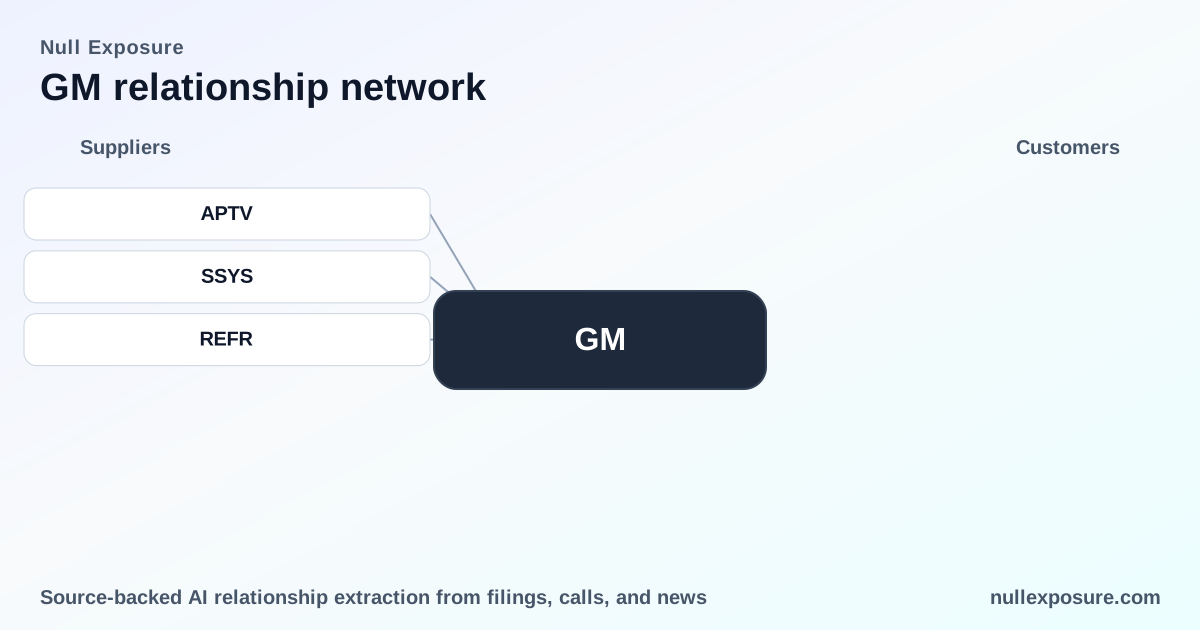
GM’s commercial map: how customer relationships shape revenue, risk and strategic optionality
General Motors (GM) is a vertically integrated automaker that monetizes through three clear channels: wholesale vehicle sales to dealers and fleets, direct monetization of software and subscription services, and finance/leasing through GM Financial. Investors should value GM as a mature OEM whose core cash flows still come from hardware (vehicle and parts sales) while recurring revenue from software, connected services, and energy partnerships is expanding the company’s margin mix and balance‑sheet exposure. Learn more at https://nullexposure.com/.
Why this matters for investors: GM’s commercial footprint exposes it to concentrated dealer, fleet and government channels while simultaneously making it a counterparty for dozens of suppliers, platform licensees and utility pilots — each relationship carries different revenue profiles, contract structures and operational criticality.
Business model signals that drive valuation and downside risk
- GM sells vehicles and parts at wholesale to authorized dealers and distributors, and to fleet and government buyers, and offers software-enabled features and subscriptions globally, creating a hybrid hardware + recurring revenue model.
- The company’s contracting posture mixes long‑term supply and licensing arrangements (platform sharing, joint development) with high-volume wholesale dealer agreements; dealer and fleet resales create distribution concentration that supports volume but concentrates counterparty credit and logistics risk.
- Geographic concentration in China (1.9 million units in 2025; ~7.1% market share in that year) and significant North American scale (Super Cruise availability across U.S./Canada networks) make GM highly exposed to APAC and NA demand cycles.
- Product segmentation spans core hardware (vehicles, parts), services (after‑sales, warranties), and software (over‑the‑air features, driver assistance), implying evolving margin structure and higher lifecycle revenue capture for successfully monetized software features.
Selected relationship-by-relationship read on how GM connects to its ecosystem Below I summarize every relationship flagged in the reviewed results, with short plain‑English takeaways and source context.
ABG — dealer/new‑vehicle membership relationship
ABG’s FY2024 10‑K lists General Motors (Chevrolet, Buick and GMC) in the context of new vehicle membership, indicating ABG carries GM’s new‑vehicle franchises and sells GM product lines through its retail network. According to ABG’s FY2024 filing, GM brands are represented among ABG’s new‑vehicle offerings (ABG 10‑K, FY2024).
ASPN — supplier of battery‑system thermal barriers
Aspen Aerogels disclosed in its FY2024 10‑K that it entered contracts in 2020–2021 to supply thermal barrier products for GM’s EV battery systems, identifying it as a component supplier integrated into GM’s electrification supply chain (Aspen FY2024 10‑K).
PCG‑P‑D — charger / V2H technology participant in a V2G ecosystem article
An Electrive report (April 2026) describes a participant supplying a 19.2 kW bidirectional PowerShift charger and a V2H bundle enabling Vehicle‑to‑Home functionality in a program that includes GM vehicles, pointing to GM’s involvement in residential energy integration pilots (Electrive, Apr 2026).
DRVN — certified repair network includes GM fleet coverage
Finviz reported that DRVN’s certified EV repair programs list “GM Fleet” among supported OEMs, signaling that GM vehicles are covered within third‑party certified collision/repair networks (Finviz, Mar 2026).
RUSHB — origins tied to a GMC franchise
An obituary and historical note about Rush Enterprises cites its founding as a single GMC truck franchise in Houston, illustrating historical dealer franchise relationships tied to GM heavy‑truck brands (Treshewell obituary, FY2018).
HMC (Honda Prologue coverage) — Ultium platform partner (news)
Auto review coverage on Yahoo noted the 2025 Honda Prologue is built on GM’s Ultium platform and shares architecture with GM models such as the Chevrolet Blazer EV, confirming cross‑OEM platform sharing and assembly relationships (Yahoo Autos, 2025/2026 coverage).
Honda — platform partner and OEM collaboration
The same reporting on the Honda Prologue reiterates that Honda sourced GM’s Ultium architecture for several joint vehicles, a strategic partnership that monetizes GM’s battery and platform IP through OEM customers (Yahoo Autos, 2026).
MCFT — brand/promotional activation with Chevrolet trucks
A GlobeNewswire release shows MasterCraft’s “Let Her Rip” campaign is “Powered by Chevrolet Silverado 2500HD Trucks,” demonstrating GM’s use of brand‑level activation and product placement to support marketing and co‑sponsorship revenue/awareness (GlobeNewswire, Mar 2026).
SOJE — fuel‑cell demonstration partner with Southern Company
EV news coverage reports GM is sending trucks to Southern Company to demonstrate fuel‑cell applications for fleets and commercial customers, which indicates GM’s strategic experimentation with alternative powertrains in utility pilot deployments (The Buzz EV News, FY2024).
RUSHA — public company history tied to GMC franchise
Local news reporting on Rush Enterprises’ history reiterates the company’s origins with a GMC truck franchise and its later IPO, underscoring longstanding dealer OEM ties that route GM volume into public and private dealer chains (ExpressNews, FY2022).
PHIN — DELCO REMY trademark licensee mention
A news item (MEXC, Mar 2026) notes that DELCO REMY is a registered trademark of General Motors LLC and is licensed to PHINIA Technologies Inc., highlighting GM’s licensing of legacy component brands or IP to third parties (MEXC press note, Mar 2026).
HMC (Motor1) — commercial/financial consequences of platform sourcing
Motor1 reported Honda will owe GM money after reduced Prologue sourcing and the discontinuation of the Acura ZDX EV, underscoring the contractual and financial linkages when OEMs jointly develop and assemble vehicles under GM’s production footprint (Motor1, Mar 2026).
SOLO — speculative use of an OEM facility
A 2019 report flagged talk that ElectraMeccanica was in discussions to use GM’s Oshawa plant, reflecting how GM’s physical manufacturing footprint can become an asset redeployed or discussed in M&A/contract manufacturing contexts (Proactive Investors, FY2019).
PCG‑P‑I — PG&E residential V2E pilot with GM Energy products
Pacific Gas & Electric announced in 2025 that GM joined its residential Vehicle‑to‑Everything pilot, offering incentivized pricing for qualifying GM Energy home products — concrete evidence of GM’s push into home energy and utility partnership channels (PG&E press release, 2025).
MCFT (Auto show coverage) — Chevrolet as official tow vehicle
Event coverage of MasterCraft’s water tour again identifies Chevrolet Silverado as the official tow vehicle, reinforcing multiple appearances of GM trucks in marketing activations and co‑brand events (Auto show coverage, 2026).
CROX — consumer brand collaborations with Chevy
An investor call transcript from Crocs describes collaborations that include Chevy as a brand partner, reflecting GM’s licensing and co‑branding activity with consumer goods companies (InsiderMonkey, Q1 2026 earnings call).
AN — heavy dealer dependence on GM manufacturing
AN’s FY2025 10‑K states that approximately 89% of its new vehicle sales came from brands manufactured by GM, illustrating single‑OEM concentration for some retailers and the downstream sales dependence that amplifies GM’s channel power (AN FY2025 10‑K).
Investor takeaways and risk posture
- Concentration + criticality: GM’s revenue is anchored by dealer and fleet channels that create both scale and concentration risk; several dealer and reseller relationships (AN, ABG, Rush Enterprises) confirm downstream dependence.
- Transition risk and upside from software/energy: Platform licensing (Ultium to Honda) and energy pilots (PG&E V2E) create recurring revenue potential beyond one‑time vehicle sales, shifting future margin profiles toward higher‑margin services.
- Supplier and IP exposures: Component suppliers (Aspen) and trademark licensees (PHIN) reveal both supply chain dependencies and IP monetization opportunities; contract terms for joint development (Honda) create cash settlements if volumes change.
- Brand and marketing monetization: Co‑sponsorships and licensing (MasterCraft, Crocs) show GM actively leverages its consumer brands for non‑vehicle revenue and awareness.
For investors focused on revenue mix, credit exposure, and strategic optionality, these relationships collectively present a company that is still hardware‑centric but accelerating recurring and platform monetization, with concentrated dealer/channel dependencies that require monitoring. For deeper relationship mapping and context, visit https://nullexposure.com/.