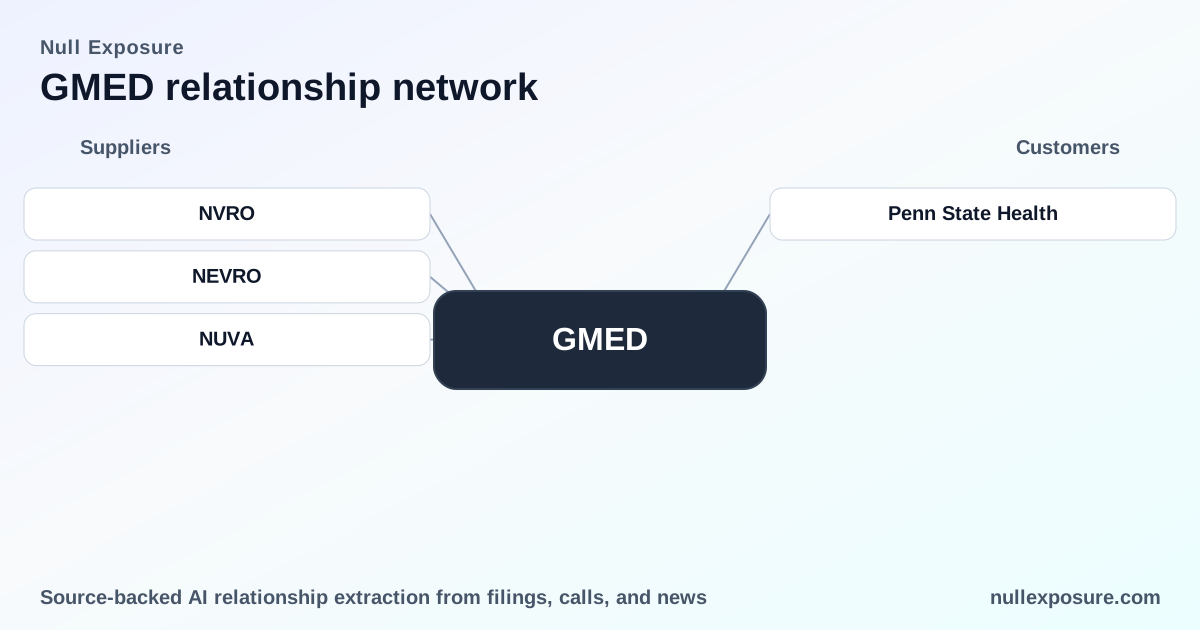
Globus Medical (GMED): Customer Relationships and What They Signal for Investors
Globus Medical develops and sells musculoskeletal implants and enabling technologies and monetizes through direct sales and commissions to exclusive distributors, with the United States as the core market and international expansion contributing meaningful incremental revenue. The company’s business model is a hybrid direct-sell/exclusive-distributor model that captures high-margin implant revenues domestically while growing international exposure through partner channels and regulatory-assisted market entry. For a concise operational profile and ongoing coverage, see https://nullexposure.com/.
Investment thesis — clear revenue mechanics and a distributor-led expansion path
Globus converts product development into repeatable surgical revenue streams via its Musculoskeletal Solutions portfolio and complementary enabling technologies; direct sales drive U.S. scale while exclusive distributors and regulatory strategies accelerate international uptake, supporting the company’s premium valuation and steady operating margins.
How to read the customer signals
Globus’s customer relationships fall into two observable categories in recent public reporting: clinical/health system adoption and regulatory-facilitated third‑party product launches tied to Globus’s capabilities or market channels. Together these items illustrate a commercially mature U.S. franchise with selective international partnerships that can catalyze new product shipments.
- Commercial concentration: The U.S. remains the primary revenue engine, but international sales accounted for roughly 20.6% of total net sales in 2024, indicating meaningful runway outside North America (company filing, year ended Dec. 31, 2024).
- Channel mix and contracting posture: Globus sells through a combination of direct sales representatives and exclusive independent distributors; this hybrid approach supports surgical adoption while outsourcing regional market access (company filing, FY2024).
- Regulatory leverage: Third-party sponsors referencing “via GMED” for EU regulatory milestones indicate Globus’s involvement in enabling regulatory pathways or acting as a channel for market entry in Europe (press reporting, 2026).
For more detailed signal aggregation and relationship tracking, visit https://nullexposure.com/.
Customer relationship snapshots — direct, clinical and regulatory ties
This section covers every relationship listed in our sources and summarizes the investor-relevant facts.
Profusa / PFSA — regulatory pathway tied to shipments
Profusa announced that it intends to provide an update on its European CE Mark approval via GMED under the EU Medical Device Regulation in 1Q2026, and that approval will catalyze product shipments beginning in 2Q2026. This suggests Globus plays a role in the European regulatory or commercialization pathway for Profusa’s tissue oxygen monitoring product. (GlobeNewswire press release, Feb. 19, 2026.)
Penn State Health — early clinical adoption and opinion-leader validation
In coverage of Globus’s ANTHEM™ Elbow Fracture System, a surgeon from Penn State Health described the design as practical and reliable in the system’s first clinical use, highlighting anatomically contoured plates and effective fixation with minimal disruption to surrounding tissue. This is a classic clinical endorsement that supports commercial adoption within academic and trauma centers. (OrthospineNews, Oct. 15, 2025.)
What these specific relationships imply for GMED’s operating model
The documented relationships map directly to Globus’s strategic playbook:
- Regulatory-enabled channel activity: The Profusa item demonstrates Globus’s capacity to be enlisted in regulatory or distribution roles that accelerate non‑Globus products into European markets, indicating value beyond pure product sales and potential service or partnership revenue streams. (GlobeNewswire, Feb. 2026.)
- Clinical validation driving adoption: The Penn State Health quote functions as market signaling — early clinical endorsements from recognized centers speed surgeon acceptance and support case-volume ramp for new implants. (OrthospineNews, Oct. 2025.)
Constraints and company-level signals that shape risk and runway
Below are firm-level constraints derived from company disclosures and their implications for contracting posture, concentration, criticality, and maturity.
- Government counterparty exposure is material internationally. Globus discloses that many non‑U.S. customer relationships are with governmental entities and are therefore governed by anti‑bribery and similar laws; this elevates compliance and contracting risk in markets with government-sponsored healthcare (company filing, FY2024). Expect more structured procurement cycles and longer negotiation timelines in those jurisdictions.
- Geographic footprint is global but U.S.-centric. The company has sold products in roughly 65 countries and reported international sales at ~20.6% of total sales in 2024, while the U.S. remains the dominant market (company filing, FY2024). This configuration produces concentration risk in North America but also upside from international expansion.
- Regional pockets of strength: APAC and EMEA matter. A significant portion of foreign revenues comes from Japan, the Euro zone, the UK and Australia, indicating regional maturity in select advanced healthcare markets (company filing, FY2024).
- Hybrid selling model defines contracting posture. Globus’s revenue is driven by direct sales representatives in the U.S. and exclusive independent distributors internationally, implying a balance between direct margin capture and distributor-enabled scale (company filing, FY2024).
- Product portfolio and revenue mix reflect commercial maturity. Most revenue sits in Musculoskeletal Solutions, with Enabling Technologies contributing a smaller but growing share—a profile consistent with an established device company rolling new technology into an incumbent install base (company filing, FY2024).
Each of these constraints is a company-level signal: they collectively shape sales cycles, regulatory exposure, and margin durability instead of being tied to any single customer unless explicitly noted.
Key investor takeaways
- Globus is an established surgical device vendor with a repeatable U.S. revenue base and deliberate international expansion through distributors and regulatory partnerships.
- Customer evidence spans practical clinical adoption (Penn State Health) and regulatory/commercial facilitation for third parties (Profusa), both of which support adoption pathways and potential non-traditional revenue streams.
- Risk profile is governed by U.S. concentration, government counterparties internationally, and the hybrid channel model; investors should weigh steady domestic cashflows against execution risk in complex international procurements.
If you want continuous, transaction-level visibility into Globus’s counterparties and channel activity, Null Exposure tracks these relationship signals in real time — learn more at https://nullexposure.com/.
Conclusion: Globus’s customer signals reinforce a classic med‑tech growth narrative — solid domestic cash generation, targeted international expansion via distributors and regulatory partnerships, and clinical endorsements that underpin steady adoption across its implant and enabling-technology portfolios.