Genie Energy (GNE): Customer Relationships That Drive Revenue and Concentration Risk
Genie Energy monetizes through two complementary channels: Genie Retail Energy (GRE) resells electricity and natural gas to residential and small-business customers across deregulated U.S. markets, while Genie Renewables / Genie Solar develops, constructs and sometimes operates utility-scale solar projects and sells solar panels. Revenue accrues from commodity resale margins in GRE and from construction and project revenue in renewables, with construction services recognized over time for customer-specific solar projects and panel sales recognized at a point in time. For deeper relationship analytics and ongoing monitoring, visit https://nullexposure.com/.
A concise picture of how customers translate to cash flow
Genie’s consolidated revenue profile is heavily weighted to GRE: GRE accounted for roughly 95% of consolidated revenue in recent years, and GRE produced $403.3 million of revenue in 2024 (electricity $350.5M; natural gas $52.1M). That concentration makes customer composition and counterparty dynamics the primary drivers of short- and medium-term cash flow volatility. Geographic exposure is anchored in the Eastern and Midwestern U.S. plus Texas, with only small foreign receipts (primarily Israel) reported in 2024.
- Business model drivers: resale margins on commodity supply and recurring recognition of construction services for solar projects.
- Revenue concentration: one named customer accounted for 20% of consolidated revenue in 2024, creating a tangible single-customer risk vector.
- Counterparty mix: business is dominated by residential and small-business end-customers; GRE’s REP subsidiaries act as resellers to those end-users.
Contracting posture: project-level long-term commitments versus spot product sales
Genie operates with a dual contracting posture that shapes both revenue certainty and working-capital profile. Solar project contracts are long-term, multi-performance-obligation contracts where construction services create customer-specific assets and revenue is recognized over time. In contrast, solar panel sales are point-in-time transactions that convert inventory to cash upon delivery or shipment. This mix gives the company a blend of predictable, multi-year project cash flows and more volatile spot sales.
Customer and segment constraints that matter to investors
Several company-level signals define operational risk and maturity:
- Segment dominance: Distribution (GRE) is the revenue engine and the core product offering for retail energy resale.
- Materiality and concentration: GRE’s revenue contribution (~95% of consolidated revenue) and a single customer representing 20% of revenue are material and require monitoring for churn or contract repricing.
- Scale of spend: GRE’s revenue scale places it in a >$100M spend band, suggesting meaningful counterparty procurement and credit exposure in wholesale markets.
- Geographic concentration: North America (Eastern/Midwestern U.S. and Texas) is the primary market; EMEA exposure is immaterial in scale but present by footprint.
- Relationship roles: GRE’s subsidiaries primarily resell electricity and natural gas; Diversegy functions as an energy procurement advisor in Genie’s group structure.
These characteristics produce a business that is operationally mature in retail distribution, project-oriented in renewables, and sensitive to wholesale commodity cycles and customer concentration.
The counterparties disclosed in filings and press coverage
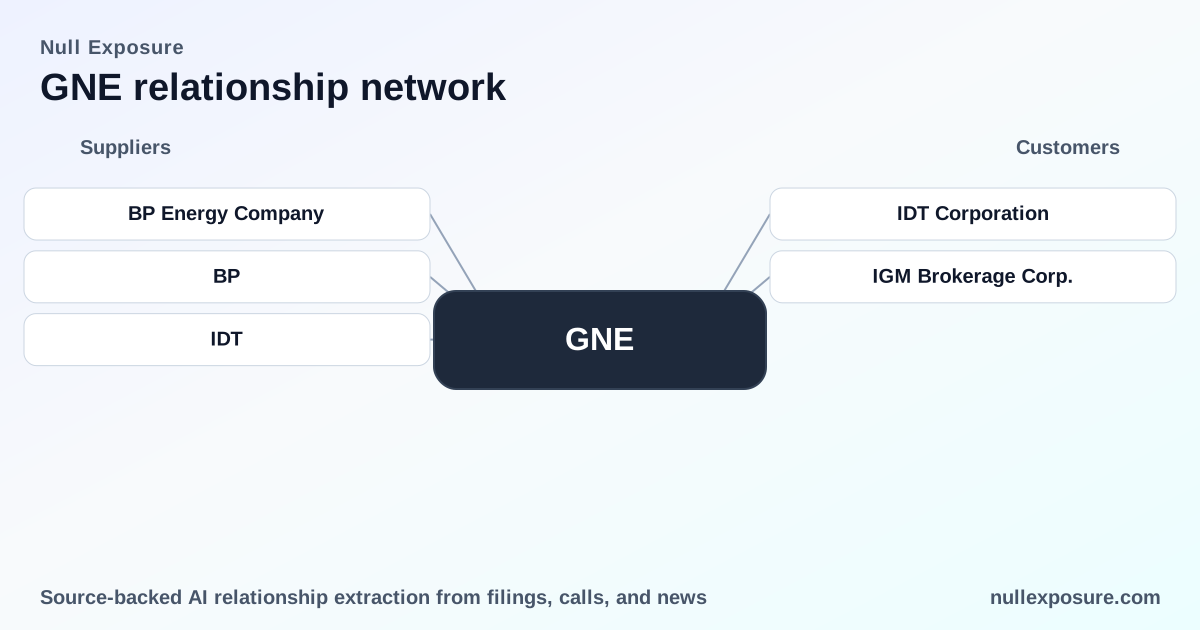
Below are the explicit relationships turned up in Genie’s customer-focused disclosures and recent press.
-
IDT Corporation
Genie provides specified administrative services to certain of IDT Corporation’s foreign subsidiaries, indicating direct B2B administrative arrangements beyond commodity resale. This relationship is documented in Genie’s 2024 Form 10‑K. -
IGM Brokerage Corp.
Genie paid approximately $0.4 million in 2024 (and the same in 2023) to IGM Brokerage for insurance premiums brokered by IGM, demonstrating a modest but recurring vendor/broker relationship tied to the company’s risk-transfer arrangements, according to Genie’s 2024 Form 10‑K. -
Diversegy
Diversegy, a majority-owned advisor under Genie’s renewables segment, contributed to revenue growth linked to solar activity, with press coverage of FY2025 results noting Diversegy’s revenue contribution to Genie Renewables’ progress on solar projects. Diversegy also functions as an energy procurement advisor for industrial, commercial and municipal customers and is majority‑owned by Genie Renewables per the company’s disclosures (ownership percentages appear in the 2024 Form 10‑K and the FY2025 press release).
Each relationship above is anchored in the company’s 2024 Form 10‑K or in a FY2025 press release noted in The Globe and Mail; these documents supply the disclosure basis for the summaries.
Strategic implications for investors and operators
- Revenue concentration is the headline risk. With GRE composing ~95% of consolidated revenue and a single customer at 20%, contract loss or wholesale margin compression would have outsized P&L impact. Investors should track customer A exposures, contract renewal terms and wholesale hedging coverage.
- Solar projects provide locked‑in, time‑phased revenue but introduce construction and counterparty credit risk. The long-term, customer‑specific nature of many solar contracts creates predictable recognition patterns but requires capital and execution discipline.
- Operational complexity spans retail resale, procurement advisory, and project construction. That mix drives diverse cash conversion dynamics: retail resale is margin and working-capital sensitive, while project revenue is recognition- and completion-driven.
If you want structured, queryable context on each disclosed relationship and how it maps back to contract type, counterparty type, geography and materiality, explore more at https://nullexposure.com/.
Bottom line
Genie Energy’s customer profile is dominated by retail resale economics and large, long-term renewables contracts. The business delivers steady top-line scale through GRE but carries material single-customer concentration and wholesale market sensitivities. Diversegy’s advisory role and Genie Solar’s long-term contracts diversify revenue types but do not offset concentration risk at the consolidated level. Active monitoring of the largest customers, contract renewal cadence, and wholesale hedges is essential for any investor or operator assessing GNE’s risk/return profile.