Genco Shipping & Trading (GNK): Customer map and what it means for revenue durability
Genco Shipping & Trading monetizes its fleet of drybulk vessels by chartering ships to large trading houses, commodity producers and government-owned entities—primarily on spot and short‑term voyage charters and a mix of fixed-rate time charters—earning voyage revenues and charterhire while retaining flexibility to redeploy vessels. Customer concentration is non-trivial (two customers accounted for more than 10% of voyage revenue in 2024), and recent market activity around vessel sales highlights the dual levers for value: operating cashflow from charters and asset realization through ship sales. For actionable customer-level signals and research, visit https://nullexposure.com/.
Quick take: what GNK’s customer list signals for investors
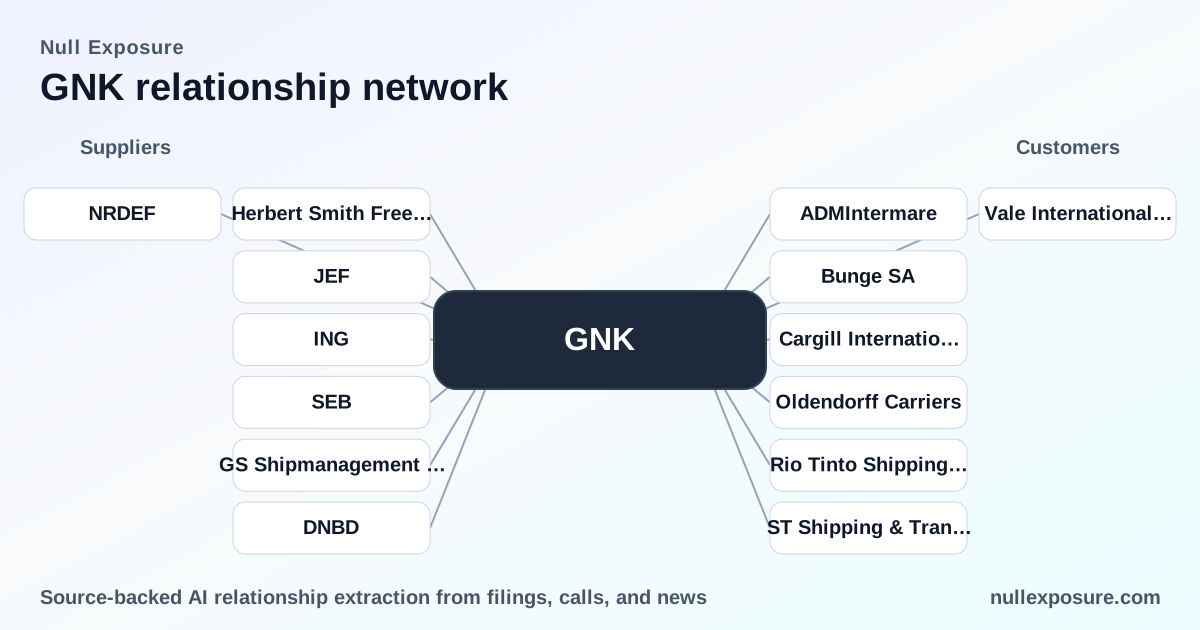
Genco’s disclosed customer roster reads like a who’s‑who of global commodity logistics: major traders (Cargill, Bunge, ADM), miners and producers (Vale, Rio Tinto) and large third‑party shipowners/operators (Oldendorff, ST Shipping). That mix drives a business model with concentrated counterparty exposure but broad geographic reach—the company explicitly runs vessels worldwide and intentionally weights fleet deployment toward short‑term fixtures to capture market upside. GNK’s contracting posture is spot/short‑term biased, counterparties are primarily large enterprises and government-owned entities, and the relationship set is operationally critical to generate voyage revenues and servicing capital costs.
The customer roll call — relationship-by-relationship notes
Below are the relationships extracted from GNK’s filings and recent coverage; each entry is a concise, source‑backed take.
-
ADMIntermare
GNK names ADMIntermare (a division of ADM International Sarl) among its national, regional and international customers in the company’s FY2024 Form 10‑K. According to GNK’s 2024 10‑K, ADMIntermare is listed alongside other large commodity traders as a charterer of GNK vessels (FY2024 Form 10‑K). -
Bunge SA
Bunge is disclosed as a customer in GNK’s FY2024 Form 10‑K, reflecting GNK’s exposure to global agricultural traders that charter vessels to move grain and related bulk cargoes (FY2024 Form 10‑K). -
Cargill International S.A.
Cargill International S.A. is explicitly listed in GNK’s FY2024 Form 10‑K as a charterer, underscoring GNK’s commercial ties to leading grain and commodity houses (FY2024 Form 10‑K). -
Oldendorff Carriers (10‑K mention)
Oldendorff appears in GNK’s FY2024 Form 10‑K as one of the company’s national, regional and international customers, indicating chartering relationships with established shipowners and operators (FY2024 Form 10‑K). -
Rio Tinto Shipping (Asia) Pte. Ltd.
GNK discloses Rio Tinto Shipping (Asia) Pte. Ltd. among its customers in the FY2024 10‑K, reflecting direct ties to large mineral producers for movements such as iron ore (FY2024 Form 10‑K). -
ST Shipping & Transport Pte. Ltd.
ST Shipping & Transport is named in GNK’s FY2024 Form 10‑K customer list, consistent with the company’s pattern of chartering to sizable regional and international transport firms (FY2024 Form 10‑K). -
Vale International S.A.
Vale International is included in GNK’s FY2024 Form 10‑K customer roster, evidence of GNK serving major mining producers in global drybulk trades (FY2024 Form 10‑K). -
Oldendorff Carriers (revenue share reported)
Independent coverage notes Oldendorff accounted for 11.0% of GNK’s voyage revenues in 2025, making it a material revenue source by the company’s reporting window and elevating counterparty concentration risk into tangible numbers (TradingView report summarizing GNK filings, Mar 2026). -
Star Bulk Carriers (IndexBox report on vessel sale dispute)
Recent media coverage describes a dispute tied to a proposed transaction involving the sale of multiple Genco vessels to Star Bulk, where GNK argued the sale prices were substantially below broker valuations and resembled distress pricing (IndexBox blog, May 2026). -
Star Bulk (Manila Times coverage on valuation gap)
GNK publicly rejected a revised non‑binding indicative proposal from Diana Shipping made in partnership with Star Bulk; reporting highlighted GNK’s claim that the agreed vessel valuations were ~14% below average broker assessments (Manila Times / GlobeNewswire summary, Mar 19–20, 2026). -
Star Bulk Carriers Corp. (Diana/Star Bulk commentary)
In commentary tied to the acquisition proposal, GNK stressed that the proposed vessel sale prices to Star Bulk had no impact on GNK’s operating ability or shareholder value beyond the transaction context, per company statements quoted in coverage (Manila Times / GlobeNewswire commentary, Mar 2026). -
Star Bulk (SahmCapital republication)
Coverage syndicated through SahmCapital reiterated that the vessel sale to Star Bulk under the proposed deal was priced materially below broker valuations, reinforcing market attention on GNK’s asset pricing and deal negotiations (SahmCapital press summary, Mar 2026).
Why these customer facts matter for valuation and risk
-
Revenue volatility is structurally elevated because GNK intentionally deploys a large share of its fleet into spot and short‑term fixtures; this provides upside in tight markets and downside in slumps. Company disclosures explicitly frame fleet deployment as skewed toward short‑term fixtures to retain optionality (GNK 10‑K).
-
Concentration is real and measurable: the company reports that two customers each accounted for over 10% of voyage revenue in 2024, and public reporting places Oldendorff at 11.0% of voyage revenue in 2025. A handful of large counterparties can therefore move GNK’s top line materially.
-
Counterparties are institutional and creditable, which mitigates counterparty credit risk relative to a book of small charterers; GNK states it typically charters to major trading houses, producers and government‑owned entities (company 10‑K).
-
Asset value debates affect strategic optionality. The recent dispute over vessel sale pricing with Star Bulk highlights how ship valuations feed into corporate strategy—asset sales are a meaningful lever for liquidity and shareholder returns when market freight rates compress.
-
Global network, concentrated execution. GNK operates globally (U.S., Copenhagen, Singapore commercial presence) and moves cargoes worldwide, which spreads geographic demand risk but concentrates exposure in the drybulk cycle.
Investment implications — what to watch next
- Monitor quarterly voyage revenue mix (spot vs. time) and the identity of the top two charterers; changes there will materially change revenue sensitivity.
- Track vessel sale negotiations and broker valuations reported publicly; asset realization assumptions are central to GNK’s optionality.
- Watch charter market rates and bunker prices closely—these directly drive gross margin on spot fixtures and influence decisions to opportunistically sell tonnage.
For a data‑driven lens on customer exposures and ongoing news signals, see our research hub at https://nullexposure.com/.
Conclusion: GNK runs a high optionality, asset‑backed shipping business whose earnings hinge on a few large counterparties and the spot/short‑term charter cycle; that structure creates both asymmetric upside in tight markets and concentrated downside when a small set of customers or asset prices shift.