Global Net Lease (GNL): Customer Relationships that Drive Predictable Rent Rolls
Global Net Lease operates as a classic diversified net-lease REIT: it acquires income-producing commercial real estate and monetizes through long-term net leases, renewal premiums, and selective asset dispositions. The portfolio skews toward industrial/distribution and retail, is concentrated geographically in North America with a meaningful EMEA presence, and delivers cash flow stability through multi-year lease terms and high occupancy.
For a concise map of tenant exposures and recent activity, see Null Exposure’s coverage: https://nullexposure.com/.
Management's message to investors: steady cash flow and renewal leverage
Management emphasized during its 2025 earnings cycle that GNL’s strategy is execution-focused: pursue long-term leases, maintain high occupancy, and capture renewal spreads. In 2025 GNL executed more than 3.7 million square feet of leases across the portfolio and reported renewal spreads running roughly 12% for the year, with select deals delivering up to 26% above expiring rents (notably tied to large renewals). The portfolio remains highly occupied (97% as of Dec‑31, 2024) with a weighted-average remaining lease term of 6.2 years, underpinning predictable cash flows and lower cash rent volatility. These points were emphasized across GNL’s 2025 Q3 and Q4 earnings calls.
If you want a one-stop view of GNL’s tenant relationships and disclosures, visit Null Exposure: https://nullexposure.com/.
How the operating model shapes risk and upside
GNL’s public disclosures present a clear operating posture:
- Contracting posture — long-term orientation. GNL routinely seeks long-term net leases and reported that a measurable portion of its income derives from leases with more than ten years remaining; the company targets stable, rent-bearing contracts to support distributions.
- Concentration and diversification. Approximately 80% of annualized rental income is tied to the U.S. and Canada, with ~20% in Europe; sector exposures are meaningful in Industrial & Distribution (34%), Multi‑Tenant Retail (28%), Single‑Tenant Retail (21%) and Office (17%).
- Materiality of single-tenants — immaterial today. No single tenant represented 5% or more of consolidated annualized rental income as of Dec‑31, 2024, indicating low customer concentration risk at the company level.
- Relationship maturity and criticality. The portfolio is largely active and performing (97% leased); the company functions primarily as a licensor/landlord rather than a service vendor, so tenant performance impacts cash flow but not ongoing service delivery.
These constraints are drawn from GNL’s public filings and earnings commentary in FY2024–FY2025.
Customer roster — what matters right now
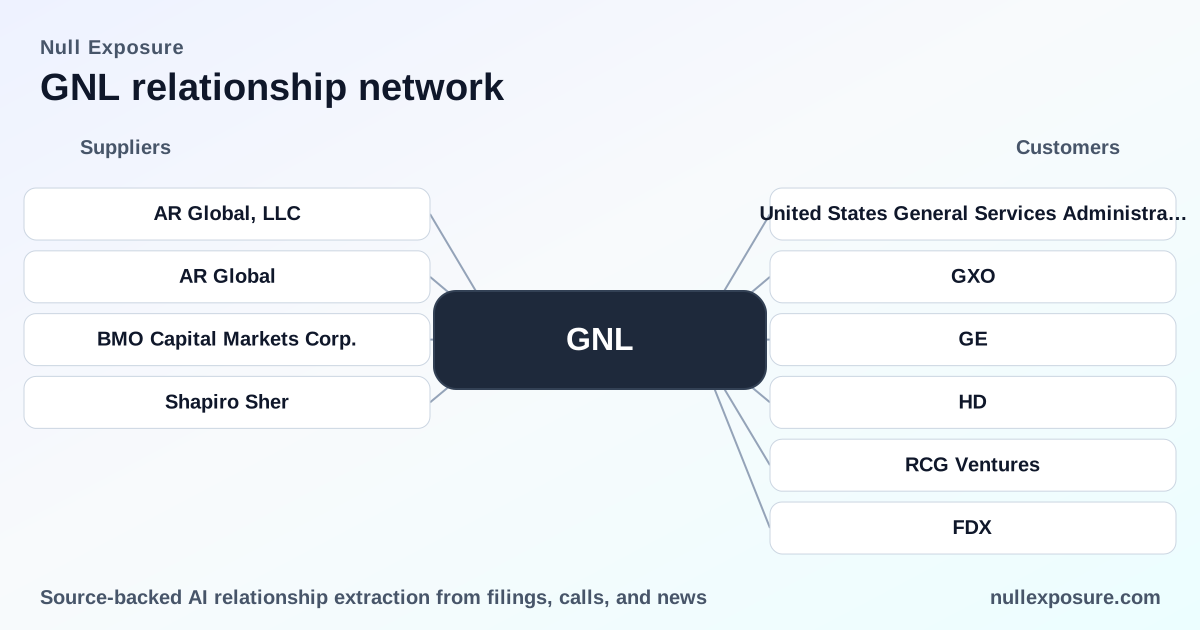
Below are every customer relationship flagged in the recent results, with a plain-English summary and source reference.
United States General Services Administration (GSA)
GNL announced a 20‑year lease renewal with the U.S. General Services Administration at its Lakewood, Colorado asset, reinforcing the REIT’s exposure to government tenants and very long-term contracted rent streams. According to GNL’s 2025 Q3 earnings call (reported March 2026), this renewal extends tenancy and supports stable cash flow; corporate filings also reference GSA properties (e.g., Franklin, TN) as government counterparty exposures.
GE Aviation / GE
GNL completed a 10‑year renewal with GE Aviation for a 369,000‑square‑foot, high‑quality office asset, a large transaction that materially contributed to renewal spread performance in 2025. Management disclosed the GE Aviation renewal during the 2025 Q3 earnings call (reported March 2026).
GXO / GXO Logistics
GXO was a key renewal driver in 2025; management cited GXO as one of the tenants behind renewal spreads that were 26% higher than expiring rents on specific deals. GXO was referenced in both the 2025 Q3 and Q4 earnings calls as part of material lease renewals and extensions that lifted portfolio rent per square foot.
FedEx
FedEx completed a lease extension with GNL during 2025 as part of a cluster of renewals and extensions with high‑quality tenants; management highlighted FedEx in the 2025 Q4 earnings call as contributing to full‑year leasing activity and renewal spread capture.
Home Depot / HD
Home Depot executed a lease extension with GNL in 2025 and was specifically named among the high‑quality tenants supporting the company’s annual renewal performance; this was disclosed in the 2025 Q4 earnings call where management summarized the year’s leasing outcomes.
RCG Ventures
RCG Ventures purchased the first phase of a multitenant portfolio from GNL in early 2026, representing an asset sale / disposition that monetized non-core holdings. Local press coverage (Local12, March 2026) reported that Atlanta‑based RCG acquired the first phase from Global Net Lease, confirming GNL’s use of sales to reallocate capital.
Walmart / WMT
GNL announced the acquisition of a 90,000‑square‑foot office building in Bentonville that was leased to Walmart, reflecting strategic purchases of single‑tenant office assets occupied by creditworthy corporates. Arkansas Business reported the transaction in FY2021 coverage of the acquisition and lease.
Why these relationships matter to investors
- Renewal economics drive valuation multiple expansion. GNL’s ability to secure double‑digit renewal spreads — including outsized 26% spreads on select large renewals — directly lifts cash NOI and supports dividend coverage and NAV stability.
- Tenant credit quality reduces default risk. The roster features investment‑grade and high‑quality corporate tenants (GE, Walmart, FedEx, Home Depot) plus government occupancy (GSA), which lowers probability of rent loss relative to a lower-quality tenant mix.
- Geographic and sector balance limits single‑point failure. The company’s North America weight and diversified sector mix (industrial/distribution heavy) lower correlated rent downside from localized economic stress.
- Active portfolio management. GNL uses both lease renewals and selective dispositions (e.g., phase sale to RCG Ventures) to optimize portfolio composition and redeploy capital to higher-yielding opportunities.
Key takeaways for investors
- GNL is a long‑term, stability‑oriented landlord with disciplined leasing that has recently delivered meaningful renewal spreads.
- Tenant mix is high quality and widely diversified, with no single tenant accounting for >5% of rent as of Dec‑31, 2024, reducing concentration risk.
- Renewals and disposals are tactical levers management uses to drive cash flow and rebalance the portfolio; recent transactions with GE, GXO, FedEx, Home Depot, Walmart, GSA and institutional buyers illustrate both wings of that strategy.
For a deeper read on tenant relationships and contract-level signals that matter to underwriters and investors, explore Null Exposure’s research hub: https://nullexposure.com/.
Bold positions: GNL’s renewal execution and tenant credit quality are the primary drivers of near‑term cash flow stability and valuation support.