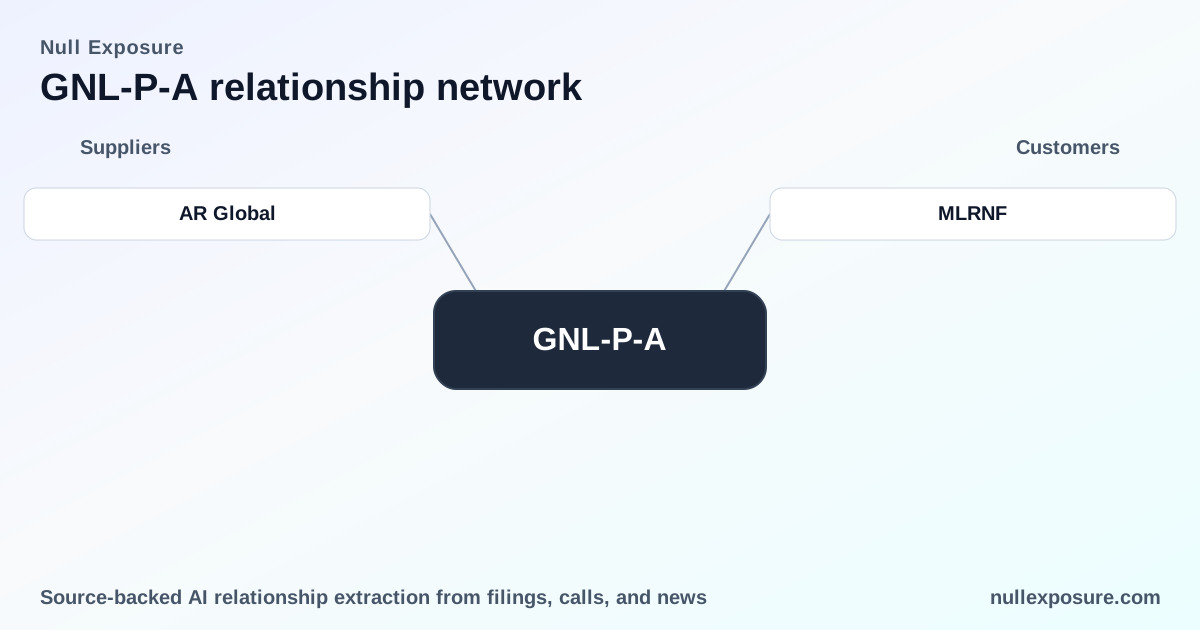
Global Net Lease (GNL-P-A) — Customer Relationship Snapshot and Investment Implications
Global Net Lease’s 7.25% Series A cumulative preferred (GNL-P-A) is a fixed‑income vehicle tied to a REIT business that owns and rotates commercial property under long‑term net leases. The company monetizes by acquiring income-producing assets and contracting multi-decade, triple‑net or sale‑leaseback arrangements with corporate tenants; preferred holders collect a cumulative coupon that ranks ahead of common equity for cash distribution priority. For investors focused on income stability, GNL-P-A offers contractual dividend certainty; for analysts, the key questions are tenant quality, lease duration, and the company’s active asset‑rotation strategy.
For ongoing monitoring and deeper customer‑relationship intelligence visit https://nullexposure.com/.
Why customer relationships matter for a net‑lease REIT
Global Net Lease is a contractually driven operator: revenue largely depends on long‑dated lease commitments and periodic asset sales rather than active property management. That operating posture produces predictable cash flows but also creates two linked tradeoffs:
- Concentration and counterparty risk. Large, long leases with a small number of corporate tenants concentrate exposure; a single tenant dispute or default can materially affect cash available for preferred dividends.
- Asset rotation and liquidity as a business lever. The company regularly sells non‑core assets to crystallize gains or redeploy capital, which supports dividend coverage but introduces execution risk when market liquidity is thin.
Those characteristics—contractual revenue, tenant concentration, and an active disposal program—define how investors should underwrite GNL‑P‑A’s income reliability and capital‑structure resilience. There are no explicit operational constraints disclosed in the relationship data set; that absence itself is a company‑level signal that publicly reported customer linkage is limited to discrete property transactions and sale‑leaseback deals rather than an embedded servicing network.
Customer relationships: what public reporting shows
Below I walk through every customer relationship returned in the search results and what each means for GNL’s cash flow profile.
Colliers International Property Consultants Inc.
Colliers acquired Wilmer Place from Global Net Lease for $10.1 million, reflecting a targeted asset sale by GNL. According to MarketScreener reporting on May 3, 2026, Colliers purchased Wilmer Place as part of GNL’s ongoing portfolio rotation, a transaction disclosed around the company’s third‑quarter release and associated rating commentary. This sale is evidence that GNL uses selective disposals to manage portfolio composition and liquidity (MarketScreener, May 3, 2026).
MarketScreener covered the same disposition detail in a separate item tied to corporate credit commentary on the same date, reinforcing that this was a confirmed asset sale and not a rumor (MarketScreener, May 3, 2026).
McLaren (MLRNF)
McLaren sold its Woking headquarters to Global Net Lease in a deal that included a long‑term leaseback, with GNL contractually required to lease the asset back to McLaren for the next 20 years. A news piece republished in March 2026 notes this structural feature of the transaction, which positions the deal as a classical sale‑leaseback that provides GNL with a stable, long‑dated cash flow stream while transferring real‑estate ownership. The 20‑year leaseback underlines GNL’s emphasis on sale‑leaseback contracts as a way to secure predictable tenant cashflows (Carbuzz, March 2026).
What these customer ties reveal about GNL’s business model and risk profile
- Contracting posture: GNL operates as a landlord that prefers long, net lease commitments and sale‑leaseback structures where tenant obligations cover most operating costs. That posture supports predictable distributions to preferred shareholders but makes the company reliant on the credit quality and longevity of tenants.
- Concentration: The relationships shown are asset‑level and corporate tenants—single‑asset sales to professional buyers (Colliers) and single‑tenant sale‑leasebacks (McLaren) illustrate a business model that is top‑down concentrated by tenant and asset. Investors must underwrite tenant credit, lease duration, and the economic sensitivity of a small number of large counterparties.
- Criticality: Tenants like McLaren occupying headquarters or mission‑critical manufacturing/distribution sites often have strategic imperatives to honor long leases, which improves recoverability and rent durability; however, loss of a single critical tenant would be highly visible to distributions.
- Maturity and capital structure: The existence of long leases and an active disposal program supports debt service and preferred dividends but also signals a mature REIT strategy that uses both rental income and asset sales to fund returns. GNL‑P‑A’s cumulative dividend feature is a structural protection for holders, but dividend coverage ultimately depends on tenant performance and the success of asset rotations.
For investors, these characteristics translate into a familiar REIT tradeoff: stable, contractually backed income versus idiosyncratic tenant and execution risk.
Investment implications and near‑term monitoring priorities
- Monitor tenant credit and lease expiries. Given the long lease terms seen in these relationships, watch covenant provisions, escalation clauses, and tenant financials that underpin rent streams.
- Track disposals and reinvestment pace. The Colliers Wilmer Place sale is an example of portfolio pruning; consistent, profitable asset rotation supports preferred dividend coverage, but frequent disposals at depressed prices would weaken it.
- Assess sale‑leaseback strategy. Deals like the McLaren transaction lock in cash flows but commit GNL to landlord obligations and reversion timing; investors should evaluate the economics of these leases relative to market cap rates and GNL’s cost of capital.
If you want a structured feed of these relationship updates and thematic flags, explore the coverage at https://nullexposure.com/.
Bottom line — concise takeaways for investors
- GNL‑P‑A is fundamentally a contract‑driven income play: cumulative preferred dividends are supported by long net leases and selective asset sales.
- Customer relationships confirm a strategy built on sale‑leasebacks and targeted disposals—useful for income stability but concentration‑sensitive.
- Key risks are counterparty credit and execution on asset rotation; both are observable in the Colliers and McLaren transactions cited in public reporting.
Investors should weigh the preferred coupon security against the underlying tenant credit and the company’s repeated use of disposals and sale‑leasebacks when sizing exposure to GNL‑P‑A.