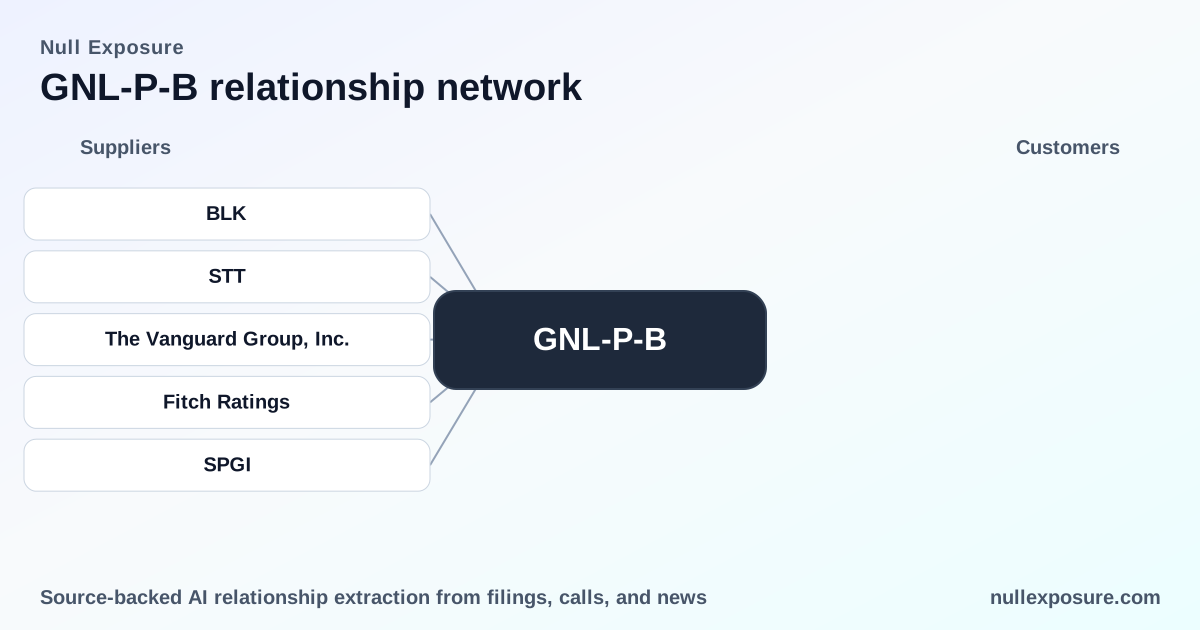
GNL-P-B (Global Net Lease Preferred): Customer relationship note and strategic implications
Global Net Lease operates as a single-tenant, net-lease REIT that monetizes through long-term, triple-net leases with creditworthy tenants across the United States and Europe, capturing predictable rental income and deploying capital through disciplined acquisitions and selective dispositions to enhance shareholder value. This capital-light operating model emphasizes lease duration and tenant credit quality as primary value drivers and positions preferred shareholders to benefit from stable cash flows backed by underlying real estate collateral. For a concise briefing on broader coverage, visit https://nullexposure.com/.
A concise read on the Colliers transaction and what it means for GNL-P-B investors
Global Net Lease sold Wilmer Place, with Colliers International Property Consultants acquiring the asset for $10.1 million. According to a MarketScreener report dated May 3, 2026, the transaction reflects GNL’s active portfolio management and willingness to rotate assets when valuation or strategic priorities dictate (https://www.marketscreener.com/news/global-net-lease-enters-into-agreement-to-sell-mclaren-campus-for-250-million-ce7d51ddde8cf424).
This disposition is a discrete customer/market-facing event where Colliers operated as the buyer; the move reduces GNL’s exposure to that specific facility while converting a real estate position into liquidity that management can redeploy into higher-yielding or higher-quality net-lease opportunities.
Why this relationship matters
- Counterparty role: Colliers functioned as purchaser/advisor in a transaction that directly alters GNL’s customer and tenant risk profile by removing a leased asset from the portfolio.
- Signal on capital allocation: The modest size of the sale ($10.1 million) combined with publicized larger transactions cited in the same reporting cycle underscores an active capital recycling strategy rather than a forced liquidity event. (MarketScreener, May 3, 2026)
How GNL-P-B’s operating model shapes customer exposures
Global Net Lease’s business is built on three interlocking structural choices that determine how customer relationships evolve:
-
Contracting posture — long-dated, landlord-favorable leases. GNL’s single-tenant, net-lease focus means contracts transfer most operating and capex responsibility to tenants, producing low-variation income streams for investors in preferred shares. This contracting posture reduces landlord operational burdens and concentrates credit risk at the tenant counterparty level.
-
Concentration dynamics — customer concentration is inherent. The single-tenant model produces fewer customers with larger individual exposures. That concentration drives higher sensitivity to tenant credit events but enables deeper underwriting and rent-roll defensibility when tenants are investment grade.
-
Criticality and cash-flow durability. Leased assets under triple-net terms typically house mission-critical tenant operations (distribution, retail anchors, logistics), so lease uptime and tenant solvency are the principal determinants of cash-flow continuity.
-
Maturity and portfolio management. Net-lease REITs like GNL operate a mature cash-yield model, where management actions (selective dispositions such as the Wilmer Place sale) are primary levers to optimize weighted-average lease duration, tenant mix, and geographic concentration.
These characteristics form company-level signals that shape investor expectations and underwriting for preferred-stock claims on GNL’s cash flow.
All customer relationships identified in the records
- Colliers International Property Consultants Inc.: Colliers purchased Wilmer Place from Global Net Lease for $10.1 million in a transaction reported on May 3, 2026, shifting that asset out of GNL’s portfolio and providing immediate liquidity (MarketScreener, May 3, 2026 — https://www.marketscreener.com/news/global-net-lease-enters-into-agreement-to-sell-mclaren-campus-for-250-million-ce7d51ddde8cf424).
This record represents the only customer-side relationship surfaced in the available results; the Colliers purchase is an execution of GNL’s portfolio rotation discipline rather than a change to the company’s core leasing strategy.
For broader coverage of portfolio transactions and modeling implications, see https://nullexposure.com/.
Investor implications and what operators should watch
-
Earnings and distributable cash flow stability rely on tenant credit and lease structure. Preferred shareholders depend on predictable cash flows; asset sales like Wilmer Place are neutral to preferred claims if proceeds are used to preserve dividends or refinance at similar terms.
-
Portfolio turnover is an active lever for yield management. Small-to-mid-size dispositions indicate management is actively pruning non-core or lower-return assets; investors should track the cadence and destination of proceeds (growth capex vs. mortgage paydown vs. distributions).
-
Customer concentration magnifies idiosyncratic risk. A small number of large tenants means a single tenant covenant weakening has outsized impact on occupancy and cash flow coverage. Underwriting must prioritize tenant covenant strength over diversification counts.
-
Geographic spread matters for recovery and market liquidity. U.S. and European exposures have asymmetric recovery profiles and buyer pools; transactions such as the Colliers acquisition provide real-world markers of demand and pricing for specific markets.
Constraints and company-level signals for risk modeling
-
No explicit constraints were returned in the relationship dataset. Treat the absence of flagged constraints as a company-level signal: the record set does not disclose binding covenants, material third-party restrictions, or announced regulatory limits affecting customer dealings.
-
From an operating-model perspective, expect:
- Contracting certainty: long-term leases reduce short-run vacancy volatility.
- Counterparty concentration: a persistent sensitivity to tenant credit events.
- Mature cash-flow profile: portfolio management and asset rotation are the main levers to lift yield rather than rapid organic revenue growth.
Bottom line: concise takeaways for research and asset allocation
- GNL-P-B’s cash flow is a function of long-term net leases and tenant credit quality; the Colliers purchase of Wilmer Place for $10.1 million is consistent with active portfolio recycling. (MarketScreener, May 3, 2026)
- Preferred holders benefit from the stability of triple-net rent rolls but must underwrite concentrated counterparty risk and monitor management’s capital redeployment choices.
- Management’s disposition activity provides visible price discovery and liquidity signals that investors should watch to assess portfolio quality and preferred dividend coverage.
For continued monitoring of GNL-P-B customer transactions and portfolio-level implications, visit https://nullexposure.com/ for ongoing briefings and research.