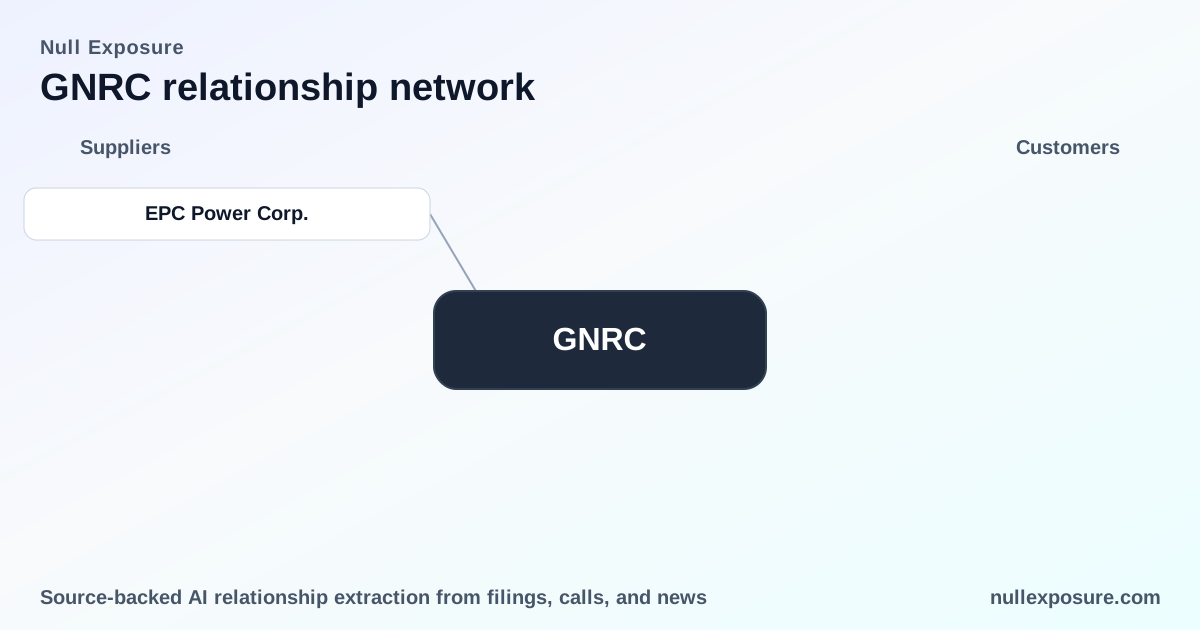
Generac’s customer map: retail giants, channel breadth, and what that means for investors
Generac Holdings sells power generation hardware and complementary services: it monetizes primarily through hardware sales to dealers, distributors and national retailers, plus a smaller but growing stream of subscription and aftermarket service revenue (extended warranties, remote monitoring, installation and grid services). The company’s go-to-market mixes direct sales to enterprise accounts, broad retail placement through national chains, and dealer/distributor channels that smooth demand cycles. Learn the relationship-level signals that matter for revenue durability and operating leverage at https://nullexposure.com/.
Why customer relationships matter for Generac’s returns
Generac is a classic industrial with hardware-led topline and services-led margin expansion potential. Retail and distribution partnerships drive scale and inventory flow; subscription and remote-monitoring contracts create recurring, higher-margin revenue. The firm’s operating posture is channel-diversified — no single customer exceeded 5% of 2024 net sales — which reduces counterparty concentration risk while keeping the business sensitive to retail inventory cycles and headline events that affect mass retail placement.
Key company-level constraints that shape outcomes: a large U.S. revenue base (roughly 79% of sales), a diversified dealer/distributor network, material but small services revenue (<4% of net sales), and growing subscription-like monitoring and deferred warranty amortization. These characteristics support stable manufacturing scale while leaving execution risk concentrated in supply chain, product safety, and retail placement.
Retail recall: large-box sellers tied to the recent generator recall
-
Lowe’s sold units implicated in the recall; the article notes the recalled generators were among products sold at Lowe’s and other home improvement stores (azcentral, Apr. 23, 2026). (https://www.azcentral.com/story/grocery/stores/2026/04/23/costco-generac-generator-recall/89751974007/)
-
The same azcentral coverage reiterates Lowe’s presence in the recall list and quotes the recall notice on a fire/burn hazard when first filling the generator with gasoline (azcentral, Apr. 23, 2026). (https://www.azcentral.com/story/grocery/stores/2026/04/23/costco-generac-generator-recall/89751974007/)
-
Costco is identified as a point-of-sale for the recalled generators; the report states close to 150,000 units were sold at Costco along with other major retailers (azcentral, Apr. 23, 2026). (https://www.azcentral.com/story/grocery/stores/2026/04/23/costco-generac-generator-recall/89751974007/)
-
A duplicate listing for COST in the feed highlights the same placement at Costco and underscores the scale — roughly 150,000 units across major retailers — calling attention to potential near-term warranty, recall and inventory remediation costs (azcentral, Apr. 23, 2026). (https://www.azcentral.com/story/grocery/stores/2026/04/23/costco-generac-generator-recall/89751974007/)
-
Home Depot appears on the same retail list and is named among the national chains that sold the affected units, adding another major distribution partner who will handle returns and customer remediation logistics (azcentral, Apr. 23, 2026). (https://www.azcentral.com/story/grocery/stores/2026/04/23/costco-generac-generator-recall/89751974007/)
Note: the azcentral story is the primary source tying multiple national retailers to the recall; the repeat mentions in the results reflect distinct entity matches in the media-extraction process but point to the same underlying retail placements and operational implications.
Installer/channel partner adding Generac ecosystem
-
Sunation Energy plans to broaden its home-energy offering in 2026 by adding the Generac full home ecosystem, signaling channel-level demand from solar/storage installers who want integrated backup solutions (Sunation Energy press release, Mar. 18, 2026). (https://www.globenewswire.com/news-release/2026/03/18/3258625/0/en/sunation-energy-reports-fourth-quarter-and-full-year-2025-financial-results-beats-2025-annual-guidance-provides-2026-market-outlook.html)
-
A TradingView report covering Sunation’s FY2025 results also notes the company’s plan to broaden offerings with the Generac ecosystem in 2026, reinforcing that solar installers and integrated home-energy providers are adopting Generac’s platform as a complementary upsell opportunity (TradingView news, 2026). (https://www.tradingview.com/news/tradingview:cd37134b4752a:0-sunation-energy-reports-fy2025-revenue-71-9m-q4-revenue-77-to-27-2m/)
What the relationship map implies about contract structure and risk
Use these signals to form a view on near-term earnings and strategic optionality:
-
Contracting posture: Generac’s go-to-market mixes one-time hardware sales with recurring elements (extended warranties, remote monitoring and grid services subscriptions). The constraints show explicit subscription revenue recognition and amortized deferred warranty revenue, indicating a hybrid revenue model where recurring lines are growing but remain a minority of sales.
-
Customer concentration and materiality: The company-level disclosures assert no single customer >5% of net sales and top ten <16%, which is a material corporate-level signal that revenue is broadly distributed across channels and end markets and reduces single-counterparty credit risk.
-
Counterparty types and criticality: Generac sells to individual end users through national retailers and to large enterprise/utility customers via dealers, EPCs and distributors; this mix allows margin diversification but creates execution complexity across order sizes, warranty exposure and aftermarket service expectations.
-
Geography and scale: With about 79% of sales in the U.S., Generac’s revenue is concentrated in North America even as products are sold globally; macro and regulatory shifts in the U.S. power market therefore disproportionately affect the business.
-
Role diversity: Relationships include distributors, resellers and service providers, plus finance partners providing floor-plan financing for dealers — a channel-leveraging mechanism that accounts for a notable portion of dealer-funded purchases (approximately low-double digits of sales).
Investor takeaways and course of action
-
Retail placement gives scale but concentrates operational risk. The recall coverage demonstrates how placement at major retailers can create rapid, visible demand shocks and warranty liabilities; investors should watch recall remediation costs and inventory impacts in upcoming filings.
-
Services and subscription revenue are small but strategic. Remote monitoring, extended warranties and grid services add margin durability; investors should track subscription growth and deferred revenue amortization to see if recurring revenue meaningfully increases longevity of cash flow.
-
Diversified channels mitigate concentration risk but add execution complexity. The firm’s dealer and distributor breadth protects against single-customer exposure but requires disciplined supply-chain and quality controls across many retail partners.
-
Monitor three near-term datapoints: recall-related remediation expenses, subscription/recurring revenue growth, and U.S. end-market demand (storm-driven replacement cycles). For deeper relationship analytics and ongoing tracking of retailer exposure, visit https://nullexposure.com/.
Generac’s customer footprint is a mixed blessing for investors: scale and channel depth support growth, while retail concentration and product-safety events are the primary operational risks. Assess valuation versus execution on those axes before relying on multiple expansion from services alone.