Genasys (GNSS): Customer relationships that define revenue durability and concentration risk
Genasys Inc. builds and sells critical communications hardware and software—loudspeaker arrays, LRAD acoustic devices, and geo‑targeted mass‑notification software—and monetizes through a mix of projected hardware orders, long-term system contracts, and growing recurring SaaS subscriptions. For investors, the company’s commercial profile is defined by government and municipal procurement, concentrated revenue from a handful of large customers, and an order backlog that underpins near‑term revenue visibility. Explore the customer signals below to judge how those dynamics affect runway and risk-adjusted valuation. For a broader provider comparison and risk dashboard, visit https://nullexposure.com/.
Why customers matter more than products right now
Genasys sells two distinct things: capital equipment and multi‑channel notification software. Hardware drives lumpy, high‑value procurements (defense vessels, municipal outdoor warning systems); software drives recurring revenue and improves margin predictability as adoption expands across counties and large enterprises. The company’s FY2025 filings and recent press activity show the business is revenue‑concentrated but operationally diversified between hardware projects and SaaS—a structure that creates both upside (backlogged orders) and downside (customer concentration).
Recent customer headlines — the direct evidence
Below are each of the customer relationships surfaced in public reporting and what they mean operationally.
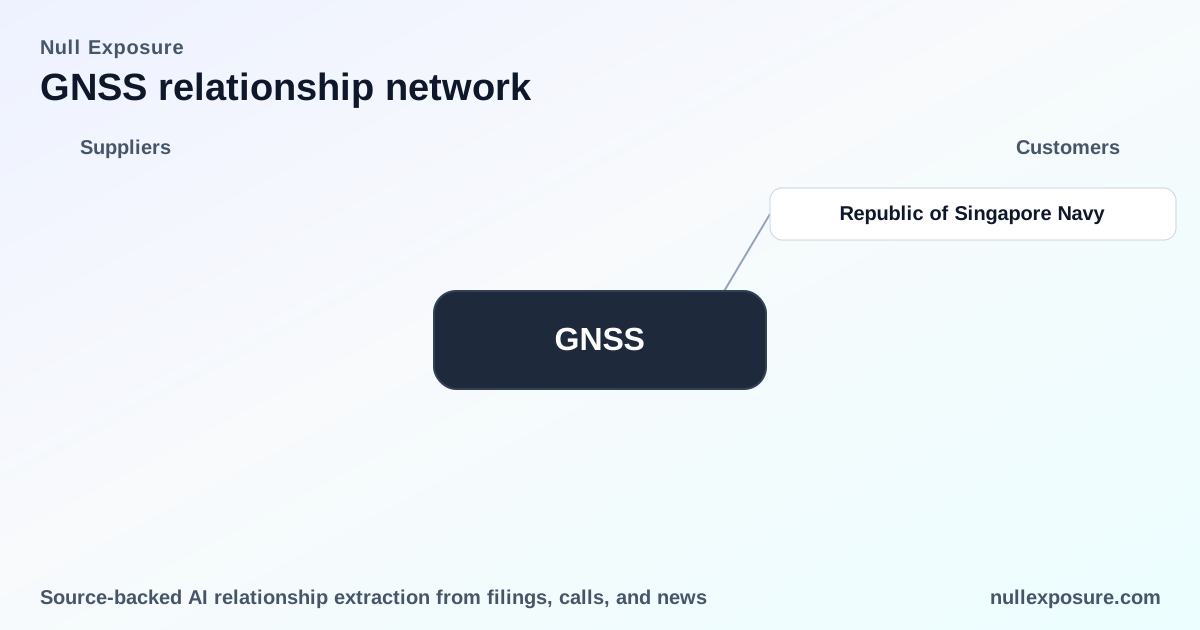
Republic of Singapore Navy (RSN)
Genasys secured a $2.0 million order to equip Republic of Singapore Navy unmanned surface vessels with LRAD 950NXT systems, demonstrating traction in international defense procurement and product fit for maritime and security use cases. This award was reported across industry outlets in February–May 2026, including Cyprus Shipping News and Reuters feeds; see the original announcement at https://cyprusshippingnews.com/2026/02/16/genasys-receives-2-0m-lrad-order-for-republic-of-singapore-navy-unmanned-surface-vessels/ and related Reuters distribution (TradingView/Reuters).
Coconino County, Arizona
Genasys won procurement orders for acoustic outdoor warning systems from Coconino County, showing continued municipal demand for outdoor alert infrastructure in regions with wildfire and public‑safety exposure. The procurement was announced in May 2026 via regional press and investor news outlets; see the bulletin at https://www.bitget.com/news/detail/12560605280861.
City of Sedona, Arizona
The Company also secured purchase orders from the City of Sedona for outdoor warning systems, reinforcing a contiguous campaign of municipal wins in Arizona and adding to localized recurring service and maintenance opportunities. Local procurement coverage ran alongside the Coconino County notice; the announcement is available at https://www.bitget.com/news/detail/12560605280861.
What the constraints and contract language reveal about Genasys’ operating model
The company’s public filings and disclosures produce a coherent picture: Genasys executes a mixed commercial model with long‑term project revenue, rising subscription services, and heavy government exposure.
-
Contracting posture — long‑term projects and cost‑to‑cost recognition. Genasys recognizes revenue on large projects over time using cost‑to‑cost methods (the Puerto Rico Early Warning System is explicitly recognized this way), which indicates multi‑quarter delivery cycles and embedded installation risk. The Puerto Rico project and a named contract with the Commonwealth of Puerto Rico Electric Power Authority are explicit examples of these long‑term arrangements cited in fiscal filings.
-
Recurring revenue growth. Management reports that FY2025 software revenue increased primarily from recurring SaaS sales, signaling an intentional shift to subscriptions that elevate lifetime value and margin leverage.
-
Customer concentration and criticality. One customer accounted for 32% of FY2025 revenues, and the order backlog of approximately $60 million as of September 30, 2025 was largely related to a single customer—both signals of high concentration that make near‑term performance sensitive to a few counterparties.
-
Counterparty mix: government heavy. Direct and indirect sales to the U.S. government represented ~56% of net sales in FY2025, confirming that public procurement cycles and budget timing are principal demand drivers.
-
Segments and geography. Genasys operates in hardware and software segments across North and South America, Europe, Middle East and Asia, with physical offices and support teams in EMEA—an operational footprint consistent with servicing sovereign and municipal customers worldwide.
-
Spend profile. The company reports a backlog in the $10–100M band and project delivery across that band, underwriting meaningful near‑term revenue recognition but also concentrating execution risk.
Taken together, these constraints indicate a business that is operationally mature in procurement channels (government and municipalities), strategically pivoting to SaaS for margin stability, but materially exposed to a small number of large customers.
Financial and strategic implications for investors and operators
Genasys’ financials show $50.9M TTM revenue with negative profitability metrics (EBITDA and EPS), while market capitalization (~$88.6M) and enterprise multiples reflect a market pricing that anticipates both revenue growth via backlog delivery and margin improvement from software. The defense and municipal wins (RSN, Sedona, Coconino) provide validation of product fit across sovereign and civic buyers, but do not eliminate concentration risk.
-
For investors: backlog and government awards provide near‑term revenue visibility, but the 32% single‑customer concentration and heavy public sector exposure require monitoring of contract renewals, payment timing, and procurement cycles.
-
For operators and procurement teams: the split between hardware projects and subscription services demands differentiated delivery governance—project management capabilities to execute multi‑quarter installs and SaaS operations to scale recurring revenue and customer support.
Actionable takeaways
- Backlog is meaningful and underpins revenue for the next 12 months, but it is concentrated—monitor disclosures for customer identity and revenue recognition progress.
- Government sales are core to the model; budget cycles and political risk translate directly into revenue timing volatility.
- SaaS growth is the stabilizer; recurring revenue expansion will be the primary path to improved margins and a higher multiple.
For investors interested in further relationship mapping and risk scoring for Genasys and comparable players, see our analyst pages at https://nullexposure.com/.