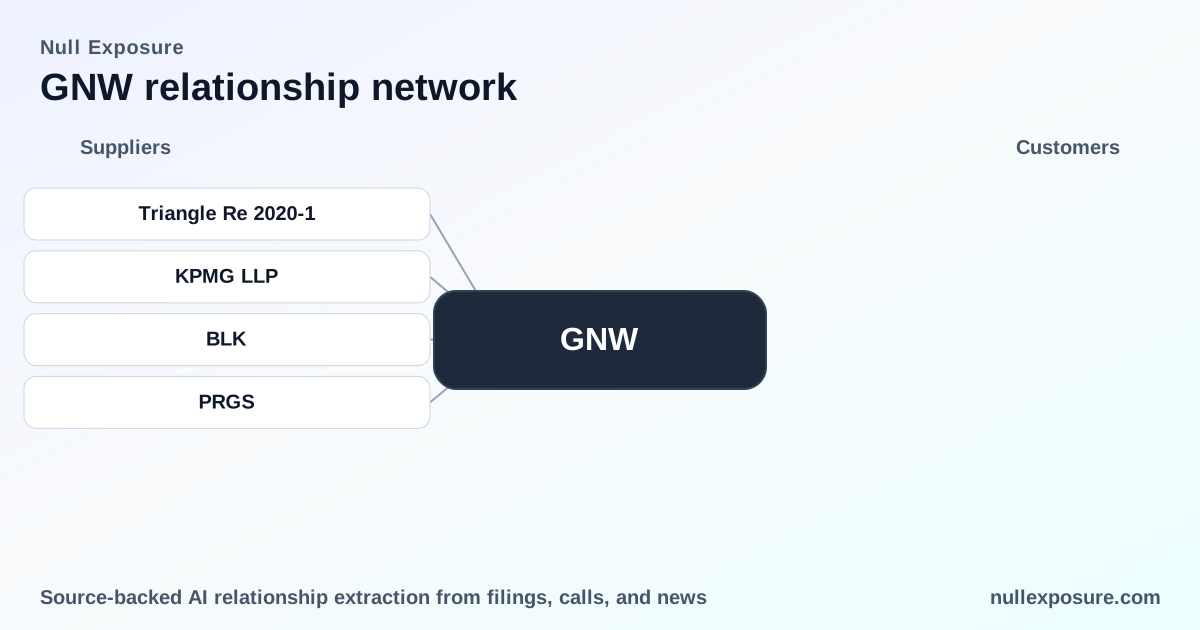
Genworth Financial (GNW): How customer ties, capital moves, and Enact shape the investment thesis
Genworth Financial monetizes through three principal channels: mortgage insurance (primarily via its Enact segment), long‑term care underwriting, and life & annuity servicing, with investment income and capital management layering on returns. For investors, the relevant thread is how Genworth converts insurance exposure into cash flow—premiums, servicing fees and selective capital redeployments—while managing concentrated counterparty footprints and multi‑year liabilities. For a concise view of corporate customer relationships and recent activity, explore more at https://nullexposure.com/.
Why Enact is the fulcrum of GNW’s customer story
Enact is Genworth’s largest operating reportable segment and functions as a direct conduit to banks, mortgage originators and non‑bank lenders. Enact’s customer mix—large national banks to community lenders—drives underwriting volumes and revenue concentration, which in turn affects GNW’s capital allocation choices and credit profile. Recent market activity shows Enact involved in significant capital return mechanics with Genworth entities, signaling active balance sheet management between parent and operating segments.
Observed customer relationships and the reporting trail
The filings and press coverage returned for GNW’s customer scope all reference Enact/Enact Holdings, Inc. Below are every observed relationship item in the results, each summarized and sourced.
Enact / ACT — SimplyWall.st narrative on buyback linkage (first seen 2026‑03‑09)
News coverage noted that Enact entered a share repurchase agreement with Genworth Financial to buy back up to $500 million of Enact common shares with no stated expiration date, positioning capital returns as a mutual priority. According to the SimplyWall.st narrative dated March 2026, this was presented as a key development in Enact’s capital program.
Enact / ACT — Form 4 / SEC filing context on the repurchase agreement (first seen 2026‑03‑09)
A Form 4 disclosure references that a sale was effected pursuant to a Share Repurchase Agreement between Enact Holdings, Inc. and Genworth Holdings, Inc., dated February 2, 2026, documenting the legal mechanism underpinning the transaction. This filing was summarized in a March 2026 aggregation of SEC filing activity on StockTitan.
Enact / ACT — SahmCapital report on Enact’s capital returns (first seen 2026‑05‑02)
Market commentary from SahmCapital in early May 2026 reiterated that Enact had increased capital returns via a new buyback that involved Genworth, underscoring capital allocation alignment and potential downstream effects on Genworth’s reported financials.
Enact / ACT — AM Best / Yahoo Finance note on dividend dependence and capital priorities (first seen 2026‑05‑03)
An AM Best assessment reported on May 3, 2026 and summarized by Yahoo Finance highlighted dependence on dividends from Enact to service GNW‑related obligations, linking dividend flows to both companies’ priorities of buybacks, opportunistic debt reduction and selective growth investment (including CareScout).
Business model constraints and what they imply for investors
Genworth’s operating model is shaped by a mix of long‑duration liabilities, concentrated counterparty flows, and a services arm that creates cross‑segment optionality. Below are the principal constraints derived from company disclosures and excerpts, presented as company‑level signals unless the excerpt explicitly names Enact.
-
Contracting posture: Long‑dated, actuarial commitments. GNW explicitly executes multi‑year rate action plans for legacy long‑term care products; those contracts are structurally long‑term, creating predictable but slowly evolving revenue and cash flow profiles. This pushes management to focus on capital adequacy and rate approvals rather than short‑cycle volume growth.
-
Counterparty mix: Individuals and large enterprises coexist. GNW retains individual life policies (typical single‑policy limits referenced), while its Enact segment interfaces with large enterprise clients—money center banks, non‑bank lenders and credit unions. The firm runs a dual exposure model: retail policy longevity and institutional mortgage distribution.
-
Geography: North America concentrated. The firm’s private mortgage insurance activities operate across all 50 U.S. states and D.C.; the core market is domestic, which concentrates regulatory and credit exposure to U.S. housing and interest‑rate cycles.
-
Concentration / materiality (Enact related). GNW reporting cites that Enact’s largest customer accounted for 20% of new insurance written in 2024 and the top five generated 34%, illustrating meaningful revenue concentration within the Enact relationship and highlighting counterparty risk tied to a handful of large lenders.
-
Relationship roles and criticality. Enact functions primarily as a seller of private mortgage insurance to lenders and as a critical capital source within GNW’s consolidated view; Genworth more broadly is a holding company that also serves life and annuities customers. That duality means management must balance underwriting markets with servicing obligations.
-
Relationship stages: Active underwriting and legacy runoff. Enact’s delegated underwriting programs are operational and active, representing a high share of new insurance written (around 70% by loan count), whereas GNW’s traditional life and annuity lines are increasingly in runoff, with no new solicitation but ongoing servicing of retained blocks.
-
Segment dynamics: Services as optional value. GNW is investing additional capital into CareScout Services, indicating an intent to broaden fee‑based revenue beyond pure underwriting—a strategic hedge against insurance cycle volatility.
Key takeaway: Enact is both a revenue engine and a capital partner for GNW; concentration among a few large lender customers amplifies upside in a benign mortgage environment and magnifies downside if originations or counterparty health deteriorates.
Investment implications and recommended investor actions
-
Capital allocation is the active lever. The February 2026 repurchase agreement and subsequent reporting show GNW and Enact using share buybacks and dividends as deliberate capital‑management tools, which will materially influence book value and capital buffers going forward.
-
Concentration risk requires monitoring. With Enact’s top clients driving a large share of new insurance written, investors must watch lender portfolios, housing credit trends, and any regulatory shifts affecting private mortgage insurance.
-
Legacy liabilities create tail risk while services offer diversification. Long‑term care and life runoff demand conservative reserving and rate approvals; CareScout and other services investments are positive signs of revenue diversification but require execution.
For a focused dashboard on GNW customer relationships, capital moves, and segment performance, visit https://nullexposure.com/ for deeper investor intelligence.
Bottom line
Genworth is a hybrid insurer: a mortgage‑insurance growth engine through Enact, a legacy long‑term care and life runoff book, and an emerging services platform. Recent documents show Enact and Genworth coordinating capital returns and dividend flows, which is material to GNW’s balance sheet trajectory. Investors should weigh the upside from mortgage markets and capital management against concentration and long‑duration liability dynamics when sizing GNW in a portfolio.