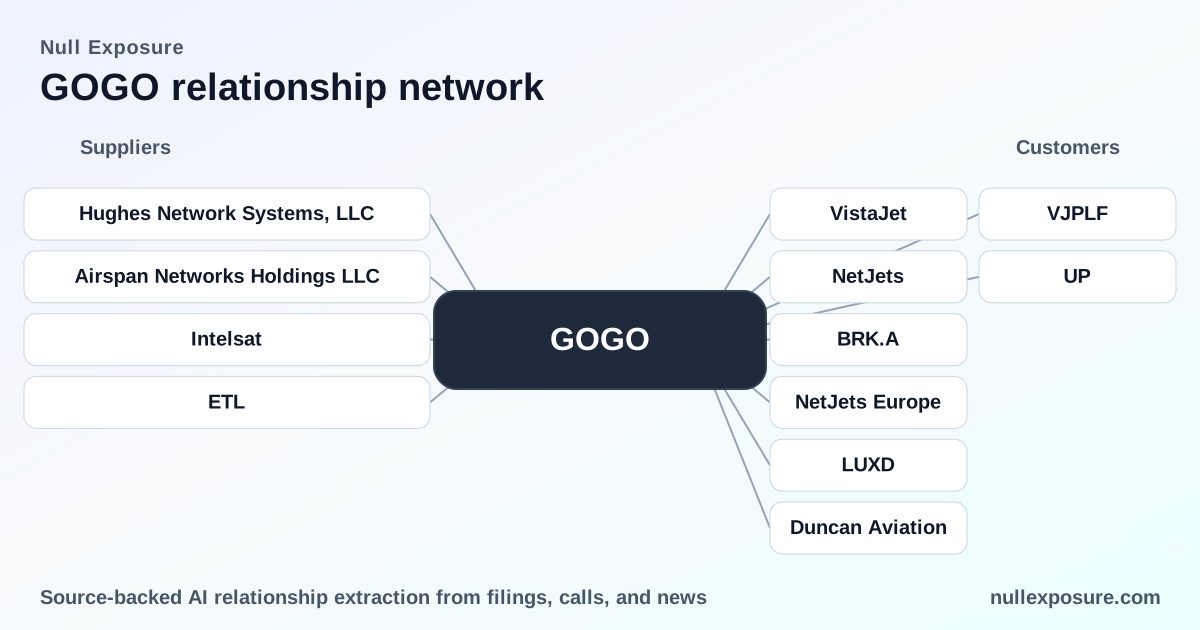
Gogo Inc.: Customer Relationships and What They Signal for Investors
Gogo Inc. operates and monetizes a two-part connectivity business: it sells cabin hardware and network services to aviation operators and collects recurring subscription and usage fees for in‑flight broadband and entertainment. Revenue is driven by per‑aircraft service plans and multi‑year installation agreements across business aviation, government/military channels, and commercial fleet customers; the company supplements service economics with hardware sales and STC (supplemental type certificate) installation programs. For investors, the thesis is straightforward: Gogo converts hardware penetration into recurring service revenue, but business value is highly sensitive to fleet concentration, competitive displacement (notably Starlink), and debt reduction progress. For more structured customer-intelligence on Gogo, visit https://nullexposure.com/.
How Gogo’s customer model works in practice
Gogo’s commercial reality is a hybrid of equipment sales and annuity-like service contracts. The company’s disclosures and market reporting show contracts ranging two to ten years, with service revenue recognized over time and split across subscription and usage fees. That structure creates predictable recurring cash flow when aircraft remain activated, while also exposing the company to churn risk if large fleet customers switch providers. The business serves a mix of North American‑heavy revenue with a growing global footprint, and it sells both directly to OEMs and via value‑added resellers in government and military channels—supporting higher margin service offerings but adding execution complexity.
- Key drivers: per‑aircraft activations, hardware STC rollouts, and subscription take‑rates.
- Principal risks: customer concentration, satellite competition (Starlink), and elevated leverage that constrains investment pace.
Company-level operational constraints investors should treat as signals
Treat the following constraints as structural features of Gogo’s operating model rather than isolated facts:
- Contracting posture is long‑term and recurring. Gogo’s contracts are typically multi‑year (2–10 years) and service revenue is largely subscription and usage based, which supports recurring cash flows but requires ongoing service quality to avoid churn.
- Revenue mix is subscription + usage. Service economics depend on per‑aircraft per‑month pricing and variable usage fees, aligning revenue with flight activity and passenger consumption.
- Counterparty set includes governments. Gogo sells into government and military channels via Satcom Direct, introducing procurement complexity and stable, often higher‑margin opportunities.
- Geography is North America‑centric but global in scope. Reported dollars show heavy U.S. revenue with growing international sales, meaning regional regulatory and satellite access dynamics matter.
- Relationship roles vary: buyer, reseller, service provider. Gogo sells directly to OEMs and aircraft operators, and Satcom Direct functions as a value‑added reseller, adding distribution layers into some markets.
- Segment maturity: The services segment is the primary, recurring revenue engine; hardware and installation are usefully cyclic to accelerate service adoption.
These constraints imply revenue durability with concentrated counterparty risk: recurring economics are attractive, but investor outcomes hinge on retention of large fleet customers and competitive positioning in LEO vs GEO satellite markets.
Relationship map — every customer referenced in media and filings
Below are plain‑English summaries of every customer relationship identified in recent reporting, with source citations.
-
VistaJet / VJPLF — VistaJet has signed a global contract to deploy Gogo’s HDX and FDX/Galileo installations across its fleet, with STC installations beginning in late 2025 and ramping through 2026. Source: company remarks and media reporting summarizing the contract (earnings call 2025Q4; finviz/InsiderMonkey coverage, March 2026).
-
UP / Wheels Up — Wheels Up announced the first Phenom 300 equipped with Gogo Galileo HDX has entered service, initiating a fleet‑wide upgrade to Gogo’s satellite solution. Source: PR Newswire and multiple March 2026 news reports (PR Newswire release; Finviz summary).
-
NetJets / NetJets Inc. — NetJets remains Gogo’s largest fleet customer by activated aircraft, per the company’s Q4 2025 earnings call; historical reporting notes NetJets as one of Gogo’s biggest accounts. Source: Gogo 2025 Q4 earnings call and CantechLetter coverage (2025/2026).
-
NetJets Europe — Gogo recently won a portion of NetJets Europe’s fleet for the HDX (Galileo) solution, representing a subset of what is a larger NetJets opportunity. Source: CantechLetter analysis (Dec 2025).
-
Vista Global Holding — Moody’s and other credit observers cited that Gogo won business with Vista Global Holding in competitive situations, underscoring wins against Starlink in select deals. Source: Moody’s commentary summarized in Investing.com (May 2026).
-
BRK.A (Berkshire Hathaway) — Company commentary referenced BRK.A in the context of NetJets; Gogo’s management explicitly noted NetJets (a Berkshire‑owned operator) as its largest fleet customer by activations. Source: Gogo 2025 Q4 earnings call (March 2026).
-
TXT / Textron Aviation — Textron announced availability of Gogo 5G upgrades for Citation operators, signaling OEM partnerships that drive equipment and service attach rates in business jets. Source: Textron announcement summarized in CyprusShippingNews and ASDNews (April 2026).
-
Lux / LUXD — Media and analyst commentary list Lux among recent fleet wins that support confidence in Gogo’s sales momentum across high‑end operators. Source: CantechLetter commentary (Dec 2025).
-
Duncan Aviation — FAA supplemental type certification (STC) activity tied to Duncan Aviation was cited for Gogo’s belly‑mounted multiband 5G antenna, indicating third‑party MRO/installation providers supporting rollouts. Source: Runway Girl Network (Feb 2022 referenced in 2026 aggregation).
-
Wheels Up (explicit entry separate from UP) — Wheels Up’s fleet modernization strategy includes letters of intent and STC plans with Gogo Business Aviation to equip targeted aircraft with Galileo HDX. Source: SkiesMag and PR Newswire coverage (Mar 2026).
Each of these relationships reinforces a common dynamic: fleet conversions and OEM/installation partnerships drive hardware penetration, which in turn establishes recurring service revenue. The customer list spans direct fleet operators, OEM partnerships, and third‑party installers, underscoring both distribution breadth and executional complexity.
Investment implications and risk calibration
- Concentration is material. NetJets is identified as the largest activated fleet customer; investor returns depend on retention and incremental sales into these large customers. That concentration elevates downside if competitive displacement occurs.
- Recurring revenue quality is high but usage variability matters. Subscription plus usage pricing creates predictability, but revenue growth is linked to activation rates and passenger usage patterns.
- Competition is now event‑level strategic. Multiple sources highlight Starlink as a headwind and a driver of missed opportunities (NetJets) even as Gogo wins business with VistaJet and others. Credit agencies have reacted to this dynamic.
- Execution hinges on STC and OEM partnerships. Rollout speed for Galileo HDX, 5G antenna installations, and OEM upgrade programs will determine the pace of service attach and cash conversion.
Final read: where to watch next
Investors should watch (1) activation trajectory and churn at NetJets and VistaJet, (2) STC and installation cadence with Duncan Aviation and OEM partners like Textron, and (3) debt reduction progress relative to Moody’s commentary on competitive pressure. For a focused, data‑driven view of Gogo’s customer network and competitive signals, consider more detailed customer‑level intelligence available at https://nullexposure.com/.
Bold takeaway: Gogo’s cash flow profile is powered by recurring service contracts and fleet wins, but the company’s valuation and credit story are tightly coupled to a handful of large customers and the outcome of LEO competition.