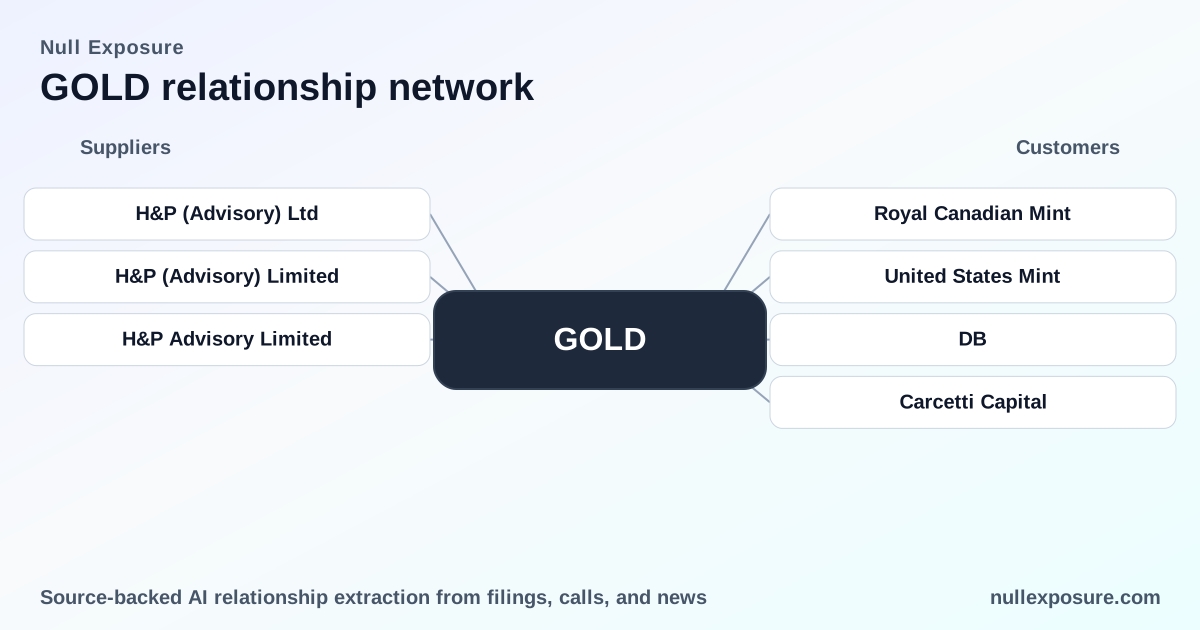
GOLD (Gold.com, Inc.) — Customer relationships and what they mean for investors
Gold.com operates a vertically integrated precious-metals business that monetizes through wholesale and direct-to-consumer sales of coins, bars and bullion, supplemented by ancillary services (financing, storage, logistics and auctions). Revenue is driven primarily by transactional metal sales with short-term pricing and settlement conventions, while services contribute a modest but strategic share of revenue. For further context on source materials and modeling inputs visit https://nullexposure.com/.
Quick investor thesis
Gold.com’s business combines high-volume, low-margin bullion distribution with recurring ancillary service revenues; the operating model depends on short-term contracts, geographic diversification across North America, Europe and Asia, and a mix of individual retail and institutional counterparties. The customer list and disclosures show both breadth (millions of retail customers) and pockets of concentration (one customer >10% of revenue), so investors must price in liquidity-driven revenue swings and counterparty concentration risk.
How the customer relationships translate into an operating model
The public disclosures and relationship signals describe a company that trades physical metals with short-term contractual posture (spot and forward contracts up to six months and provisional orders up to a year), services a very large retail base alongside institutional buyers such as mints and banks, and offers value-add services that amount to roughly 2% of consolidated revenue. These features imply:
- Contracting posture: Predominantly short-term commercial terms — spot pricing with two-day settlement and forwards/provisional orders with delivery windows measured in months. This requires active treasury and inventory management and exposes margins to short-term metal price moves.
- Counterparty mix and concentration: A dual retail/institutional customer base (millions of retail accounts, plus banks, refiners and sovereign mints), with one customer comprising more than 10% of revenues in FY2025 — a material concentration signal that raises customer-specific risk.
- Geographic footprint: Sales and operations are meaningfully international; revenue is reported across the United States and Europe with deliberate expansion in Asia (Hong Kong and Singapore), supporting global distribution but also multi-jurisdictional operational complexity.
- Revenue criticality and maturity: Core product sales remain the dominant revenue stream; services such as storage, auctions and financing are complementary and currently limited in scale, but strategically valuable as margin enhancers.
Relationship-by-relationship run-through
Below is a concise, plain-English summary of each customer relationship or counterparty mentioned in the results, with source context.
-
Royal Canadian Mint — The FY2025 10‑K lists the Royal Canadian Mint among sovereign mints the company counts within its customer categories, signaling direct commercial ties with national coin producers. Source: FY2025 10‑K disclosure.
-
United States Mint — The FY2025 10‑K also lists the United States Mint among sovereign mint customers, indicating Gold.com engages at least categorically with national mints as part of its wholesale distribution and refined-product relationships. Source: FY2025 10‑K disclosure.
-
Carcetti Capital (sale of Canadian mine) — Press coverage in The Globe and Mail reported Barrick’s sale of a Canadian mine to Carcetti Capital for up to $1.09 billion, a transaction cited in the customer/ownership context of the company’s broader mining and metal-supply relationships. Source: The Globe and Mail, March 2026.
-
Deutsche Bank AG — The FY2025 10‑K includes Deutsche Bank AG in a passage tagged for customer concentration and secured loans receivable, signaling that Gold.com counts major banking counterparties for financing and secured receivable arrangements. Source: FY2025 10‑K disclosure.
-
DB — The same FY2025 10‑K references “DB” alongside Deutsche Bank AG in the customer concentration and secured loans context, effectively the same banking counterparty referenced under a shorthand label within the filing. Source: FY2025 10‑K disclosure.
-
RGLD (Royal Gold) — A TIKR blog noted that Royal Gold holds a 1.6% gross smelter royalty on Barrick’s Fourmile deposit in Nevada, an example of how royalty and streaming companies intersect with metal producers and downstream distributors. Source: TIKR blog, May 2026.
-
Newmont Corp. — Market commentary has tracked speculation that Newmont expressed interest in acquiring certain Nevada operations, illustrating industry-level consolidation dynamics that influence supply relationships with downstream sellers and royalties. Source: Aktiencheck, May 2026.
-
OreCorp — A news report recounted that Barrick sold a 51% stake in the Nyanzaga Gold Mine to OreCorp, showing the company’s practice of monetizing assets and the ripple effects on counterparties in development-stage projects. Source: The Citizen (Tanzania), referenced FY2021 reporting.
-
Shandong Gold Corporation — Coverage described a mutual agreement between Barrick and Shandong Gold involving equity purchases and cross-investment, an example of strategic partnering between a major miner and a large Chinese producer that can influence supply chains. Source: The Citizen (Tanzania), FY2021 context.
-
Randgold Resources Ltd. — The Globe and Mail reported historical strategic discussions involving Randgold as a potential buyer of certain assets, which informs historical counterparty options and asset-allocation outcomes. Source: The Globe and Mail, retrospective coverage.
-
Carcetti Capital (additional mention) — A separate Globe and Mail article reiterated the Carcetti transaction in the context of executive changes and asset dispositions, underlining the same buyer relationship from a governance and strategic-transaction perspective. Source: The Globe and Mail, March 2026.
-
GROY (Gold Royalty) — A press release from Gold Royalty highlighted progress at the Ren project (an underground extension of the Goldstrike Mine) and referenced management discussion and analysis disclosures by the producer, showing how royalty holders communicate developments that affect downstream revenue flows. Source: InvestingNews press release, March 2026.
-
NG (Novagold) — MarketScreener coverage — MarketScreener reported that Novagold increased a bought-deal financing and intended to use proceeds in part to settle a prepayment option on a promissory note with Barrick, evidencing financial settlements and prepayment dynamics between developers and major producers. Source: MarketScreener, March 2026.
-
NG (Novagold) — Globe and Mail press release — A Novagold press release carried on The Globe and Mail described use of offering proceeds for Donlin Gold project expenditures and settlement of the company’s prepayment option with Barrick, representing the same financial linkage seen in market coverage. Source: Novagold press release via The Globe and Mail, March 2026.
Investment implications and risk checklist
- Short-term pricing exposure. The company’s contracting behavior—spot market pricing with two-day settlement and forwards/provisional orders with delivery windows up to six months or one year—creates direct exposure to metal-price volatility and requires efficient inventory and hedging operations.
- Customer concentration. One customer accounted for over 10% of revenue in FY2025, a material concentration that increases revenue volatility and counterparty risk even as the retail base is broad.
- Global distribution complexity. Revenue is reported across North America and Europe with targeted expansion in Asia; international scale supports growth but increases regulatory and logistics complexity.
- Services are strategic but small. Ancillary service revenues are approximately 2% of consolidated revenue, useful for differentiation but not yet a large buffer against cyclical metal margins.
- Counterparty sophistication. Relationships span individuals, sovereign mints and major banks; the mix requires dual operational modes—retail e-commerce scale and institutional credit management.
Key takeaway: GOLD’s model is fundamentally transactional and volume-driven; investors should weigh scale and distribution reach against short-term margin sensitivity and a documented concentration of revenue. For further research and integrated relationship maps, visit https://nullexposure.com/.
If you want a tailored risk model or a counterparty concentration scenario for GOLD, I can prepare one focused on revenue shocks, hedging coverage and margin sensitivity.