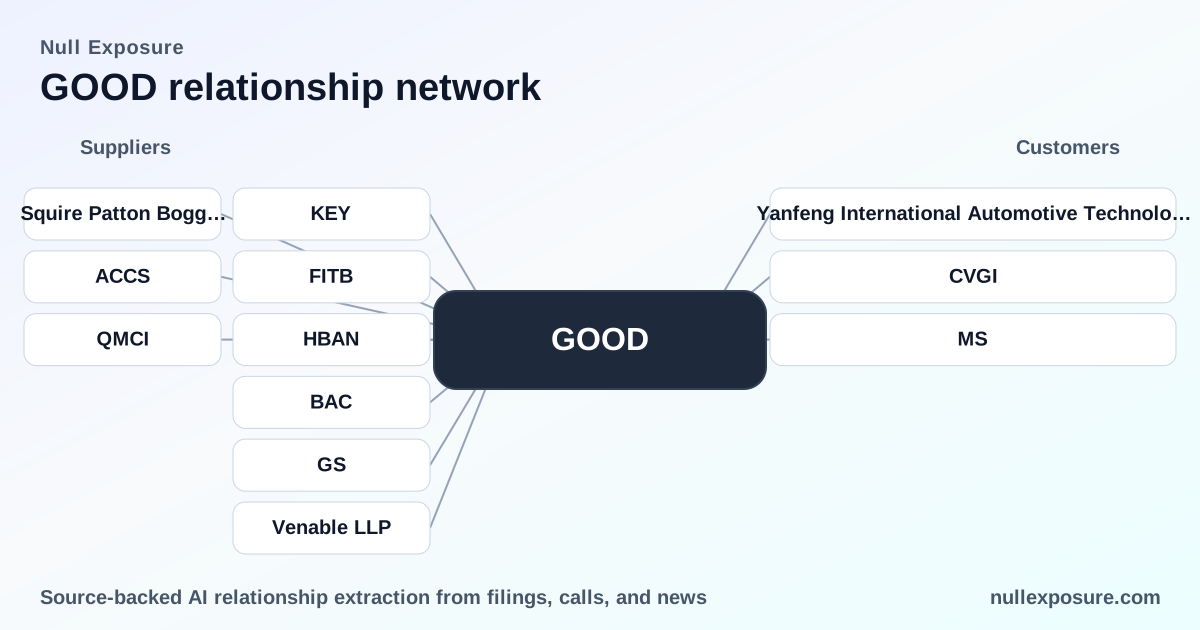
Gladstone Commercial (GOOD): Customer relationships that underwrite a net‑lease REIT
Gladstone Commercial acquires, owns and operates net‑leased office and industrial properties and monetizes primarily through long‑term lease income, built‑in rent escalations and portfolio-level yield management. For investors, the company operates as an externally‑advised REIT that converts property control into stable cash flow and dividend distribution; its risk/reward hinges on tenant credit mix, lease term length, and geographic concentration across U.S. industrial and office assets. Learn more about our coverage at https://nullexposure.com/.
How Gladstone builds and protects recurring cash flow
Gladstone’s operating model is built around long‑dated, net leases and diversified tenant types. Company disclosures state the firm targets net leases with remaining terms of roughly seven to 15 years with built‑in rental increases, and that its adviser sources tenants across the spectrum from small private businesses to very large public companies. The firm’s portfolio is U.S.-centric—135 wholly‑owned properties totaling 16.9 million square feet across 27 states at year‑end 2024—and management reports high collection and occupancy metrics (100% collected base rent in 2024; 98.7% occupancy). These are company‑level signals that explain Gladstone’s contracting posture: conservative, lease‑driven cash flow with intentional tenant diversification.
- Contracting posture: Primarily long‑term net leases with structured escalations.
- Counterparty concentration: Mix of small businesses and large/very large enterprises (public and private).
- Geographic maturity: Focused on the continental United States, limiting cross‑border execution risk.
- Operating criticality: High reliance on rental collections and occupancy control rather than development risk.
What investors should watch for
Gladstone’s relationships skew toward durable, income‑generating tenants, but monitor two structural sensitivities: tenant credit quality (large tenants can represent material rent share) and industrial vs. office exposure (office fundamentals diverge from industrial). Management commentary during Q4 2025 emphasized that a single tenant—General Motors—represents roughly 3% of straight‑line rent, a useful data point for assessing concentration risk. For further portfolio context, visit https://nullexposure.com/.
Tenant and investor relationships — line‑by‑line review
Below I cover each relationship captured in the record. Each entry is a plain‑English summary with the source provided.
-
Jacobs Engineering Group Inc. (JEC) — Gladstone owns a suburban Philadelphia office property that has been fully leased to Jacobs since its completion in 1997, indicating a long‑standing tenant relationship at that asset. Source: CommercialSearch news item on Gladstone acquisition (reported May 3, 2026) — https://www.commercialsearch.com/news/gladstone-buys-suburban-philly-office-asset/.
-
Yanfeng International Automotive Technology US — Gladstone acquired a 215,102 sq. ft. crane‑served industrial facility in Harrison Township, Michigan, that is 100% leased to Yanfeng’s U.S. subsidiary, reflecting industrial manufacturing exposure and a single‑tenant industrial lease backing the acquisition. Source: Daily Commercial press release (March 9, 2026) — https://www.dailycommercial.com/press-release/story/1889/gladstone-commercial-announces-industrial-acquisition-in-harrison-township-michigan/.
-
CVG Management Corp. (CVGI) — Gladstone executed a 15‑year lease with CVG for an office building in New Albany, Ohio, exemplifying the company’s preference for extended lease terms to lock in rental income. Source: Accesswire / FinancialContent press release originally dated March 28, 2022 (reposted) — https://markets.financialcontent.com/stocks/article/accesswire-2022-3-28-gladstone-commercial-corporation-executes-15-year-lease-renewal-at-office-property-in-new-albany-ohio?CSSURL=36.htm.
-
CVGI (duplicate entry) — The same March 2022 release documents the 15‑year lease renewal with CVG Management Corp. at the New Albany office property, reinforcing that renewal as a multi‑year income anchor. Source: Accesswire / FinancialContent (March 28, 2022) — https://markets.financialcontent.com/stocks/article/accesswire-2022-3-28-gladstone-commercial-corporation-executes-15-year-lease-renewal-at-office-property-in-new-albany-ohio?CSSURL=36.htm.
-
O-I / Owens‑Brockway Glass Container Inc. (OI) — Gladstone executed lease extensions covering 444,000 sq. ft. across two industrial properties used for glass container manufacturing and distribution, signaling continued industrial tenancy from a manufacturing‑grade customer. Source: Herald Tribune press release on the lease extensions (January 20, 2026) — https://www.heraldtribune.com/press-release/story/126581/gladstone-commercial-executes-444000-sf-of-lease-extensions-at-two-industrial-properties/.
-
OI (duplicate entry) — A Coshocton Tribune release reiterates the lease extensions with Owens‑Brockway at large industrial buildings in Brockport, PA and Lexington, NC, underlining the tenant’s footprint across multiple Gladstone assets. Source: Coshocton Tribune press release (January 20, 2026) — https://www.coshoctontribune.com/press-release/story/42408/gladstone-commercial-executes-444000-sf-of-lease-extensions-at-two-industrial-properties/.
-
General Motors (GM) — Management stated on the Q4 2025 earnings call that the Austin asset leased to GM represents approximately 3% of Gladstone’s straight‑line rent, making GM a notable single‑tenant contributor to rental revenue. Source: Q4 2025 earnings transcript on Investing.com (published May 2026) — https://www.investing.com/news/transcripts/earnings-call-transcript-gladstone-commercial-q4-2025-beats-expectations-93CH-4513895.
-
Morgan Stanley Smith Barney Financing LLC (MS) — Gladstone executed a 5‑year lease extension with Morgan Stanley through December 31, 2030 for 72,301 sq. ft. of an office building in Columbus, Ohio, indicating financial services tenancy and mid‑term lease renewal activity. Source: Gladstone Commercial press release (company newsroom; FY2024 announcement) — https://www.gladstonecommercial.com/newsroom/press-releases/detail/516/gladstone-commercial-executes-5-year-lease-renewal-at.
-
MS (duplicate entry) — The same Gladstone newsroom release documents the 5‑year extension with Morgan Stanley, confirming the lease term and occupied square footage. Source: Gladstone Commercial press release (FY2024) — https://www.gladstonecommercial.com/newsroom/press-releases/detail/516/gladstone-commercial-executes-5-year-lease-renewal-at.
-
New York Life — New York Life is listed among institutional investors referenced by management on the Q4 2025 earnings call, indicating institutional investor engagement with Gladstone but not a tenant relationship. Source: Q4 2025 earnings transcript on Investing.com (May 2026) — https://www.investing.com/news/transcripts/earnings-call-transcript-gladstone-commercial-q4-2025-beats-expectations-93CH-4513895.
-
Nuveen — Nuveen was named alongside New York Life by management as an investor referenced during the earnings call, suggesting institutional capital participation rather than a leasing counterparty. Source: Q4 2025 earnings transcript on Investing.com (May 2026) — https://www.investing.com/news/transcripts/earnings-call-transcript-gladstone-commercial-q4-2025-beats-expectations-93CH-4513895.
What these relationships imply for investors
- Lease tenor and predictability: Multiple entries document lease renewals and long‑term leases, consistent with Gladstone’s stated strategy of securing extended income streams. This underwrites dividend sustainability in a stable occupancy scenario.
- Tenant mix and concentration: The roster blends industrial manufacturers (Yanfeng, O‑I), large corporate tenants (GM, Jacobs), and financial tenants (Morgan Stanley). Single‑tenant exposures can be material at the asset level; monitor individual tenant rent share disclosures.
- Investor relations: Mentions of New York Life and Nuveen on the earnings call indicate institutional investor interest in the stock or securities, which supports liquidity and market perception.
Bottom line for operators and investors
Gladstone Commercial’s customer base is strategically aligned with a long‑lease, cash‑yield REIT model: long tenors, high occupancy, U.S. geographic focus, and a mix of tenant sizes. The portfolio shows commercially sensible risk mitigation through diversification by tenant and state, but investors should monitor concentration exposures to large tenants and the split between industrial and office as macro dynamics evolve. For ongoing coverage and deal tracking, visit https://nullexposure.com/.
Key takeaway: Gladstone converts property ownership into predictable rental cash flow through long leases and tenant diversification, but single‑tenant concentration and sector exposure remain the principal risks to watch.