Gladstone Commercial (GOODO): Tenant Relationships Drive Predictable Cash Flow — Here’s What Investors Need to Know
Gladstone Commercial Corporation (GOODO preferred) is a net-lease REIT that acquires, owns and operates primarily industrial and office properties and monetizes through long-term lease revenue, operating-expense recoveries and built-in rental escalations. The company structures leases to deliver predictable cash flow — high occupancy, multi-year lease terms, and a diversified tenant mix that ranges from small businesses to very large enterprises. For credit and portfolio analysts, tenant-level exposure and lease maturity profile are the primary levers that determine income stability and concentration risk. Learn more at Null Exposure.
How Gladstone Commercial runs its customer relationships and why that matters
Gladstone Commercial’s commercial model is straightforward: buy net-leased properties and extract durable rental income over extended lease terms. Company disclosures state a strategic target for lease terms of roughly seven to 15 years with built-in rental increases, which creates a contracting posture focused on long-term, inflation-linked cash flow. The company reported 98.7% occupancy and an average remaining lease term of 7.0 years as of late 2024, reinforcing that the portfolio is largely stabilized and revenue streams are contractual in nature.
Operational characteristics that flow from those contract terms:
- Contracting posture — long-term: Leases are intentionally long-dated to lock in revenue and provide forward earnings visibility, per the company’s filing language about seven- to 15-year terms.
- Concentration — modest but present: Tenants span a spectrum from small private firms to very large public companies, so concentration is a function of individual asset tenants rather than sector bets; individual tenant contributions are generally single-digit percentages of rent.
- Criticality — rental cash flow is core: Rental receipts and expense recoveries form the bulk of operating cash flow, which supports dividends and preferred distributions.
- Maturity and predictability — steady: The average remaining lease life and near-full occupancy indicate a mature portfolio with limited near-term rollover risk.
Financial context for these relationship dynamics: Gladstone Commercial reported roughly $135 million in trailing revenue and a high dividend yield profile (dividend per share $1.502, yield ~7.48%) alongside a market capitalization in the mid-hundreds of millions, which places an emphasis on steady rent collection and tenant credit quality to preserve payout capacity.
Customer roster, examined: the relationships in our coverage
Below I cover every tenant-level relationship surfaced in the available results. Each entry includes a concise plain-English takeaway and a source citation.
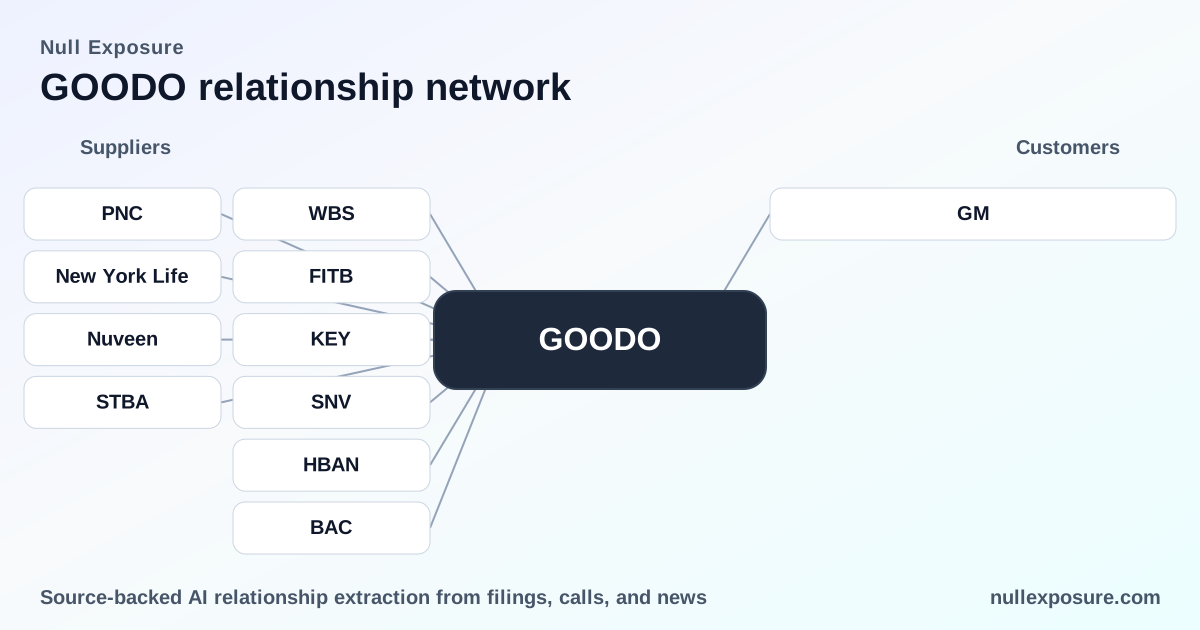
GM — tenant in Austin representing a material single-asset exposure
Gladstone Commercial disclosed that General Motors (GM) occupies an Austin asset that represents approximately 3% of the company’s straight-line rent, indicating a measurable but manageable single-tenant concentration for the portfolio. This detail was reported in an earnings call transcript covering FY2026 (published March 9, 2026) on InsiderMonkey. (InsiderMonkey Q4 2025 earnings call transcript, March 9, 2026 — https://www.insidermonkey.com/blog/gladstone-commercial-corporation-nasdaqgood-q4-2025-earnings-call-transcript-1699617/)
What the constraint signals tell investors about counterparty risk and portfolio design
Company-level constraints drawn from Gladstone’s filings and investor materials produce a clear picture of how tenant relationships are sourced and managed:
- Long-term leases are the rule, not the exception. The firm explicitly targets leases of about seven to 15 years with built-in rental increases, which creates predictable cash flows and reduces short-term rollover exposure. The company’s disclosures state: “We seek to obtain lease terms of approximately seven to 15 years with built-in rental increases.”
- Tenant mix spans the spectrum. Management describes tenants as ranging “from small to very large private and public companies,” which signals diversification by size but a need to monitor creditworthiness across different counterparty risk profiles.
- Geographic focus is the continental U.S. Holdings are concentrated in North America; the filing noted 135 wholly-owned properties totaling 16.9 million square feet across 27 states as of December 31, 2024, which implies regional diversification within the U.S. but minimal international exposure.
- Active, revenue-generating relationships dominate. With occupancy near 98.7% and full base rent collection for calendar year 2024, the portfolio operates as an active, income-producing book rather than a development pipeline.
These constraints are company-level signals that define Gladstone’s operating posture — long-term net leases with exposure across tenant sizes and a U.S.-centric footprint. They are not specific to one tenant unless the company explicitly names that tenant.
Concentration, credit and the things that move valuation
From an investor or operator perspective, the combination of long-term, high-occupancy leases and a diverse mix of tenant sizes is supportive of reliable cash flow and preferred-security coverage. Still, valuation and credit risk hinge on three axes:
- Tenant credit mix and single-tenant contributions (for example, GM’s ~3% straight-line rent contribution is a concrete data point to quantify concentration).
- Lease maturity cliffing: although the average remaining lease is ~7 years, watch the specific annual maturities for lumpy rollover years.
- Macroeconomic rent-reset environment: built-in escalators mitigate inflation risk, but market rent differentials at renewal will drive long-run NAV and cash-on-cash returns.
Key takeaway: Gladstone’s model privileges stability over high-growth upside. That tradeoff supports preferred shareholders who prioritize dividend coverage and downside protection in a late-cycle environment.
Practical next steps for analysts and operators
- Stress-test tenant-level scenarios where a handful of mid-size tenants underperform; quantify dividend coverage under 5–10% rent shortfalls.
- Map lease expirations by year to identify rollover concentration and potential re-leasing risk in years with clustered maturities.
- Monitor large single-tenant exposures and their credit profiles; GM’s 3% exposure serves as a template for how management reports material tenant contributions.
For further portfolio-level intelligence and tailored tenant analytics, visit Null Exposure to see how tenant relationships score against concentration and contract-risk factors.
Bottom line
Gladstone Commercial structures customer relationships to deliver predictable, contract-driven rental income through long-term net leases, high occupancy and a geographically diversified U.S. portfolio. The tenant mix reduces sector-specific volatility but still requires active monitoring for single-tenant concentrations and rollover risk; the GM tenancy at ~3% of straight-line rent is an example of the granular exposure investors should track. Financial and operational signaling from company filings and earnings commentary together give a clear read on the REIT’s income stability and the levers that move valuation.