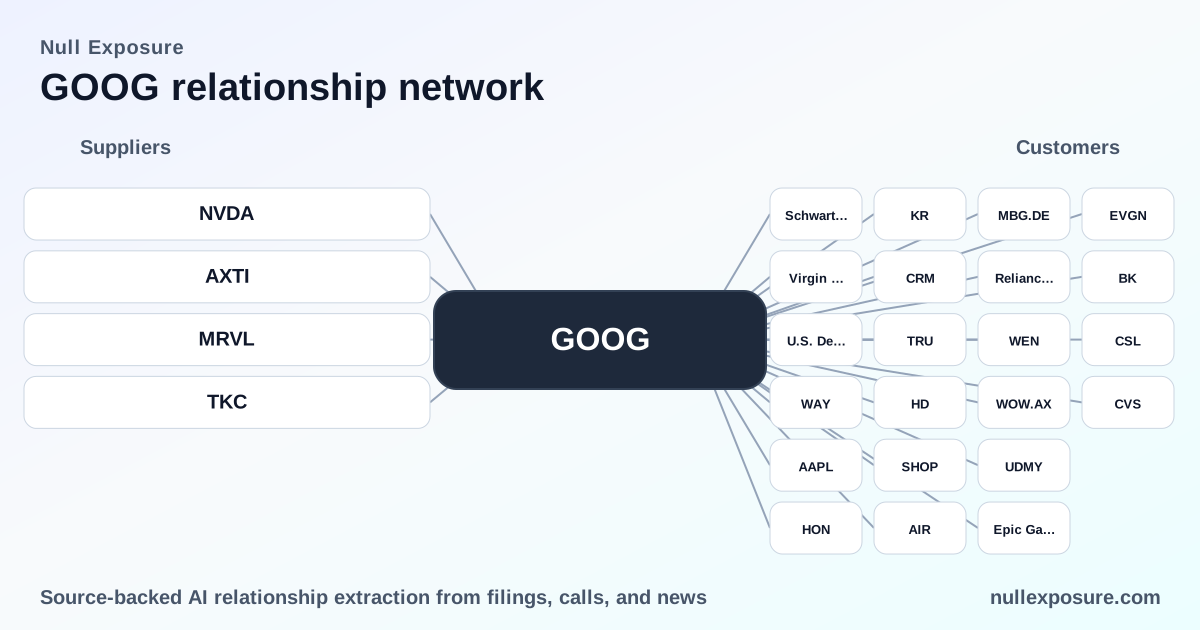
Alphabet (GOOG) — who pays for Gemini, Cloud and related services
Alphabet monetizes by selling advertising, cloud infrastructure and enterprise AI products — notably its Gemini models and Google Cloud services — through a mix of subscription and consumption-based contracts to global enterprises, public-sector agencies and software partners. Revenue flows combine ratable subscription recognition with usage fees for compute and platform services, with strategic partnerships that both deepen product integration and broaden distribution. For deeper customer signals and relationship scoring, visit https://nullexposure.com/.
What the contract and operating model tells investors
Alphabet’s go-to-market for Google Cloud and Gemini is service-provider oriented, global, and multi-segment. Public disclosures frame the business as:
- Subscription plus usage-based economics: Google Cloud recognizes subscription revenue ratably while also billing consumption for infrastructure and platform services, signaling recurring revenue with variable upside from usage spikes.
- Global distribution and scale: International revenues accounted for roughly half of consolidated revenues in 2025, underscoring a geographically diversified customer base.
- Product mix across segments: Google sells infrastructure, platform and application services as well as other product lines (Other Bets), meaning enterprise contracts can range from mission-critical compute to ancillary product integrations.
- Service-provider posture: Alphabet positions Google Cloud and Gemini as strategic partners that accelerate automation and AI adoption for customers — a relationship that is operationally sticky when integrated deeply.
These are company-level signals extracted from Alphabet’s reporting and recent commentary; they are not assigned to individual customers unless those excerpts explicitly name them.
Customer roll call — who Alphabet is working with today
Below is a compact investor-focused summary of every customer relationship cited in the recent corpus, with source context for each mention.
- Virgin Voyages: Google reported selling Gemini Enterprise seats to Virgin Voyages as part of an 8 million-seat enterprise deployment to streamline knowledge management and automation (GOOG 2025 Q4 earnings call, Mar 2026).
- Schwartz Group: Listed as a global brand win for integrated Gemini and Google Works solutions (GOOG 2025 Q4 earnings call, Mar 2026).
- U.S. Department of Transportation: Identified as a public-sector customer for integrated Gemini/Google Works deployments (GOOG 2025 Q4 earnings call, Mar 2026).
- Waystar (WAY): Announced an expanded collaboration with Google Cloud to accelerate agentic AI for healthcare revenue-cycle automation (PR Newswire, Mar 9, 2026).
- V2X / VVX: Reported plans to deploy Google’s advanced AI models inside secure, on-premises environments (Yahoo Finance, Mar 10, 2026).
- Xcel Energy (XEL): Named as the electricity supplier for a new Minnesota Google data center and partner in a clean-energy initiative (tech news coverage, Mar 10, 2026).
- TransUnion (TRU): Launched an AI Analytics Orchestrator built on Vertex AI and Gemini to accelerate credit analytics workflows (SiliconANGLE / SimplyWall / Q1 2026 transcripts, Mar–Apr 2026).
- Deloitte: Partnered with Elevance Health to build a solution on Google’s Agent Development Kit for multi-agent enterprise workflows (SiliconANGLE, Apr 29, 2026).
- Elevance Health (ELV): Collaborated with Deloitte to deploy an agent-based solution on Google’s Agent Development Kit addressing provider inquiry workflows (SiliconANGLE, Apr 29, 2026).
- Vodafone (VOD): Expanded its AI and cybersecurity offerings for SMBs through a partnership with Google Cloud (Benzinga, May 4, 2026).
- Shopify (SHOP): Cited among top SaaS companies using Gemini as part of broad SaaS adoption (GOOG 2025 Q4 earnings call, Mar 2026).
- Salesforce (CRM): Named as a leading SaaS customer leveraging Gemini in enterprise workflows (GOOG 2025 Q4 earnings call, Mar 2026).
- Amdocs (DOX): Partnered with Google Cloud to develop a generative contact center combining Gemini and Amdocs’ Cognitive Core (TradingView summary, Mar 9, 2026).
- ADT: ADT Plus integrates Google Nest and Yale devices as part of a modernized monitoring and smart-home experience (Earnings transcript summary, Apr 2026).
- The Home Depot (HD): Applying Google AI across cloud tools, ads and YouTube creator partnerships (GOOG 2025 Q4 earnings call, Mar 2026).
- Honeywell (HON): Listed among global enterprises using Gemini and Google Cloud capabilities (GOOG 2025 Q4 earnings call, Mar 2026).
- Kroger (KR): Named as a commercial customer where Gemini Enterprise handled customer interactions at scale (GOOG 2025 Q4 earnings call, Mar 2026).
- Wendy’s (WEN): Cited as a customer using Gemini Enterprise for large-scale customer-interaction automation (GOOG 2025 Q4 earnings call, Mar 2026).
- Woolworths Group: Listed among retail customers using Gemini Enterprise in Q4 deployment statistics (GOOG 2025 Q4 earnings call, Mar 2026).
- Evogene (EVGN): Announced a collaboration to integrate AI agents into its ChemPass platform using Vertex AI (company filings and industry press, Mar 2026).
- Apple (AAPL): Described as a cloud collaboration where Google is the preferred cloud provider for next-generation foundation models built on Gemini technology (GOOG 2025 Q4 earnings call, Mar 2026).
- Perfect Corp. (PERF): Reported higher payment-processing fees to digital distribution partners including Google tied to app subscription growth (company release, Jul 2025).
- Calix (CALX): Cited Google Cloud partnership supporting customers’ AI journeys on its service-provider platform (company release, Feb 2026).
- MHH: Reported upgrading its data platform with an expanded relationship with GCP alongside Snowflake (MHH earnings call, Q4 2025).
- Papa John’s (PZZA): Noted continued expansion of its Google Cloud partnership (PZZA earnings call, Q4 2025).
- WRBY: Reported partnership with Google in AI-enabled wearables (investment commentary, Hedgeye, 2025/2026).
- Udemy (UDMY): Launched an AI training plan in partnership with Google to deliver Google professional AI certification (Finviz summary, Feb 19, 2026).
- Deutsche Bank (DB): Ran an AI experiment using Google’s Gemini 2.5 Pro model for sector analysis (Fortune, Feb 18, 2026).
- CXAI (CXAI): Reported product benefits derived directly from partnership with Google Cloud on agentic AI (company release, Aug 2025).
- HCA Healthcare (HCA): Using Google Cloud to automate clinical documentation, targeting physician time savings (industry coverage, 2026).
- Epic Games: Reported deal activity allowing Fortnite relaunch on Google Play following negotiated terms (tech press coverage, Mar 2026).
- Myseum (MYSE): Launched a product with a YouTube use case, leveraging Google’s platform distribution (company announcement, Jan 2026).
- BNY / Bank of New York Mellon (BNY): Named among enterprise buyers of Gemini Enterprise seats in Alphabet commentary (GOOG 2025 Q4 earnings call, Mar 2026).
- Citadel Securities: Cited as a high-performance computing client for Google Cloud AI accelerators (GOOG 2025 Q4 earnings call, Mar 2026).
- Mercedes‑Benz: Identified as an enterprise customer deploying Cloud AI accelerators (GOOG 2025 Q4 earnings call, Mar 2026).
- Reliance Jio: Partnered to give 500 million consumers an 18‑month free trial of Gemini and cloud storage as part of a mass-distribution play (GOOG 2025 Q4 earnings call, Mar 2026).
- CVS Health (CVS): Included in reporting about expanded Google Cloud collaborations across healthcare and retail (industry roundup, Mar 2026).
- ServiceNow (NOW): Benefits from integrations with Google among other model providers to add AI capabilities into its platform (TradingView / Zacks summary, May 2026).
- Airbus: Cited among global enterprises leveraging Gemini and Cloud AI accelerators (GOOG 2025 Q4 earnings call, Mar 2026).
What this customer map implies for investors
- Concentration and criticality: Alphabet wins marquee, sticky integrations (Apple, Reliance Jio, large retailers and financial firms) that create multi-year, high-life-time-value relationships and justify Cloud capex.
- Contract maturity: The mix of ratable subscriptions plus consumption exposure drives predictable recur revenue with upside during customer AI rollouts.
- Go-to-market leverage: Partnerships with systems integrators and software vendors (Deloitte, Salesforce, Amdocs) act as distribution multipliers for Gemini and Google Cloud.
- Operational risk: Large deployments require data center and energy partnerships (e.g., Xcel Energy), linking capex and sustainability execution to customer-delivery timelines.
Investment takeaway and next steps
Alphabet’s customer roster demonstrates that Gemini and Google Cloud have moved from proof-of-concept to commercial scale across multiple industries, with both direct enterprise contracts and embedded partnerships amplifying reach. Investors should watch adoption cadence (seat growth, consumption trends) and the operating metrics that convert technical wins into recurring revenue.
For regular updates on customer-level signals, methodology and alerting, see https://nullexposure.com/ — or contact our research team through the site for bespoke diligence.