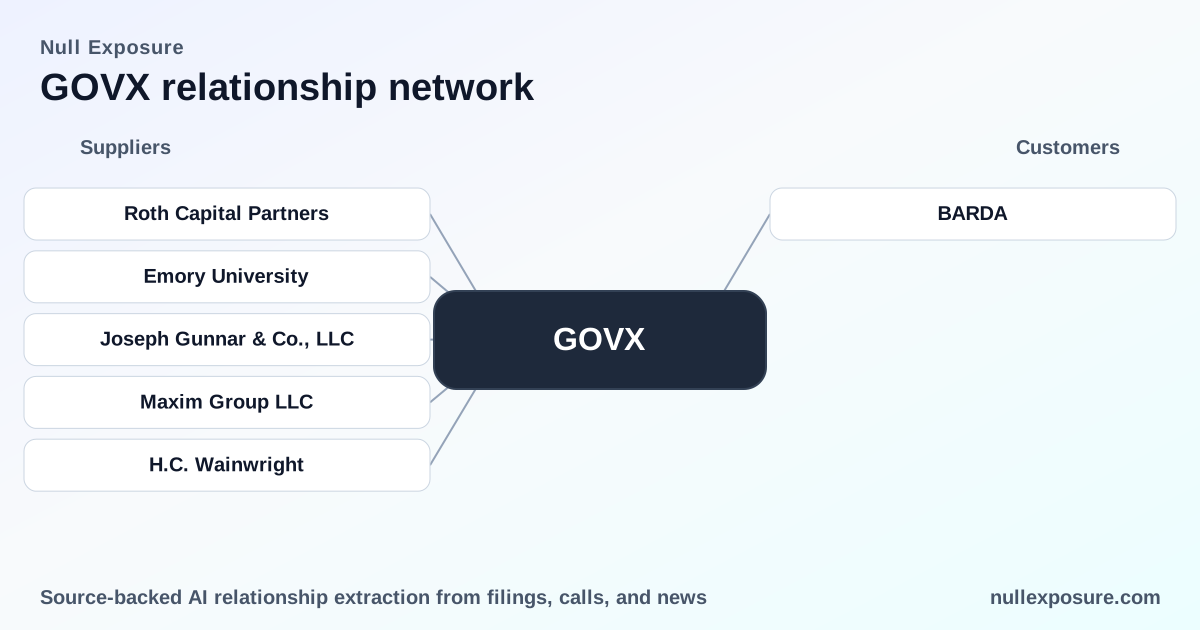
GeoVax and BARDA: A funding lifeline that defines valuation and execution risk
GeoVax Labs (GOVX) is a clinical-stage vaccine developer that monetizes primarily through government contracts and grants, milestone-driven partnerships, and occasional equity raises while it advances candidates such as GEO-CM04S1 through late-stage clinical work. For investors and operators, GeoVax’s trajectory is tightly coupled to a single large government funding relationship and the company’s ability to convert award funding into clinical milestones without recurrent liquidity shocks. Learn more at https://nullexposure.com/.
The short thesis investors need up front
GeoVax builds value by advancing vaccine candidates with a modified vaccinia ankara virus-like particle platform; near-term enterprise value is dominated by government-sponsored development funding rather than product revenue, making contract stability and milestone delivery the primary drivers of upside or downside. The company’s market capitalization, capital raises and operating runway are responsive to the status of that government relationship and to clinical readouts that de-risk future commercialization or partner licensing.
Why BARDA is the relationship that moves the stock
GeoVax’s relationship with BARDA (the Biomedical Advanced Research and Development Authority) is the operational and financial fulcrum for the business. The award is structured as a direct cash-funded program to support manufacturing and a Phase 2b clinical trial, and the funding scale is material — currently reported at approximately $26.2 million with potential to increase to $45 million. That size places BARDA in the 10m–100m spend band and creates a concentration dynamic: loss of this single counterparty would meaningfully stress liquidity and force additional equity raises.
According to company disclosures cited in federal contract summaries, execution of the study is fully funded by BARDA under its Clinical Studies Network and GeoVax’s role is financed in whole or in part with federal funds under Other Transaction OT 75A50123D00005. This structure produces reliable reimbursement when contract conditions are met, but it also creates binary operational dependency: the award funds development through a specific clinical milestone set and is not recurring commercial revenue.
The three public mentions investors should track
-
A Globe and Mail press release in March 2026 covering GeoVax’s public equity offering referenced the negative impact of a BARDA contract termination on investor sentiment, highlighting liquidity pressure as a driver for the offering. This release frames the equity raise as a response to funding uncertainty tied to BARDA.
Source: The Globe and Mail press release on GeoVax’s public equity offering, March 2026. -
An Intellectia.ai earnings note in March 2026 flagged financial instability driven by the BARDA contract termination, emphasizing how a change in the award status materially affects the company’s funding profile and near-term viability.
Source: Intellectia.ai earnings coverage of GOVX, March 2026. -
A Globe and Mail press release in May 2026 describing a $6 million public offering reiterated the same dynamics: equity issuance to shore up liquidity amid developments related to BARDA funding and program execution. The filing-level narrative ties equity activity directly to the company’s need to maintain operations while clinical activities progress.
Source: The Globe and Mail press release on GeoVax’s $6M offering, May 2026.
Each mention underscores the same theme: BARDA funding status is the proximate cause of recent capital markets activity for GOVX.
Constraints, contracting posture and what that says about execution risk
-
Counterparty type — government (high confidence). Evidence shows BARDA funds GeoVax through the Rapid Response Partnership Vehicle and under an Other Transaction authority, establishing GeoVax as a government contractor for this program. This classification raises expectations for rigorous compliance, milestone-based disbursements, and program-specific audit exposure.
Source: Company disclosures describing RRPV and BARDA funding (2024–2025 period). -
Relationship role — service provider (company-level signal). GeoVax records revenue when reimbursable costs are incurred and contractual conditions are satisfied, indicative of a cost-reimbursement/grant posture rather than a fee-for-service or product-sales orientation. This implies predictable expense recovery when the program is active but limited upside outside contractual scope.
-
Relationship stage — active (high confidence). GeoVax recognized nearly $3.95 million in revenue in 2024 associated with the ATI-RRPV contract, indicating the program was actively funding work and supporting operations. Active stage funding reduces near-term technical uncertainty but maintains execution risk tied to clinical timelines and regulatory interactions.
-
Spend band — $10M–$100M (high confidence). The direct award figure (~$26.2M, with upside to ~$45M) signals meaningful capital commitment sufficient to underwrite Phase 2b manufacturing and regulatory activities, but it is not a product-launch-level contract. This is large enough to move the company’s burn profile, yet small enough that loss or delay would force external capital markets action.
What this means for investors and operators
-
Concentration risk is the primary valuation lever. With one principal government counterparty providing material funding, GeoVax’s cash runway and dilution profile are sensitive to contract continuity and milestone achievement. Recent public offerings are evidence that the market prices this concentration into share issuance and valuation dynamics.
-
Operational discipline and compliance are non-negotiable. Because BARDA funding flows under an Other Transaction and is milestone tied, the company must demonstrate precise program management, documentation and timely regulatory progress to avoid payment delays or contract termination.
-
Clinical success is binary but high-impact. Advancement through Phase 2b and successful regulatory steps would transform the funding model from grant-funded development to commercialization or partner licensing paths, unlocking optionality for revenue and licensing. Conversely, setbacks amplify liquidity stress.
-
Watch the signals investors can act on: BARDA milestone notices, FDA interactions, disclosures around contract amendments or terminations, and registrational trial endpoints. Also monitor capital markets activity — equity offerings are the company’s fallback to bridge funding when program funding is uncertain.
Practical next steps for due diligence
- Review BARDA notices and the OT award language to understand termination triggers and allowable cost recovery.
- Monitor filings and press releases for milestones tied to manufacturing, Phase 2b enrollment, and regulatory submissions.
- Incorporate concentration-adjusted scenarios into financial models—run sensitivity to funding continuity and dilution outcomes.
For further investor-focused relationship analysis and to monitor government contract exposures across portfolios, visit https://nullexposure.com/.
Bottom line
GeoVax’s business case is fundamentally tied to one large government relationship: BARDA provides the capital and program framework that underwrites near-term clinical progress. That funding profile creates clear upside if clinical milestones are met and the award remains in place, and sharp downside if funding is interrupted, as recent equity raises have signaled to the market. Investors and operators must evaluate GeoVax through the twin lenses of contract stability and clinical execution discipline.