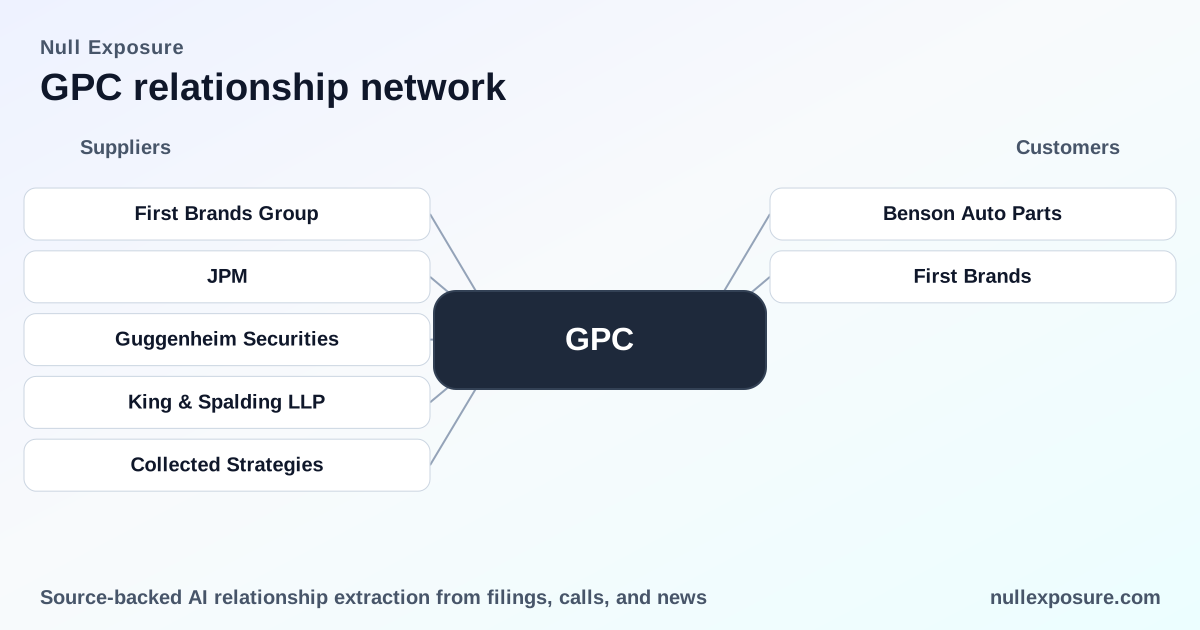
Genuine Parts Company (GPC): Commercial Relationships that Drive Distribution Economics
Genuine Parts Company operates a large-scale distribution and services business that monetizes through wholesale parts sales, inventory distribution to company-operated and independently owned stores, and value-added services (cataloging, software, training, membership programs). The firm's financial engine is volume-driven: broad geographic reach, high catalog breadth, and long-term commercial agreements underpin recurring revenue and margin capture in automotive and industrial replacement parts. For investors, GPC is a play on distribution scale, network effects in parts availability, and stable aftermarket demand—tempered by geographic concentration and thin near-term profitability metrics. Explore deeper customer relationship intelligence at https://nullexposure.com/.
How GPC actually transacts with counterparties
GPC is a distributor at scale. It sources components, holds inventory centrally, and sells to two primary customer types: company-operated outlets and independent resellers. The company also offers services to customers—software, cataloging, marketing and training—that increase stickiness and raise the lifetime value of those relationships.
- Distribution-first model: GPC’s business is fundamentally wholesale distribution; margins rely on scale, inventory turns, and logistics efficiency.
- Services layer for retention: The company embeds software, training and membership benefits into commercial relationships to preserve share and reduce churn.
- Geographic concentration: Company-level signals indicate ~74% of sales in North America, with the remainder split between Europe (~16%) and Australasia (~10%), which concentrates revenue risk in North America while offering international growth optionality.
These operating characteristics are visible in public commentary and filings and are reinforced by relationship-level disclosures discussed below.
Company-level commercial posture and constraints
Investors should treat the following as company-level signals about GPC’s contracting posture, relationship roles, and maturity:
- Long-term contracting posture: There is a signal that GPC’s commercial framework leans toward long-term agreements that underpin a material portion of sales, consistent with distribution partners and national accounts that require predictable supply and pricing arrangements (supporting evidence flagged at the company level).
- Buyer / Reseller / Seller roles: GPC functions simultaneously as a seller to independent stores and as a buyer/reseller within its supply chain — it distributes product both through company-operated centers and to third-party resellers who then retail to end customers.
- Active and mature relationships: The company serves customers from a network exceeding 10,700 locations, indicating highly mature, operationally embedded commercial channels across its footprint.
- Segment focus: The core activity is distribution, supplemented by services that increase customer retention and monetization per account.
Taken together, these signals point to a high-maturity distribution business with long-term commercial linkages, significant North American concentration, and recurring revenue characteristics enhanced by services.
What GPC told investors about its counterparties (two disclosures)
Below are the two customer-related disclosures GPC made in its recent earnings commentary, summarized for the investor audience.
Benson Auto Parts — strategic acquisition into Canada
GPC announced that it has signed a definitive agreement to acquire Benson Auto Parts, a large independent aftermarket operator in Canada with approximately 85 stores across Ontario and Quebec. This transaction expands GPC’s retail footprint and strengthens its Canadian distribution density. According to GPC’s 2025 Q3 earnings call (first reported March 8, 2026), the company described the Benson deal as a clear way to accelerate market share and scale in key Canadian provinces. (Source: GPC 2025 Q3 earnings call, March 2026)
First Brands — ongoing commercial supplier relationship in Global Automotive
GPC confirmed an ongoing commercial relationship with First Brands, predominantly across its Global Automotive business, indicating First Brands supplies product or services that GPC distributes through its automotive channels. The mention in the 2025 Q3 earnings call confirms First Brands is an active supplier/partner in the core parts business. (Source: GPC 2025 Q3 earnings call, March 2026)
What these relationships mean for investors
Each disclosure provides a different signal about GPC’s strategy and risk profile.
- Acquisition as density play: The Benson Auto Parts transaction is an explicit roll-up/density move that increases GPC’s control of retail doors and reduces competitor fragmentation in Canada. For investors, this is a scale-driven margin play: higher local density typically improves logistics efficiency and parts availability, both of which support aftermarket pricing power.
- Supplier relationships sustain assortment: The First Brands commercial relationship underscores the importance of supplier diversity and brand partnerships in maintaining product assortment for GPC’s network; this supports the firm’s value proposition to end customers and resellers.
Risk and concentration considerations
- Geographic concentration: With roughly three quarters of revenue generated in North America, GPC is exposed to regional demand cycles, regulatory changes, and competitive dynamics in the U.S. and Canada. International operations (Europe/Australasia) provide diversification but are materially smaller.
- Contracting and customer stickiness: Company-level signals indicate long-term sales agreements and embedded services, which reduce churn and provide revenue visibility; however, these arrangements can lock the company into contractual pricing or service levels that limit near-term margin flexibility.
- Revenue quality: GPC’s operating model is volume-sensitive; aftermarket demand trends and automotive repair cycles drive sales variability. Services and membership programs offset some cyclicality by adding recurring revenue lines.
Investment implications and next steps
GPC is a large, mature distributor with scale advantages and a services-led retention strategy; acquisitions like Benson Auto Parts reinforce a growth-through-density approach while supplier partnerships like First Brands maintain assortment breadth. For investors and operators evaluating counterparties, the company’s profile signals stability in core distribution economics with concentrated regional exposure.
For a deeper dive into specific customer and supplier disclosures and how they influence counterparties’ risk profiles, review our detailed customer intelligence at https://nullexposure.com/.
Bold takeaway: GPC is a distribution-first company that monetizes scale and services; acquisition and supplier disclosures confirm an operational strategy focused on density and assortment rather than short-term margin experiments.