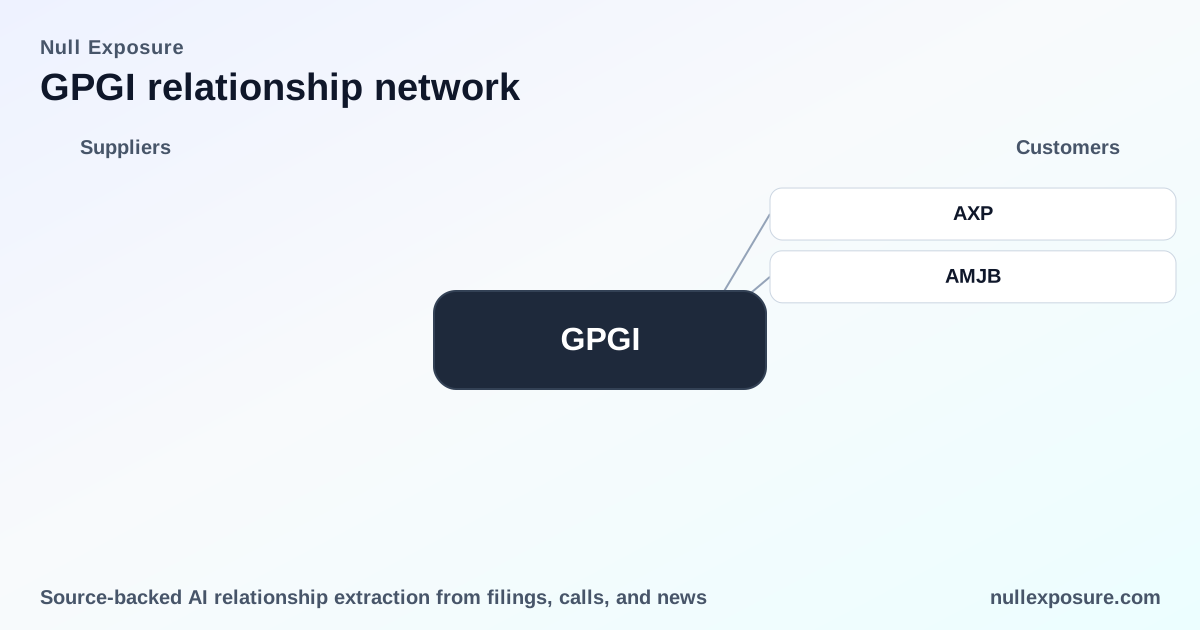
GPGI customer relationships: concentrated, long-standing, and strategically critical
GPGI, Inc. manufactures and sells premium metal payment cards and related authentication products, monetizing through the production and sale of customized card products and ancillary services to card issuers and distributors worldwide. The company's business model is highly client-driven: a small set of very large issuers account for the bulk of revenue, while a broader international base supplies incremental volume. For investors, the revenue profile is a two-edged sword—high margin product differentiation paired with acute customer concentration risk. Learn more at https://nullexposure.com/.
Why customer relationships determine valuation here
GPGI’s economics are anchored in bespoke manufacturing and long-standing commercial ties. The company sells physical goods (metal payment cards) and embedded technologies (Arculus authentication and cold-storage features), and it relies on scale orders from major card issuers for the majority of its sales. That positioning creates durable revenue when relationships persist, but produces outsized downside if a large client changes sourcing or reduces order volumes.
- Concentration is extreme: two clients represented 63.2% of net sales in 2024 (37.0% and 26.2% respectively). The 10‑K explicitly quantifies this split, making customer retention central to any cash-flow forecast.
- Relationships are mature and embedded: the company reports multi-year engagements and nearly two decades of service with top clients, supporting repeat orders and product specification depth that is costly for clients to replicate.
- Geographic diversification exists but does not dilute concentration: GPGI sells globally (U.S., EMEA, APAC, LATAM) but most revenue is still driven by a few very large issuers.
What the FY2024 10‑K makes explicit about customers
GPGI’s Form 10‑K for the year ended December 31, 2024, is concise on customer mix: JPMorgan Chase and American Express are the two largest customers and together accounted for 63.2% of the company’s net sales for the year. The filing also describes the company’s go-to-market (direct sales to card issuers and through distributors) and the product split (Payment Card and Arculus lines). According to the 2024 10‑K, many direct clients are major international and domestic banks and card issuers across multiple regions.
Customer roster: JPMorgan Chase
JPMorgan Chase is identified as one of GPGI’s two largest customers and represented approximately 37.0% of net sales in 2024, making it the single largest revenue source. According to the company’s 2024 Form 10‑K, GPGI and Chase operate under a multi‑year master service agreement that was extended in 2023 and is scheduled for renewal on December 31, 2028, indicating a long-term, highly embedded commercial relationship (GPGI 10‑K, FY2024).
Customer roster: American Express
American Express is the other principal buyer, accounting for roughly 26.2% of net sales in 2024, and is explicitly named alongside Chase as one of the two largest customers in the 2024 10‑K. This concentration underlines that two counterparties drive the majority of revenue, and AmEx’s continued engagement is therefore material to near‑term earnings (GPGI 10‑K, FY2024).
Customer roster: AMJB
The company’s FY2024 filing references an entity listed as AMJB in the customer table alongside the Chase and American Express mentions. The same 10‑K text that names the two largest customers includes the AMJB entry in the results list, so AMJB is recorded in the filing as part of GPGI’s customer landscape for FY2024 (GPGI 10‑K, FY2024).
How contractual and operating constraints shape risk and opportunity
GPGI’s 10‑K and related disclosures provide several constraints that are critical to modeling revenue durability and downside.
- Contracting posture is mixed: while the company generally states that “contracts are generally short term in nature,” it also documents multi‑year master agreements with major clients. The Chase Agreement was extended in 2023 with a renewal date at the end of 2028, demonstrating that the firm sustains a blend of short‑term orders and long‑dated institutional contracts (company 10‑K, FY2024). Treat forecasts as contingent on renewal outcomes for these master agreements.
- Concentration is a central credit risk: two customers accounted for 63.2% of net sales in 2024, which is a material single‑point failure exposure for revenue and working capital planning (company 10‑K, FY2024).
- Customer type and geography support premium pricing but not de‑risking: GPGI’s principal customers are large and very large payment issuers across North America, EMEA, APAC and LATAM, giving global reach for distribution while leaving the company dependent on the card industry’s procurement cycles across regions.
- Relationship maturity and embedding increase switching costs: GPGI has served its two largest clients for nearly seventeen years, which implies deep product customization, operational integration, and procurement relationships that support retention—a positive for predictable revenue, absent significant strategic shifts by issuers (company 10‑K, FY2024).
- Role and segment clarity: GPGI is primarily a seller/manufacturer of metal payment cards and related Arculus products, with a hybrid product/services revenue mix that includes authentication and cold‑storage features as value‑added services.
Investment implications and risk checklist
- Upside driver: retention and expansion with top issuers; any incremental adoption of Arculus authentication technologies across the issuer base is a scalable revenue opportunity without proportionate capex increases.
- Principal downside: loss or material volume reduction from JPMorgan Chase or American Express would compress revenue and margins quickly given the 63.2% concentration.
- Modeling note: incorporate both short‑term order variability and discrete renewal events for master agreements (Chase renewal 12/31/2028) when projecting multi‑year cash flows.
- Geography and customer mix: global sales mitigate single‑market recession risk, but procurement decisions by a handful of global issuers dominate outcomes.
For a concise, investor‑grade analysis of supplier and customer footprints in industrial and payment card manufacturers, visit https://nullexposure.com/ for structured intelligence.
Bottom line for operators and investors
GPGI combines highly differentiated manufacturing and embedded client relationships with acute top‑customer concentration. The Chase and American Express contracts anchor current revenues and represent both the company’s competitive moat and its principal financial risk. Investors should underwrite valuations against two simultaneous variables: the probability of multi‑year renewals with current top issuers and the company’s ability to broaden its client base without diluting per‑unit economics. Operators should prioritize contract renewal cadence, order pipeline transparency, and contingency sourcing plans to mitigate concentration risk.
Bold long‑term contracts with major issuers provide stability; however, the balance of short‑term orders and concentrated revenue requires active monitoring of customer intent and contract renewal outcomes.