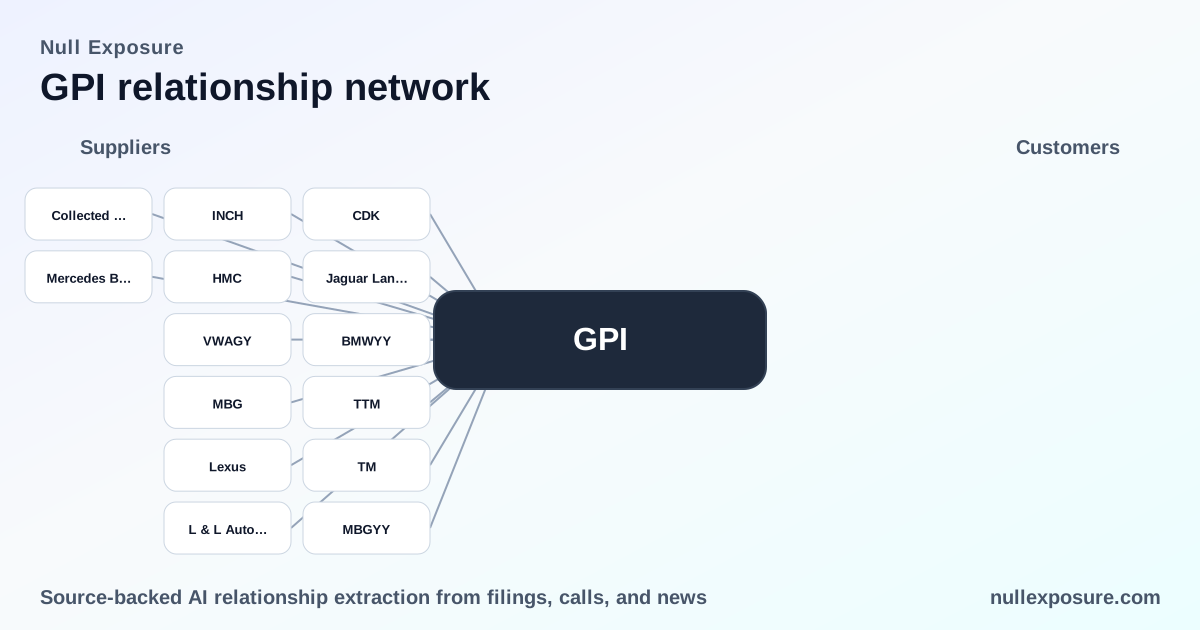
Group 1 Automotive (GPI): Buyer-seller dynamics and the Beverly Hills disposition
Group 1 Automotive operates a scaled, retail-focused automotive platform that monetizes primarily through new and used vehicle retail, parts and service, and vehicle financing contracts; the company runs 259 dealerships across the U.S. and U.K., driving high-volume, low-margin retail economics complemented by higher-margin aftercare revenue. For investors, the recent sale of the Mercedes‑Benz of Beverly Hills franchise to Fletcher Jones crystallizes an active portfolio-management posture: Group 1 selectively monetizes high-value assets while preserving recurring-service cash flows. Learn more at https://nullexposure.com/
Why the Beverly Hills sale matters to investors
Group 1 pursues a pragmatic mix of organic retail scale and opportunistic portfolio rotations. Disposing of marquee franchises such as Mercedes‑Benz of Beverly Hills is consistent with a strategy to optimize return on capital, reduce idiosyncratic operating complexity in premium urban locations, and redeploy proceeds into higher-yield or higher-growth locations and services. The buyer, Fletcher Jones Automotive Group, is a strategic acquirer in the luxury franchise space, and the transaction underscores the active and tradable nature of dealership assets in the current market.
Every related news mention — what was reported
- A Finviz headline covering earnings and cost control mentioned that The Presidio Group exclusively advised Group 1 on the sale of Mercedes‑Benz of Beverly Hills to Fletcher Jones Automotive Group, signaling an advisor-led, negotiated sale process (Finviz, May 3, 2026: https://finviz.com/news/333034/group-1-automotive-gpi-exhibits-disciplined-cost-controls).
- A Business Wire pickup noted the same transaction and tied it into Group 1’s broader FY2026 commentary on revenue performance, reporting the adviser-led sale to Fletcher Jones on May 1, 2026, which validates the company’s stated portfolio actions during the period (Business Wire via Finviz, May 1, 2026: https://finviz.com/news/298866/group-1-automotive-inc-gpi-delivers-record-year-of-robust-revenue-growth).
- MarketBeat’s instant alert referenced the Business Wire release when covering analyst activity, repeating that The Presidio Group advised the sale of Mercedes‑Benz of Beverly Hills to Fletcher Jones, and placing the deal in the public market narrative as part of Group 1’s corporate developments for FY2026 (MarketBeat alert, May 1, 2026: https://www.marketbeat.com/instant-alerts/group-1-automotive-nysegpi-earns-buy-rating-from-analysts-at-bank-of-america-2026-03-04/).
- A second MarketBeat alert similarly reproduced the press release language while reporting on analyst note adjustments, again confirming the transaction details and the adviser relationship with The Presidio Group (MarketBeat alert, early May 2026: https://www.marketbeat.com/instant-alerts/morgan-stanley-lowers-group-1-automotive-nysegpi-price-target-to-40000-2026-03-02/).
How Group 1 actually makes money — the operating model explained
Group 1’s revenue model is multi-legged and retail centric:
- Core retail sales: new and used vehicle sales drive the bulk of top-line dollars. The company operates both physical showrooms and digital retailing (AcceleRide®) channels and also distributes wholesale inventory via auctions.
- After-sales services: parts, maintenance, collision centers and service contracts create higher-margin, recurring revenue streams that stabilize cash flow across vehicle cycles.
- Financing and insurance: arranging customer financing and selling ancillary vehicle and service contracts contribute to margin capture on each retail unit.
This is a contracting posture that is predominantly B2C: Group 1 sells directly to individual consumers at dealerships and through digital retail channels, with wholesale disposition activity at third-party auctions. The business model combines high transaction volume and relatively low per-unit gross margin with durable service annuity streams as the margin stabilizer.
Learn more about our customer relationship intelligence at https://nullexposure.com/
Company-level constraints and what they signal for investors
The available relationship constraints provide several company-level operating signals:
- Counterparty type — individual (confidence 0.80): Group 1’s primary customers are retail consumers; this elevates sensitivity to consumer credit cycles, discretionary demand, and urban mobility patterns.
- Geographic exposure — NA and EMEA focus (confidence 0.90 each): operations concentrated in North America (U.S.) and the U.K. create a bi-regional exposure profile—useful diversification but also correlated risks across macro and regulatory environments in those jurisdictions.
- Relationship roles — seller and service provider (confidence 0.80): the company both sells vehicles and provides ongoing maintenance and parts services, making many dealer locations critical nodes for recurring revenue capture.
- Segment mix — core product and services (confidence 0.80): revenue is split between vehicle retail (core product) and aftermarket/financial services (services), meaning profitability depends on both sales volume and service penetration.
These constraints frame Group 1 as a mature, retail-oriented operator with significant scale, concentrated regional exposure, and a clear dependency on individual consumer demand and aftermarket penetration. They do not reference specific counterparties and instead function as company-level signals.
Financial context and investment implications
Group 1 reported Revenue TTM of $22.47 billion and EBITDA of approximately $1.08 billion, with a trailing P/E of 13.4 and a forward P/E of 8.1, reflecting earnings leverage and analyst expectations for margin improvement. Profit margin of ~1.46% and operating margin of ~4.58% indicate retail pressure on margins but also the contribution of services to operating profit.
Key takeaways for investors:
- Asset rotation like the Mercedes‑Benz of Beverly Hills sale is earnings-accretive if proceeds are redeployed into higher-return stores or used to de-lever balance sheet; it also reduces capital intensity tied to luxury urban real estate and franchise requirements.
- Scale in service and parts is a strategic moat: steady aftermarket revenue offsets cyclical new vehicle sales and supports cash generation even in softer retail periods.
- Regional concentration in the U.S. and U.K. is both strength and risk: management benefits from focused operational expertise but faces macro and regulatory risks in two major markets.
Risks to monitor
- Consumer demand and credit cycle exposure given the B2C retail orientation.
- Franchise-specific regulatory and OEM relationships—dealer rights and franchise transfers can be complex and materially affect localized profitability. The Mercedes‑Benz disposition is a reminder that premium franchise footprint is fungible and subject to negotiated sales.
- Margin sensitivity to used-vehicle pricing and service penetration; the hold/sell choices for individual high-value stores will influence near-term free cash flow.
Bottom line
Group 1’s sale of Mercedes‑Benz of Beverly Hills to Fletcher Jones illustrates an active balance-sheet and portfolio approach inside a high-volume retail and service operator. Investors should view such dispositions as tactical capital-allocation moves that can enhance returns if proceeds are redeployed efficiently into service expansion, share buybacks, or higher-yield franchises. For a deeper look at customer and counterparty signals across public companies, visit https://nullexposure.com/