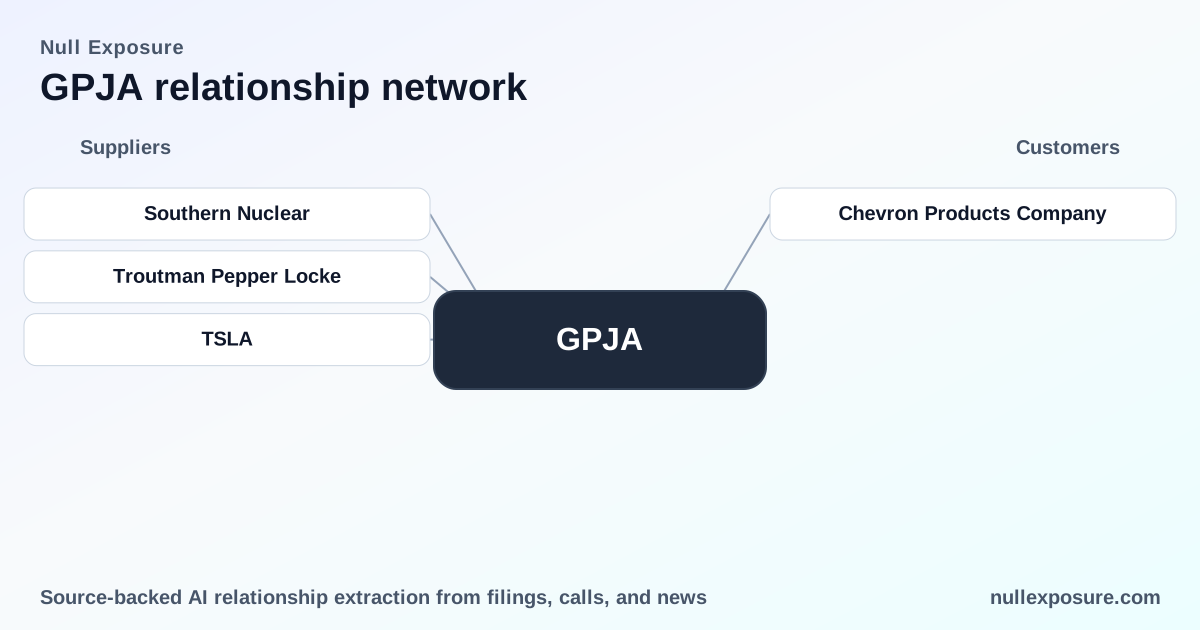
Georgia Power (GPJA): Customer relationships that anchor long-term cash flow and project execution
Georgia Power operates as a vertically integrated electric utility that generates, transmits and distributes electricity to retail customers in Georgia while its affiliated businesses sell wholesale power and provide engineering and construction services. The company monetizes through regulated retail tariffs, long-term power purchase agreements (PPAs) in the wholesale market, and fee-for-service engineering, procurement and construction (EPC) work performed by its Power Services organization. For authoritative access to the coverage behind this note, see NullExposure: https://nullexposure.com/
Two customer relationships to know right away
Chevron Products Company — long-term retail offtake via Mississippi Power
Mississippi Power, an affiliated traditional operating company within the group, provides retail electric service to Chevron’s Pascagoula refinery under agreements that extend through at least 2038, establishing a multi-year offtake anchor at that site. This is documented in Mississippi Power’s FY2024 disclosure in the company 10‑K.
Source: Mississippi Power / company FY2024 10‑K filing.
Kia Georgia — EPC and solar integration handled by Georgia Power’s Power Services
Georgia Power’s Power Services team acted as the engineering, procurement and construction (EPC) provider for the solar canopy portion of the Kia Georgia project, managing system design, construction and integration into Kia’s electrical infrastructure. This project-level role was reported by AllOnGeorgia in May 2026.
Source: AllOnGeorgia news report, May 2026.
What the relationship slate tells investors about the operating model
Georgia Power sits inside a group whose commercial posture combines regulated retail utility economics with wholesale merchant/contracted power exposures and ancillary services. The dominant commercial pattern is long-term contracting: the group’s filings repeatedly characterize generation output as sold under 15–20 year PPAs or long-term tariffs. That contracting posture translates to predictable revenue streams for generation assets and a steady underwriting profile for capital projects.
Source: Southern Company / affiliated operating companies FY2024 filings.
- Long-term PPAs are central. Multiple excerpts in the FY2024 filings describe projects contracted under 15–20 year PPAs and a corporate emphasis on long-term PPAs for capacity and energy sales.
- Short-term sales exist but are marginal. The filings note the ability to sell short-term capacity into wholesale markets, but long-term contracts are the primary revenue mechanism.
These signals indicate a business that prioritizes contract duration and cash-flow certainty over merchant exposure.
Concentration, criticality and maturity of counterparty relationships
The filing-level evidence shows meaningful concentration and materiality among wholesale counterparties. Contracts with wholesale customers accounted for 13.9% of Mississippi Power’s operating revenues in 2024, and Southern Power’s top three customers represented roughly 24% of Southern Power’s revenue for the year ended December 31, 2024. Those numbers frame both earnings stability and counterparty concentration risk at the group level.
Source: Southern Company / Mississippi Power / Southern Power FY2024 disclosures.
Additional lifecycle signals are visible in the filings: Cooperative Energy is scheduled to reduce use of Mississippi Power generation under an MRA tariff through 2035 and transition to full self-supply at MRA delivery points beginning in 2036 — an explicit winding‑down trajectory disclosed by the company. That timeline highlights how even material wholesale relationships carry replacement risk over multi‑year horizons.
Source: Southern Company / Mississippi Power FY2024 disclosures.
Roles and commercial posture across the organization
The group operates across several relationship roles that matter for investors and operators:
- Seller: Southern Power and the traditional operating companies sell electricity in wholesale and retail markets, largely under contract. Filings describe sales through PPAs, tolling agreements and tariffed wholesale arrangements.
- Distributor: The gas distribution utilities and the traditional electric operating companies provide local distribution services, subject to state regulation and rate-setting processes.
- Service provider (EPC): Georgia Power’s Power Services group performs EPC work for large commercial customers, integrating renewable assets into customer sites (as with the Kia project).
These overlapping roles mean capital allocation and counterparty risk management must account for regulated returns, contract renewals, and execution risk on construction projects.
Source: Southern Company FY2024 filings; AllOnGeorgia news report (Kia, 2026).
Relationship-level summaries (complete list from results)
-
Chevron Products Company — Mississippi Power provides retail service to the Chevron refinery in Pascagoula under agreements extending through at least 2038, creating a long-dated retail contract for the refinery site. Source: Mississippi Power FY2024 10‑K filing.
-
Kia Georgia — Georgia Power’s Power Services team served as the EPC provider for the solar canopy project at Kia, overseeing design, construction and integration with the automaker’s electrical infrastructure. Source: AllOnGeorgia news report, May 2026.
Investment implications and operational takeaways
-
Predictable cash flows from long-term contracts are a core strength. The prevalence of 15–20 year PPAs and regulated tariffs supports earnings stability and capital planning discipline. Source: Southern Company FY2024 filings.
-
Customer concentration is non-trivial and requires active replacement management. Material revenue slices tied to a small number of wholesale counterparties (e.g., 13.9% of Mississippi Power revenues and ~24% for Southern Power’s top-three customers) create exposure that the company actively manages by targeting replacement PPAs ahead of expirations. Source: Southern Company / Southern Power FY2024 disclosures.
-
Execution risk sits alongside regulated stability. EPC work for commercial customers such as Kia positions Georgia Power to capture project-level fees and integration margins, but it also places execution and construction risk on the company’s balance between regulated utility work and competitive project delivery. Source: AllOnGeorgia news (Kia), Southern Company filings.
-
Lifecycle risk is explicit and dated. The Cooperative Energy winding‑down schedule (through 2035 and full self-supply in 2036 at specified delivery points) is a concrete example of how contracted demand can erode over a known timetable, requiring proactive remarketing or redeployment of generation. Source: Mississippi Power / Southern Company FY2024 disclosures.
Bottom line for investors and operators
Georgia Power and its affiliated operating companies combine the earnings stability of regulated utility tariffing with the commercial upside and replacement risk of long-term PPAs and project services. For investors, the dominant proposition is steady, contract-backed cash flow with identifiable concentration pockets that require active management. For operators, the focus is on executing EPC projects and remarketing capacity well ahead of PPA expirations. For deeper coverage and the underlying documents that support these conclusions, visit NullExposure: https://nullexposure.com/