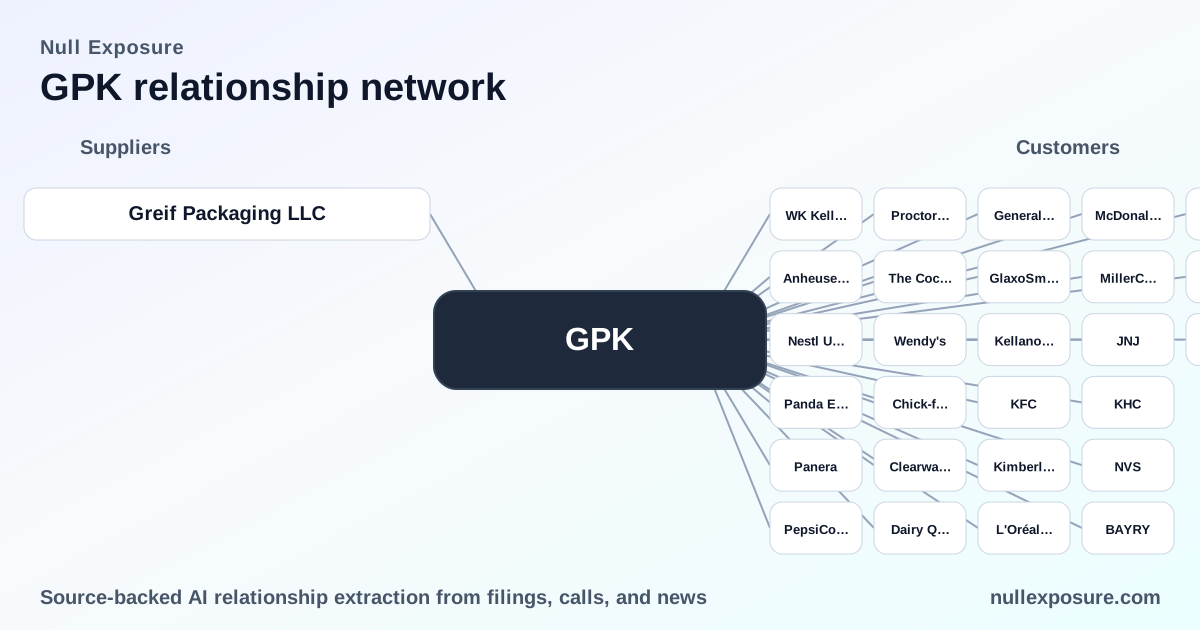
Graphic Packaging (GPK): Customer Map and Commercial Implications for Investors
Graphic Packaging is a global supplier of paperboard-based packaging that monetizes through annual and multi-year supply contracts and point-of-sale shipments to major beverage, food, foodservice and consumer goods brands. The company earns margins as a seller of core packaging products while also capturing service economics from machine installations, support and performance monitoring for customer operations. For investors, the thesis is straightforward: steady cash generation from diversified, large-enterprise customers, with upside from scale and cost efficiency but exposure to cyclical packaging demand and input-cost swings. If you want a concise customer intelligence brief for portfolio work, visit https://nullexposure.com/.
Business model signals and operating constraints
- Graphic Packaging recognizes revenue under annual and multi-year supply agreements, indicating a contracting posture that blends spot shipments with longer-term commitments and predictable revenue streams.
- Customers are predominantly very large enterprises and global brands, which lowers counterparty credit risk but increases buyer negotiating leverage.
- The company operates on a global footprint with manufacturing and sales in the U.S., Europe and select markets in Asia and Latin America; this implies diversification of demand but also exposure to regional logistics and input-cost volatility.
- Customer concentration is immaterial at the company level: no single customer exceeded 10% of net sales in 2022–2024, which supports revenue resilience.
- GPK functions as both a seller of packaging and a service provider, installing packaging machines at customer sites and providing technical support—this increases switching costs for large accounts.
- Core activity is production of renewable/recycled paperboard packaging, forming the heart of the company’s competitive position and margin capture.
Read on for a relationship-by-relationship summary drawn from the company’s FY2024 disclosures and supporting press coverage. Each listed counterparty below is documented in Graphic Packaging’s public filings or related press.
Customer relationships (what the filings and press say)
- Anheuser-Busch, Inc. — Listed among the company’s beverage customers in GPK’s FY2024 Form 10‑K, Anheuser‑Busch is a strategic buyer of beverage cartons and related packaging. According to the FY2024 10‑K, beverage companies such as Anheuser‑Busch are core industrial customers.
- MillerCoors LLC — Appears in the FY2024 10‑K as a beverage customer, reflecting GPK’s exposure to large-scale brewing/packaged beverage demand. (Graphic Packaging FY2024 10‑K)
- PepsiCo, Inc. — Named in the company’s FY2024 filing among beverage clients; PepsiCo represents broad, recurring volume for beverage and snack packaging. (Graphic Packaging FY2024 10‑K)
- The Coca‑Cola Company — Identified in the FY2024 10‑K as a beverage customer, signaling material category exposure to global soft‑drink demand. (Graphic Packaging FY2024 10‑K)
- Kraft Heinz Company (KHC) — Listed among consumer product customers in FY2024, Kraft Heinz is a repeat buyer of GPK’s consumer food cartons and folding paperboard. (Graphic Packaging FY2024 10‑K)
- Nestl USA, Inc. — Included in the FY2024 customer list under consumer product customers; Nestlé’s volumes underpin packaged food carton demand. (Graphic Packaging FY2024 10‑K)
- General Mills, Inc. — Cited in FY2024 as a consumer product customer, representing another large packaged‑foods counterparty in GPK’s portfolio. (Graphic Packaging FY2024 10‑K)
- WK Kellogg Co — Appears in the FY2024 filing among consumer product customers, reflecting cereal and snack packaging relationships. (Graphic Packaging FY2024 10‑K)
- Kellanova — Named in FY2024 as a consumer product customer, indicating exposure to branded breakfast/snack categories. (Graphic Packaging FY2024 10‑K)
- Kimberly‑Clark Corporation — Listed as a consumer product customer in FY2024; GPK supplies packaging solutions to personal care/product channels. (Graphic Packaging FY2024 10‑K)
- Proctor & Gamble — Included in the FY2024 health/beauty customer list (note spelling in filings); Procter & Gamble is a large packaged‑goods buyer of paperboard packaging. (Graphic Packaging FY2024 10‑K)
- Colgate — Named among health/beauty customers in FY2024, reflecting GPK’s participation in personal‑care packaging. (Graphic Packaging FY2024 10‑K)
- GlaxoSmithKline — Cited in FY2024 as a health/beauty customer, adding pharmaceutical/healthcare packaging exposure. (Graphic Packaging FY2024 10‑K)
- Bayer (BAYRY) — Included in the FY2024 health/beauty customer list, representing another healthcare segment counterparty. (Graphic Packaging FY2024 10‑K)
- Johnson & Johnson (JNJ) — Listed among health/beauty customers in FY2024, supporting GPK’s role supplying medical and consumer health packaging. (Graphic Packaging FY2024 10‑K)
- Novartis (NVS) — Appears in the FY2024 health/beauty customer group, reflecting pharmaceutical packaging relationships. (Graphic Packaging FY2024 10‑K)
- Abbott (ABT) — Named in the FY2024 filing among health/beauty customers, adding to GPK’s healthcare exposure. (Graphic Packaging FY2024 10‑K)
- L'Oréal S.A. — Included in the FY2024 health/beauty list, indicating cosmetic and beauty packaging demand. (Graphic Packaging FY2024 10‑K)
- Quick‑service restaurant group (Chick‑fil‑A, McDonald’s, Wendy’s, Panda Express, Dairy Queen, Chipotle, Panera, KFC) — The FY2024 10‑K explicitly lists these quick‑service restaurant (QSR) customers; they form a set of recurring buyers for foodservice packaging solutions and on‑site machine installs. (Graphic Packaging FY2024 10‑K)
- Chick‑fil‑A — QSR customer cited in FY2024. (Graphic Packaging FY2024 10‑K)
- McDonald’s — QSR customer cited in FY2024. (Graphic Packaging FY2024 10‑K)
- Wendy’s — QSR customer cited in FY2024. (Graphic Packaging FY2024 10‑K)
- Panda Express — QSR customer cited in FY2024. (Graphic Packaging FY2024 10‑K)
- Dairy Queen — QSR customer cited in FY2024. (Graphic Packaging FY2024 10‑K)
- Chipotle (CMG) — QSR customer cited in FY2024; GPK is the vendor for certain Chipotle packaging and on‑site equipment. (Graphic Packaging FY2024 10‑K)
- Panera — QSR customer cited in FY2024. (Graphic Packaging FY2024 10‑K)
- KFC — QSR customer cited in FY2024. (Graphic Packaging FY2024 10‑K)
- Colgate — (Duplicate entry in dataset) Listed among health/beauty customers in FY2024; see above. (Graphic Packaging FY2024 10‑K)
- Clearwater Paper Corporation (CLW) — Graphic Packaging announced a definitive agreement to sell its Augusta, GA bleached paperboard facility to Clearwater Paper; PR Newswire and local press covered the transaction in 2024–2026, documenting a capacity disposition. (PR Newswire release; Augusta Chronicle reporting, 2024–Mar 2026)
- Quaker Oats (PepsiCo / PEP) — Management commentary at a Raymond James conference noted Graphic Packaging as the vendor for Quaker Oats and related brands, reflecting single‑brand packaging relationships reported in 2026 event transcripts. (Investing.com transcript, May 2026)
Operational takeaways for investors
- Diversified blue‑chip customer base reduces revenue concentration risk and supports resiliency during cyclicality; no single customer accounted for >10% of sales in 2022–2024.
- Contract mix includes multi‑year supply agreements plus point‑of‑sale recognition, producing stable recurring revenue with periodic pricing renegotiation tied to input costs.
- GPK’s role as both seller and service provider increases switching costs and embeds the company in customers’ operating workflows, which supports retention but also raises capital intensity.
- The sale of the Augusta plant to Clearwater Paper is a strategic capacity move that reduces GPK’s asset footprint and crystallizes cash, per the PR Newswire announcement and local reporting.
For a turnkey briefing and deeper counterparty scoring on GPK’s customer roster, visit https://nullexposure.com/ for structured relationship intelligence and filing‑level source links.
Conclusion Graphic Packaging runs a capital‑intensive, low‑margin but cash‑generative business anchored by long‑standing relationships with major consumer and foodservice brands. The company’s diversified, global customer roster and mixed contracting posture support predictable revenue, while input‑cost and demand cyclicality remain the principal downside vectors for investors.