Granite Point Mortgage Trust (GPMT): customer relationships, credit posture, and operational signals
Granite Point Mortgage Trust originates, invests in and manages floating‑rate senior commercial mortgage loans and allied debt instruments, monetizing through interest spread on loans, fee income from originations and asset management, and return of principal on held loans. The company operates as an internally‑managed REIT that holds both long‑term commercial mortgages and intermediate‑term bridge financings, creating a hybrid lender profile that earns recurring yield while retaining residual credit exposure to borrowers.
If you want a concise view of Granite Point’s counterparties and what they imply for portfolio risk, see the summary below — and for a full look at our coverage visit https://nullexposure.com/.
How Granite Point runs the business and why customer ties matter
Granite Point’s strategy is straightforward: direct origination and active management of primarily senior, floating‑rate commercial real‑estate loans across U.S. markets. That operating model produces three defining characteristics investors should track:
- Contracting posture: Filings characterize assets as intended to be held as long‑term investments, while the platform also originates intermediate‑term bridge and transitional financings for property stabilization and repositioning — a deliberate mix of buy‑and‑hold and private lending exposure. This dual posture increases earnings stability from floating coupon income but keeps material credit event risk when borrowers execute complex value‑add plans (filing language, Dec 31, 2024).
- Concentration and geography: Lending is U.S.‑focused but spread across regions; internal schedules list meaningful exposure across Northeast, Southwest, Southeast, Midwest and West, which reduces single‑market concentration even though the company remains geographically single‑country (portfolio carrying values by region, year‑end 2024).
- Scale and criticality: The loan book is sizable relative to Granite Point’s market capitalization; as of Dec 31, 2024 the portfolio had 54 loan investments with about $2.1 billion in aggregate principal and $0.1 billion of future funding obligations, implying large counterparty exposures and a spend band consistent with $100m+ sized exposures for some assets (company filing, year‑end 2024).
These characteristics translate into a lender that is sensitive to borrower credit cycles and idiosyncratic property execution risk, while benefiting from floating rates that reduce duration risk as short‑term interest rates move.
What we found in public customer reporting
Below are the customer relationships surfaced in our review. Each entry is presented as a plain‑English takeaway with a concise source reference.
-
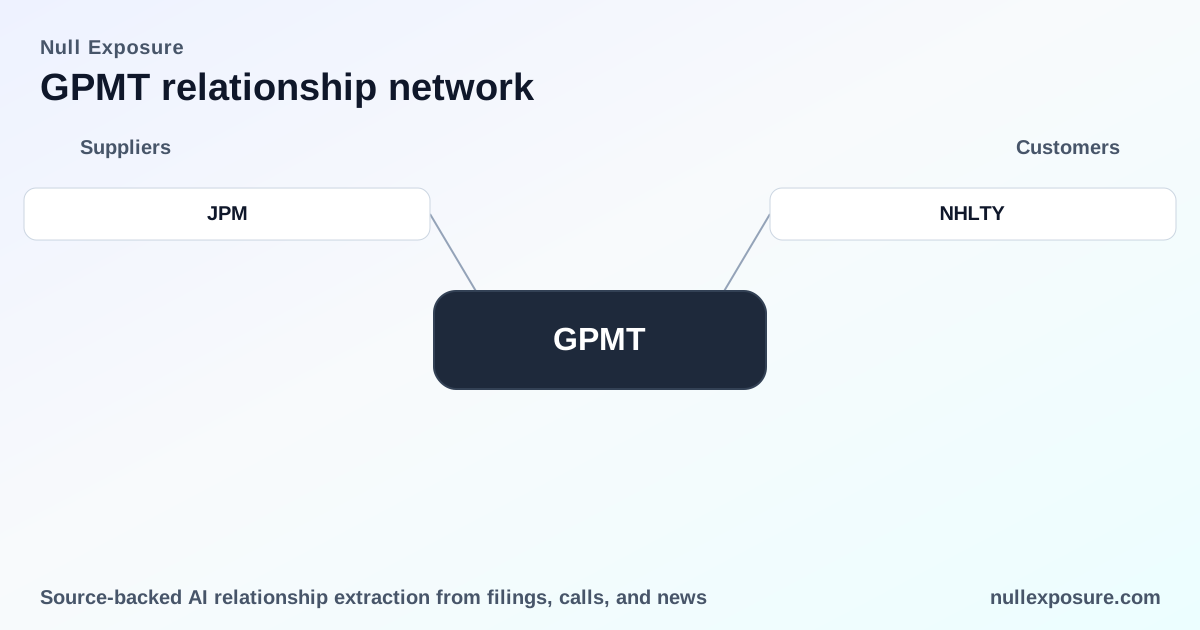
Nightingale (inferred symbol: NHLTY) — A borrower owed Granite Point approximately $84.7 million on a mortgage, and Granite Point subsequently took control actions on a Miami Beach building tied to that loan. This was reported in The Real Deal on February 27, 2025.
Source: The Real Deal, “Nightingale’s lender takes over Miami Beach building,” Feb 27, 2025. -
NHLTY (duplicate feed entry for Nightingale) — The same item appears again in our feed indicating that Nightingale’s $84.7 million obligation was being enforced by Granite Point in connection with the Miami Beach collateral. The duplicate underscores one documented, material borrower enforcement event in the coverage window.
Source: The Real Deal, “Nightingale’s lender takes over Miami Beach building,” Feb 27, 2025.
Why these relationship events matter for investors
The Nightingale enforcement event is a concrete example of how Granite Point’s underwriting and portfolio management translate into realized counterparty outcomes. A $84.7 million mortgage represents a material loan for a lender whose portfolio is $2.1 billion, thus default/foreclosure activity is not merely operational noise — it is credit realization that affects book value and near‑term liquidity dynamics.
Granite Point’s internally‑managed structure means the company retains control over workout and asset management decisions, which increases both optionality and operational execution risk relative to more passive mortgage REITs.
Constraints and company‑level signals that shape counterparty exposure
The following points are company‑level signals derived from Granite Point’s public disclosures and our relationship evidence. These are general operating constraints, not tied to any single counterparty unless explicitly named in an excerpt.
- Primary contract types: The company identifies long‑term hold as the principal posture for many investments, while also providing shorter‑term bridge/transitional financing for repositioning and recapitalization purposes (filings language).
- Geographic footprint: Lending is concentrated in the United States, with explicit portfolio carrying values across Northeast, Southwest, West, Midwest and Southeast regions (year‑end 2024 schedule).
- Relationship roles: Granite Point acts as both seller/originator of loans and a service provider in the sense of supplying bespoke transitional capital and stewardship for stabilized assets.
- Stage and scale: The portfolio is active and material in scale — 54 loans, ~$2.1bn principal, ~$0.1bn committed funding — consistent with a spend band that includes $100m+ exposures to individual assets or aggregated borrower groups.
- Segment focus: The business is squarely in commercial real‑estate finance (services) as an internally‑managed mortgage REIT.
These signals imply a credit‑first operating model: Granite Point takes principal credit exposure on loans while retaining the operational levers to manage workouts and asset transitions.
If you want a broader comparison of Granite Point’s counterparty events and portfolio signals alongside peers, visit https://nullexposure.com/ for our cross‑reference tools.
Investment implications and risk checklist
- Credit risk is the primary near‑term driver of NAV volatility—defaulted loans and enforcement actions (as with Nightingale) materially affect book value.
- Floating‑rate structure is a structural hedge against rising rates but does not eliminate borrower execution risk on transitional projects.
- Scale mismatch vs market cap: The loan portfolio is large relative to Granite Point’s market capitalization (MarketCap recorded in public data), meaning market moves or a string of credit events can produce outsized equity volatility.
- Concentration management: Geographic diversification across U.S. regions moderates single‑market shocks, but exposure to large loans ($ tens of millions) creates borrower concentration risk.
- Operational control matters: Being internally managed increases control over workouts but also places responsibility for asset management performance squarely on the company.
Bottom line
Granite Point is a reactive lender that balances long‑term held commercial mortgages with targeted bridge financings, producing yield from floating‑rate coupons but exposing equity holders to borrower execution risk. The Nightingale enforcement demonstrates that credit realization is an active part of the business rather than a theoretical risk — investors should monitor borrower events, concentration by loan size and regional exposure as leading indicators of NAV and dividend sustainability.
For a deeper look at Granite Point’s counterparties across public reporting and news coverage, explore our full research platform at https://nullexposure.com/.