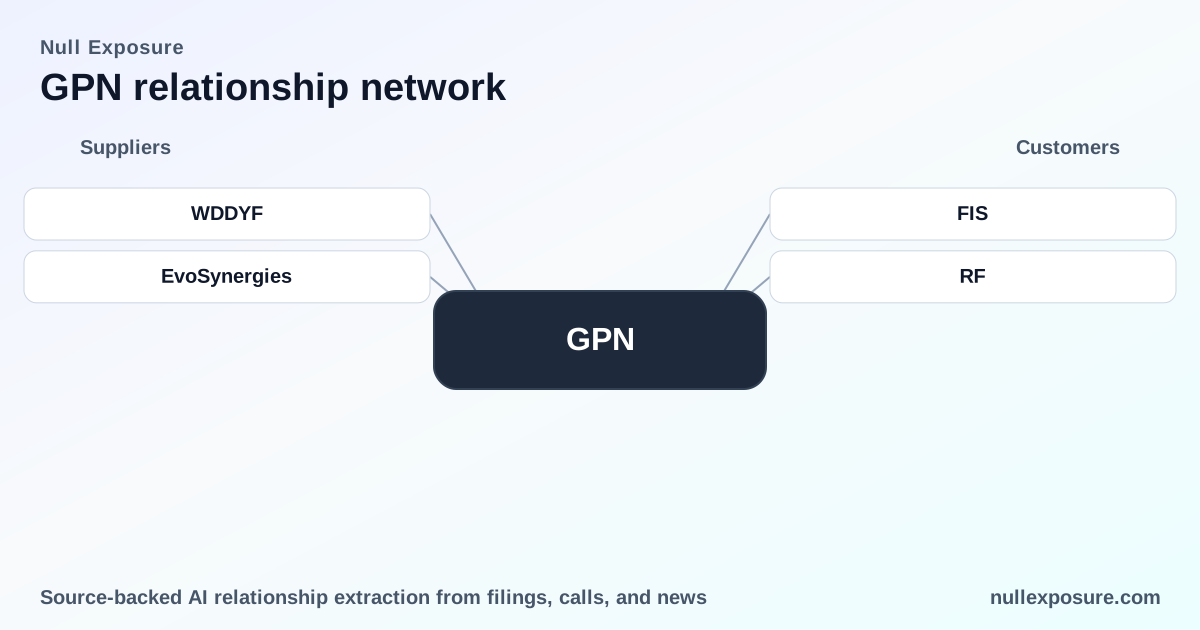
Global Payments (GPN): Customer relationships driving a payments platform with steady, usage-linked cashflows
Global Payments operates a two-pronged payments platform: a Merchant Solutions franchise that captures fees tied to transaction volumes and a software-and-services arm that sells longer-term processing and licensing contracts to banks and issuers. The company monetizes through usage-based take-rates on card volume, subscription and licensing fees for enterprise software, and multi-year processing agreements with financial institutions—an operating model that combines high-margin software economics with volume-correlated merchant processing. For a deeper look at customer-level exposures and partner moves, visit NullExposure for ongoing coverage: https://nullexposure.com/.
Why customers define value and risk for GPN
Investors should evaluate Global Payments through two lenses. First, revenue sensitivity is dominated by transaction volumes—Merchant Solutions revenues are primarily percentage- or per-transaction fees, which makes top-line growth cyclical with consumer spending and merchant acceptance trends. Second, Issuer Solutions and enterprise software are secured by multi-year contracts and licensing, which act as a stabilizer for margins and cashflows but introduce concentration and contract-renewal risk where relationships are large or strategic.
- Contract posture: The company runs a hybrid model—usage-based pricing for merchants alongside long-term processing and subscription/licensing contracts for issuers and enterprise customers.
- Customer concentration & criticality: Merchant base is broad (SMB and mid-market), but issuer/processing contracts are higher value and more strategic, creating pockets of concentration.
- Geographic footprint & maturity: Global Payments operates globally but North America dominates revenues, with meaningful EMEA and APAC operations providing diversification.
The public relationship record — who shows up in the file
The news and filings captured in the record show two principal counterparty lines of relevance: FIS (Fidelity National Information Services) and Regions Bank (RF). Each relationship carries distinct operational and strategic implications.
FIS — a major counterparty on a carve-out and reconfiguration of issuing assets
Global Payments completed a simultaneous set of transactions in January 2026: the company acquired Worldpay Holdco while divesting its Issuer Solutions business to FIS (Fidelity National Information Services). This is a material structural move that shifts where issuer processing revenue and long-term issuing contracts sit in the industry’s value chain. According to multiple contemporaneous reports and filings, FIS funded the acquisition of the Issuer Solutions business with a combination of new debt and the sale of its remaining Worldpay interest (TradingView, March 2026; Tikr, May 2026; Investing.com, May 2026).
Sources: TradingView (Mar 9, 2026) — https://www.tradingview.com/news/tradingview:0c9e57c111f08:0-global-payments-acquires-worldpay-files-worldpay-audited-financials-and-pro-forma-2025-results/; Tikr blog (May 2026) — https://www.tikr.com/blog/fidelity-national-information-services-stock-pure-play-fintech-processing-73-billion-transactions-at-46; Investing.com (May 3, 2026) — https://www.investing.com/news/company-news/global-payments-stock-hits-52week-low-at-6268-93CH-4601276.
Regions Bank — Worldpay distribution expansion in commercial banking channels
Worldpay, the merchant-facing subsidiary within Global Payments, extended its distribution through a partnership with Regions Bank that places Worldpay solutions into Regions’ commercial and merchant clients. This is a classic payments distribution play: bank partnerships accelerate merchant acquisition and deposit/payment rails integration for Worldpay’s merchant services. The relationship was reported in sector press and aggregator summaries (Zacks/Finviz referencing the Regions tie to Worldpay).
Source: Finviz/Zacks summary (Mar 2026) — https://finviz.com/quote.ashx?t=FIS; StockstoTrade noted the collaboration (Feb 2026) — https://stockstotrade.com/news/global-payments-inc-gpn-news-2026_02_18/.
What these relationships mean for revenue, risk and product mix
The FIS transaction is the clearest example of how structural portfolio moves change GPN’s risk profile. By selling Issuer Solutions to FIS, Global Payments realigns away from issuing processing—reducing exposure to large, long-term bank contracts that historically provided recurring revenue—but retains or grows merchant-facing capabilities via Worldpay. That shifts GPN’s revenue mix further toward usage-sensitive merchant flows and enterprise software, which increases revenue cyclicality but preserves attractive software margins.
The Regions Bank partnership is an executional lever to scale Worldpay’s merchant footprint, particularly among commercial banking clients. Distribution deals like this lift gross transaction volume (GTV) and therefore take-rate linked revenue, but they also increase dependence on partner-led distribution effectiveness and co-selling economics.
Operational and business-model constraints investors should monitor
Treat these constraints as company-level signals that define how GPN contracts and scales with customers:
- Usage-priced core: The Merchant Solutions segment is predominantly priced as a percentage of transaction value or a per-transaction fee, so revenue growth and margin expansion are tied to GTV growth and pricing power rather than pure seat counts.
- Long-term issuer contracts: Issuer Solutions historically derives revenue from multi-year processing contracts with financial institutions, which creates durable recurring revenue but also strategic importance of contract renewals.
- Software & licensing revenue: Global Payments collects subscription and licensing fees for enterprise software—these revenues are higher-margin and more predictable, supporting valuation multiples.
- Geographic concentration: North America contributes the bulk of consolidated revenue (~75% in 2024), while EMEA, APAC and LATAM are growing but secondary, shaping macro sensitivity and FX exposure.
- Counterparty mix: Customers span small businesses through very large enterprises; merchant volumes are broad-based, but large institutional relationships (banks, acquirers) are critical points of concentration.
These characteristics mean investors should focus on GPN’s ability to: (1) grow GTV through distribution (bank partnerships, channel expansion), (2) defend subscription and licensing margins, and (3) manage concentration risk where processing contracts are sizable.
Bottom line for investors and operators
Global Payments is now positioned as a merchant- and software-led payments platform with earnings driven by both volume-correlated merchant fees and recurring software/license revenues. The January 2026 reconfiguration with FIS and the ongoing Worldpay partnerships such as Regions Bank are clear inflection points that reduce GPN’s issuer exposure while concentrating value capture in merchant flows and enterprise software distribution. Track GTV trends, contract renewals in enterprise software, and the performance of distribution partners to assess revenue durability and upside.
For continued, granular tracking of GPN’s counterparty moves and customer exposures, go to NullExposure for research and updates: https://nullexposure.com/.